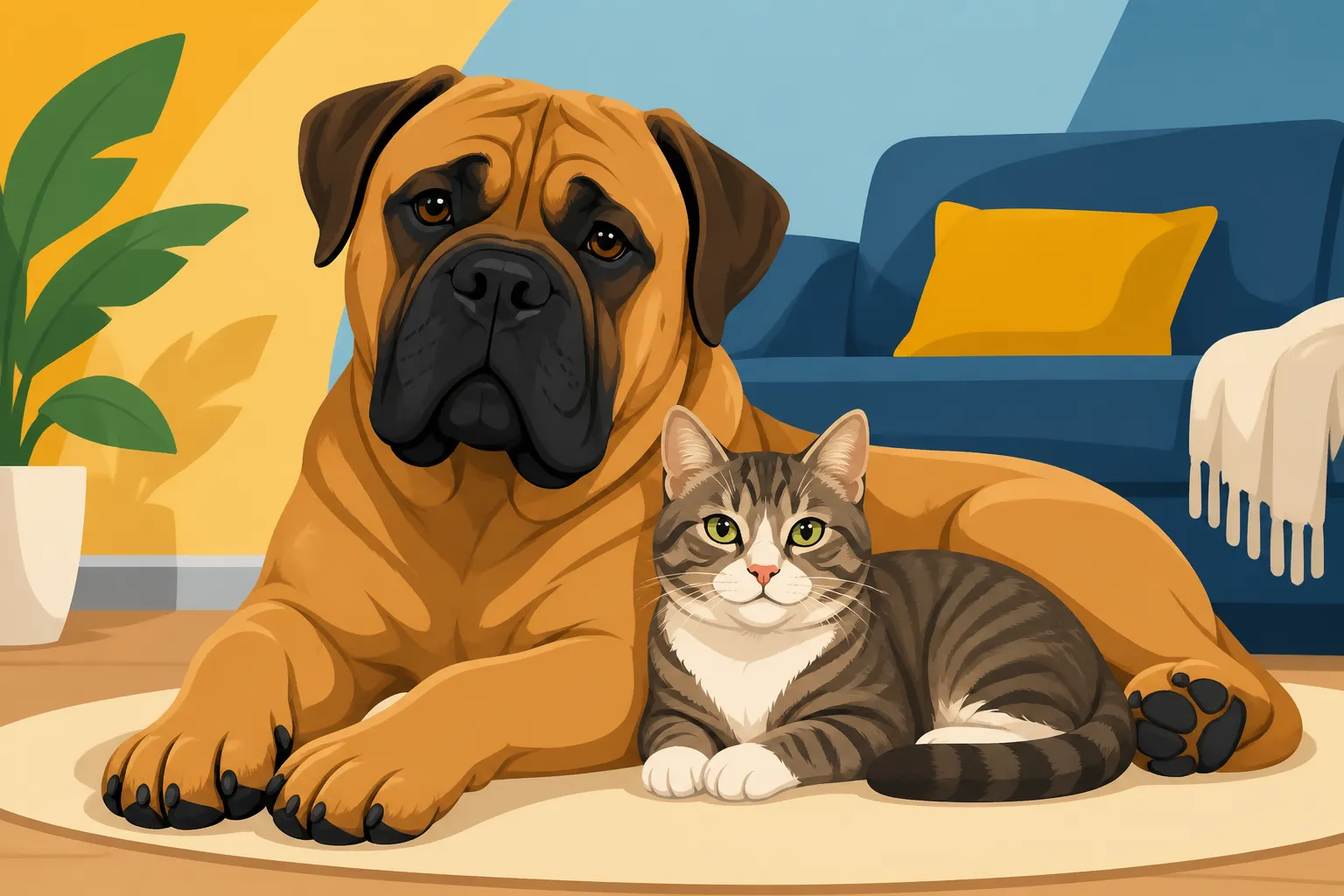
How a Bullmastiff Shares a House With a Cat
Bringing a magnificent, powerful Bullmastiff into a home that already has a resident feline can feel like you're setting the stage for a dramatic standoff. Many owners worry, and rightly so, about how their enormous, sometimes clumsy canine will interact with their often-fragile, always-opinionated cat. The fear of a chase, an accidental swipe, or even outright aggression is a very real concern that keeps many prospective Bullmastiff owners from taking the plunge. This guide is here to walk you through the careful, considered steps you need to take to foster a peaceful, even affectionate, cohabitation between your gentle giant and your nimble house tiger.
Understanding the Bullmastiff's Instincts and Personality Towards Other Animals
Before you even think about introducing your Bullmastiff to your cat, or vice versa, it's absolutely crucial to understand the foundational elements of the Bullmastiff's temperament, particularly concerning their historical purpose and how that might influence their interactions with smaller, quicker creatures. These aren't just big dogs; they come with a rich history that has shaped their instincts.
The Bullmastiff's Breed History and Prey Drive
Let's cast our minds back to the English estates where the Bullmastiff was first developed. They weren't bred to hunt small game, nor were they designed to be aggressive in a way that would harm a human. Their job was to silently track and hold poachers, not to maul them. This critical distinction is why we often describe them as "The Silent Guard: Why a Bullmastiff Barks So Little" and know their incredible ability to body-block or pin a human without causing severe injury. They needed to be powerful, intimidating, and capable of stopping an adult man, yet controlled enough not to be overly destructive.
However, that doesn't mean they lack any form of prey drive. While they might not be chasing squirrels up trees with the same fervor as a terrier, a fast-moving, darting cat can still trigger a chase instinct. It's not necessarily a predatory drive to kill, but rather an instinct to "catch" or "interact" with something moving quickly. Given a Bullmastiff's size – easily 100 to 130 pounds or more – even a well-intentioned "play" chase can have devastating consequences for a cat. Imagine a 120-pound dog barreling after a 10-pound cat; the sheer momentum is a danger in itself, completely independent of any aggressive intent.
Their historical job means they are often quite deliberate and observant, taking in their surroundings before reacting. This can be a double-edged sword: they might ignore a cat completely, or they might fixate on it as something interesting to watch, and potentially pursue. Understanding What a Bullmastiff Was Bred to Do to a Poacher helps frame their natural tendencies.
Individual Temperament and Early Socialization
Every dog, just like every person, has their own unique personality, and Bullmastiffs are no exception. While the breed generally leans towards a calm and steady disposition, there's a wide spectrum. Some Bullmastiffs are naturally more placid and tolerant, viewing a cat with mild curiosity or utter indifference. Others might have a stronger natural inclination to chase, or perhaps a more reactive personality that could be problematic. This individual variation is absolutely critical to consider when you're looking at bringing a Bullmastiff into a multi-species home.
The most powerful tool in shaping a Bullmastiff's comfort and acceptance of cats is early socialization. If a Bullmastiff puppy is raised from a young age (think 8-16 weeks) in a household with calm, dog-savvy cats, they are far more likely to integrate peacefully. These early experiences teach the puppy that cats are part of the family, not playthings or prey. They learn appropriate behavior and boundaries from both the cats and their human guardians. However, introducing an adult Bullmastiff who has never lived with cats to an existing feline resident presents a different set of challenges. It's certainly possible, but it requires even more patience, structure, and careful management, as the adult dog's ingrained habits and instincts are much harder to reshape. It's often easier to introduce a young Bullmastiff to an established cat than to bring an older, potentially unsocialized Bullmastiff into the mix.
Essential Strategies for Safe Introductions and Coexistence
Successfully integrating a Bullmastiff and a cat is less about hoping for the best and more about meticulous planning and consistent execution. It’s a marathon, not a sprint, and every step needs to be taken with the safety and well-being of both animals in mind. You're building a relationship, and that takes time and careful management.
Creating Separate Spaces and Controlled Encounters
The first, and perhaps most important, rule of cohabitation is to ensure the cat always has a safe, dog-free haven. This might mean installing baby gates that the cat can easily jump over but the Bullmastiff cannot, or dedicating an entire room as the cat's sanctuary, complete with food, water, and litter boxes. Vertical space is your cat's best friend – cat trees, shelves, or even just high furniture can provide essential escape routes and viewing perches where they feel secure and out of the dog's reach. Never underestimate a cat's need for retreat; it's what makes them feel safe enough to eventually explore coexistence.
Before any visual introductions, start with scent swapping. Exchange blankets or toys between the two animals so they can get used to each other's smell without the pressure of a face-to-face meeting. Once scents are familiar, you can move to controlled visual encounters. This might involve placing the Bullmastiff in a crate in a room where the cat can observe from a safe distance, or using a sturdy baby gate to separate them while allowing them to see each other. Keep these initial sessions short and positive, rewarding both animals for calm behavior. A leash is your best friend during these early stages, even indoors. Keeping your Bullmastiff on a leash, especially one that provides gentle control like a harness that prevents pulling (many good options are available on Amazon), allows you to redirect them immediately if they show too much interest or excitement. Remember that Training a Bullmastiff That Weighs More Than You Do is paramount, especially when handling them around smaller pets.
Managing Interactions and Preventing Problems
Consistent supervision is non-negotiable, particularly in the beginning. You cannot leave a Bullmastiff and a cat unsupervised together until you are absolutely certain of their peaceful coexistence, and even then, caution is always wise. When you're actively supervising, use positive reinforcement. Reward your Bullmastiff with treats and praise for ignoring the cat or for calm, appropriate behavior in the cat's presence. Similarly, reward your cat for staying relaxed or for approaching the Bullmastiff calmly.
One of the biggest areas for conflict can be around food and resources. Always feed your cat in a location where the Bullmastiff cannot access their food – on a counter, in a cat-only room, or using a microchip-activated feeder. Bullmastiffs are often food-motivated, and you don't want to create any scenario where your dog feels entitled to the cat's meal. Similarly, litter box placement is crucial. Many dogs, Bullmastiffs included, find cat feces strangely appealing, and raiding the litter box is not only disgusting for you but also unsanitary for the dog and stressful for the cat. Place litter boxes in high places, in rooms with cat doors, or behind baby gates that only the cat can navigate.
Training your Bullmastiff commands like "leave it" and "stay" is invaluable for managing interactions. If your Bullmastiff starts to fixate on the cat, a firm "leave it" can redirect their attention. If they are prone to pulling toward the cat, practice "loose leash walking" inside the house. Consider enrolling in an online dog training program, such as those offered by BAXTER & Bella, which can provide structured guidance on impulse control and obedience, skills vital for managing a large breed around a small, tempting feline. Remember that What Motivates a Bullmastiff often comes down to positive reinforcement and consistency, which applies just as much to cat interactions as to basic obedience.
Long-Term Management and Troubleshooting Common Issues
Even after initial introductions go smoothly, maintaining a peaceful multi-species household requires ongoing vigilance and the ability to interpret your pets' body language. Animals communicate constantly, and learning to read their signals is your key to preventing problems before they escalate.
Recognizing Stress Signals and Intervening
Both cats and dogs have distinct ways of showing they're uncomfortable or stressed, and it's essential for you to be fluent in both languages. For your cat, look for signs like flattened ears, hissing, growling, a puffed-up tail, dilated pupils, excessive hiding, or suddenly becoming withdrawn. If your cat is hunched, wide-eyed, or trying to make themselves small, they're likely feeling threatened. On the Bullmastiff's side, watch for fixation (staring intently at the cat), a stiff body posture, a low growl, excessive lip licking (without food present), yawning (when not tired), or tail tucked low. Any of these signals indicate discomfort or potential escalation, and it's your cue to intervene immediately and calmly separate the animals.
Never, ever force interaction or try to make them "be friends." This can severely backfire, increasing fear and potentially leading to aggression. If either animal shows signs of stress, separate them gently. Provide each pet with their own calm space to decompress. Sometimes, simply reducing the length of their shared time or going back to an earlier stage of introduction (like scent swapping) can help reset the situation. Understanding How a Bullmastiff Hides Pain or discomfort can also apply to stress, as they may try to be stoic even when feeling anxious about another animal.
Dealing with Persistent Chasing or Aggression
Despite all your best efforts, sometimes a Bullmastiff's instincts, particularly a strong prey drive, are simply too ingrained to allow for safe cohabitation with a cat. If your Bullmastiff consistently chases, stalks, or exhibits aggressive behavior towards your cat, and supervision or training methods aren't working, you must prioritize the cat's safety. This is a hard truth, but it's vital to face it honestly. A Bullmastiff's power means that even a single "misstep" can result in serious injury or fatality for the cat.
In these challenging scenarios, it's highly advisable to seek professional help. A certified professional dog trainer or a veterinary behaviorist can assess the specific dynamics in your home, help identify triggers, and develop a tailored behavior modification plan. They might employ specific desensitization and counter-conditioning techniques that are beyond what a typical owner can manage alone. Resources like BAXTER & Bella can offer foundational training concepts, but a one-on-one professional can offer tailored strategies for complex issues. It's crucial to have realistic expectations; not every dog and cat pair is destined to be best friends, or even peaceful roommates. In some rare cases, strict separation (e.g., the cat lives in a designated dog-free part of the house permanently) or even rehoming one of the animals may be the only safe long-term solution. Your cat's safety and quality of life must always be the top priority.
Providing for Both Pets' Needs in a Multi-Species Household
Successful cohabitation isn't just about preventing conflict; it's also about ensuring both your Bullmastiff and your cat feel loved, secure, and fulfilled in their shared home. Each animal has distinct needs, and a harmonious household ensures these are met individually, alongside their shared experiences.
Ensuring Individual Attention and Enrichment
Even if your Bullmastiff and cat learn to tolerate each other, they are still two distinct species with different requirements for interaction and play. It's really important that both pets get dedicated one-on-one time with you, away from the other. This means separate play sessions, cuddle time, and training moments. For your Bullmastiff, this might be a focused obedience session in the yard or a quiet evening grooming on the couch. For your cat, it could be a laser pointer chase, a string toy session, or just some quiet purring on your lap without a giant snoot nudging for attention. This individual attention helps reinforce their bond with you and reduces any potential for jealousy or competition.
Enrichment activities are also vital for both. Your Bullmastiff, despite their calm demeanor, benefits greatly from mental stimulation. Puzzle toys, Kongs stuffed with treats, or short training sessions can keep their minds engaged. For cats, vertical space, scratching posts, window perches for bird watching, and rotating toys can help satisfy their natural instincts. Ensuring their environment is enriching and stimulating reduces boredom, which can often be a root cause of unwanted behaviors, including excessive interest in the other pet.
The Importance of a Structured Routine
Animals thrive on routine. A predictable schedule for meals, walks, playtime, and quiet time can significantly reduce anxiety and help both your Bullmastiff and your cat understand what to expect. This structure reinforces boundaries and expectations, making them feel more secure in their environment. For instance, if your Bullmastiff knows exactly when their walk and dinner will happen, they might be less prone to bothering the cat out of boredom or hunger. Similarly, if your cat has a consistent feeding time in their safe space, they'll feel more confident and less vulnerable.
A well-established routine also makes it easier for you to manage their interactions. For example, if walks are always at the same time, the Bullmastiff will be tired and settled when they return, making them less likely to harass the cat. If you consistently put the cat's food up after a certain period, the Bullmastiff won't be tempted to raid it. This consistency is calming for everyone involved and helps to build trust between all members of the household, two-legged and four-legged alike. Establishing a strong routine from The First Year With a Bullmastiff Puppy can set them up for successful multi-pet living.
Here's a quick comparison of key considerations for both pets:
| Feature | Bullmastiff Needs | Cat Needs |
|---|---|---|
| Safety & Retreat | Clear boundaries, trained redirection, consistent supervision. | High places (cat trees, shelves), escape routes, dog-free rooms/zones. |
| Food & Water | Separate feeding area, large, sturdy bowls. | Elevated or microchip-activated feeder, fresh water in quiet location. |
| Litter Box Access | No access to cat litter boxes. | Private, secure location(s) inaccessible to the Bullmastiff. |
| Play & Exercise | Daily walks (moderate), structured play, mental stimulation. | Vertical play, interactive toys, climbing opportunities, solo hunting games. |
| Personal Space | Own bed/crate in a quiet area. | Multiple hiding spots, safe perches, undisturbed sleeping areas. |
| Human Interaction | Dedicated cuddle time, training sessions, one-on-one attention. | Lap time, gentle petting, interactive play, quiet companionship. |
| Training Needs | "Leave it," "stay," impulse control, polite leash manners. | Scratching post training, litter box etiquette, non-fearful interaction. |
| Health Monitoring | Regular vet checks, attention to joints and weight. | Regular vet checks, attention to dental health, stress-related issues. |
Disclaimer
This article is for general informational purposes only and does not constitute professional advice. Laws, prices and regulations vary by location and change over time. Consult a qualified professional for guidance on your specific situation.