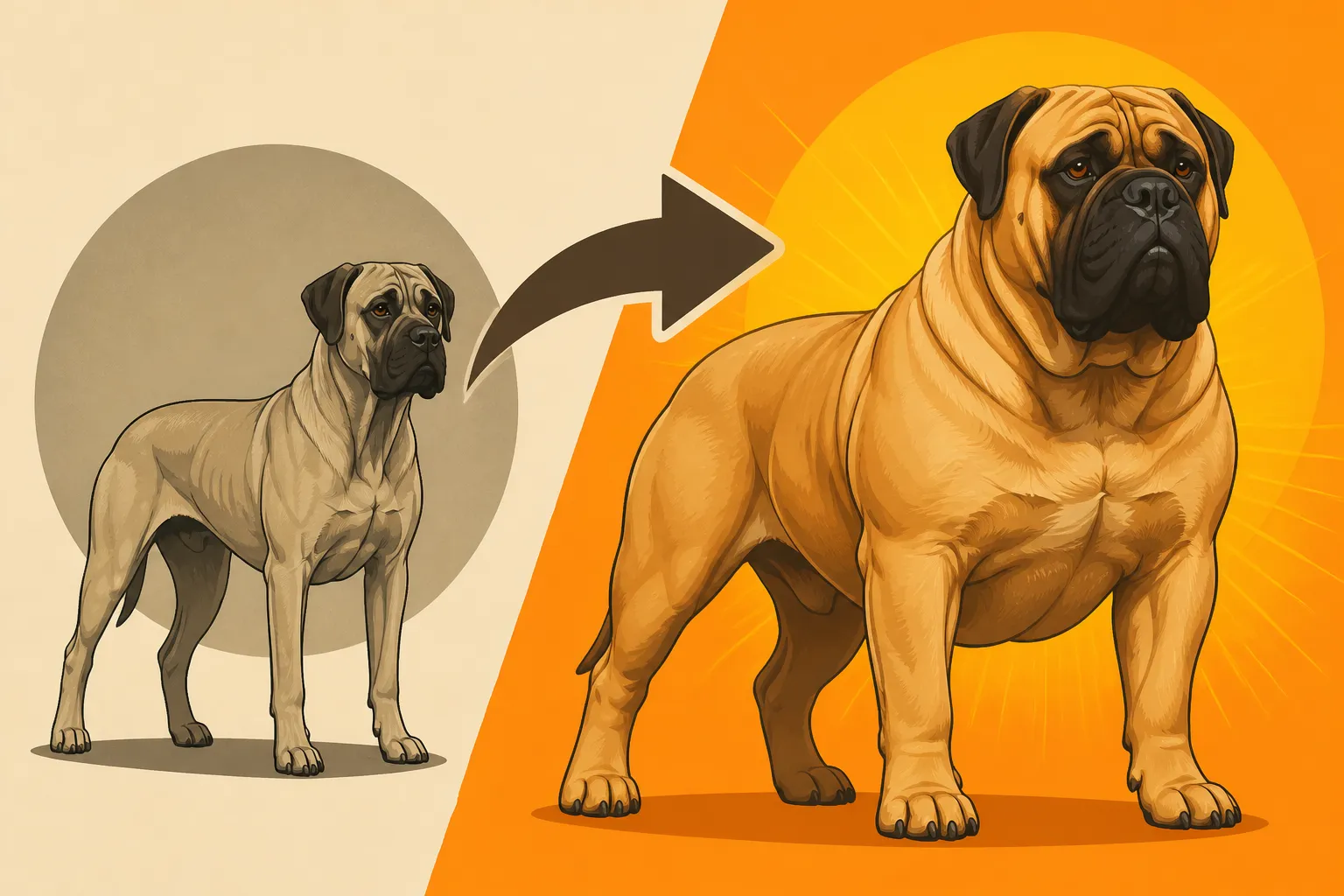
How Much Heavier the Bullmastiff Has Become Since 1924
A Bullmastiff in an old photograph can look lighter and leggier than the broad, heavy dog many people picture today. But that impression does not translate neatly into a documented number of pounds gained since 1924. This guide explains what breed standards and historical images can—and cannot—tell you, why modern Bullmastiffs may look heavier, and how to tell healthy substance from excess weight.
Did Bullmastiffs Gain a Measurable Amount of Weight Since 1924
Why there is no reliable pounds-added figure
There is no straightforward, well-documented comparison that establishes how much heavier the average Bullmastiff is today than the average Bullmastiff in 1924. To calculate that, we would need comparable records from both periods: large groups of dogs weighed at similar ages, with consistent methods and clear information about sex, build, and body condition. A breed standard or a handful of photographs cannot provide that kind of population-wide evidence.
A standard describes an ideal, not the average weight of every dog. Even if a standard gives a weight range, it does not tell us whether typical pets or working dogs actually fell near the bottom or top of that range. Nor does it show how body condition was assessed. One dog might be muscular and broad while another has excess fat, yet both could appear similar on a scale.
So the most careful answer is that Bullmastiffs may look heavier or more substantial in some modern lines, but a precise increase in average weight since 1924 is not something that can be confidently stated from a simple comparison. When you see a claim that the breed gained a specific number of pounds, ask what dogs were weighed, when, and how the records were gathered.
A breed standard is not a time-series weight chart
Breed standards have long described the Bullmastiff as a powerful, substantial working dog. Commonly cited adult ranges are around 110 to 130 pounds for males and 100 to 120 pounds for females, but a range like this is not proof that the breed’s average weight has stayed exactly the same across generations. It is a guideline for the desired type, not a historical census.
Standards also describe more than weight. They address proportions, bone, musculature, movement, and overall balance. A dog can be heavier because it is taller, broader, or more muscular—or because it carries unnecessary fat. Those are different things, and the number on the scale alone cannot explain which one is happening.
For context on how size is discussed in the breed, see How Much a Bullmastiff Weighs and A Hundred and Thirty Pounds of Bullmastiff, Measured. The important distinction is that an ideal range can help assess an individual dog, but it does not tell us how much the breed as a whole has changed since its formal recognition.
Why Modern Bullmastiffs May Look Heavier
Selection can influence the look of a breed
Over generations, breeders make choices about which dogs to breed. If they favor dogs with more bone, broader heads, deeper chests, or heavier frames, those features may become more common in some lines. This can make a modern Bullmastiff appear more imposing than a leaner dog shown in an old photograph—even if the difference in actual weight is modest.
That visual shift is not necessarily uniform across the breed. Different breeders may prioritize different qualities, and dogs from show, companion, or working backgrounds can vary in build. There is no single modern Bullmastiff shape that represents every dog. Comparing a broad, mature male with a younger, leaner female from a different period can make the apparent historical change seem much larger than it is.
The breed’s history also helps explain why there is room for variation in appearance. Bullmastiffs were developed for strength and the ability to move with purpose, not simply for maximum size. The Bullmastiff Is Sixty Percent Mastiff and Forty Percent Bulldog gives more background on the breed’s traditional type and ancestry.
Photographs can exaggerate differences
Old photographs are a tempting way to judge historical size, but they are a poor substitute for measurements. Camera angles, lenses, posture, the dog’s distance from the photographer, and the people or objects nearby can all distort scale. A dog standing square to the camera may look broader; a dog photographed from a low angle may look taller or more massive.
Condition matters, too. A working dog in lean condition can look much narrower than a dog with a thick coat, a relaxed stance, or extra weight. Age can change the outline as well: a young adult may not yet have the same muscle or body depth as a mature dog. Without a known height, weight, age, and body condition, the photograph leaves too many questions unanswered.
This is why an image of a Bullmastiff from the 1920s beside a person is not enough to show that the breed gained a particular amount of weight. It can suggest a difference in presentation or type, but it cannot establish a population trend. The same caution applies when comparing old working photographs with modern show photos.
Show and working dogs may be bred and presented differently
Show dogs are evaluated against a written standard, which includes characteristics such as structure and balance. Working dogs, where they are still bred for specific tasks, may be selected with more emphasis on practical movement, stamina, or suitability for that work. Those different priorities can produce dogs with different outlines, even within the same breed.
That does not mean every show Bullmastiff is heavier than every working Bullmastiff. There is variation within each group, and “show” or “working” does not automatically tell you a dog’s weight or body condition. It is more accurate to treat these labels as clues about selection goals than as a reliable weight category. For a closer look at that distinction, see Whether Show Bullmastiffs Are Heavier Than Working Ones.
The original working purpose is relevant here. A dog built to cover ground needs a combination of strength and mobility; adding bulk without preserving sound movement would not serve that goal. Why a Bullmastiff Was Bred Light Enough to Run explores why the historical ideal was not simply “as heavy as possible.”
What Weight Can Tell You About an Individual Bullmastiff
Body condition matters more than matching a number
A scale reading is useful, but it is only one piece of the picture. Two Bullmastiffs of the same height and sex can have different healthy weights because they differ in frame, muscle, and build. Your veterinarian can help set a sensible target for your own dog rather than relying on a breed-wide number as though it were a perfect rule.
At home, you can look for a visible waist when viewing your dog from above and a gentle abdominal tuck when looking from the side. You should generally be able to feel the ribs beneath a light covering without pressing hard, though they should not be sharply prominent. A thick coat, loose skin, and a broad chest can make visual checks tricky, so use your hands as well as your eyes.
If your Bullmastiff’s weight is changing, record the number and the date instead of trying to remember it later. A bathroom scale may work for a cooperative dog if you weigh yourself first and then weigh yourself holding the dog, but a veterinary clinic or pet store may have a suitable platform scale. Ask the clinic what approach is safest for a large dog who dislikes being lifted or standing still.
Growth and body condition should not be confused
A Bullmastiff puppy naturally gains weight as it grows, but faster growth is not automatically better. Large-breed puppies need controlled, steady development rather than being encouraged to become as big as possible as quickly as possible. Your veterinarian can assess growth over time and advise whether your puppy’s food and portions are appropriate.
A puppy’s number on the scale is most useful when tracked alongside age, body condition, and the veterinarian’s assessment. A single weigh-in cannot explain whether a puppy is growing appropriately. What a Bullmastiff Puppy Should Weigh by Month offers related guidance on interpreting puppy growth, while your own vet can account for your puppy’s build and health.
If you buy food through Chewy or another retailer, use the feeding guide on the specific food as a starting point, not a fixed prescription. Food labels often use broad weight bands, and the suggested amount may need adjustment for your dog’s age, activity, body condition, and any veterinary guidance. If you change foods, compare the feeding instructions and transition gradually unless your veterinarian recommends a different plan.
A higher weight is not automatically a healthier weight
It is easy to assume that a larger Bullmastiff is more impressive, especially when the breed is known for its imposing size. But extra pounds can add strain to joints and make it harder for a dog to move comfortably. A well-muscled dog with a large frame is not the same as a dog carrying excess fat, even if both weigh the same.
If your dog is gaining weight, do not sharply cut meals or add strenuous exercise without advice. Bullmastiffs are large dogs, and activity should suit their age, fitness, and health. Start by discussing food portions, treats, and exercise with your veterinarian. A gradual plan is usually more practical than trying to change everything at once.
For owners ordering supplies online, Chewy can be useful for keeping a familiar food or measured feeding accessories on hand, but the product choice does not replace an individualized nutrition plan. Ask your vet how often to recheck weight, especially if your dog is a growing puppy, an older adult, or already above its ideal condition.
How to Compare Bullmastiffs Across Generations More Fairly
Compare like with like
A meaningful comparison would match dogs as closely as possible by sex, age, height, and body condition. Comparing a mature male from one era with a young female from another gives a misleading result, even before photography or breeding background enters the picture. Ideally, the comparison would also include many dogs from each period, not just a few memorable examples.
You would also want to distinguish height from weight. A taller dog can weigh more while maintaining a lean, functional build. A shorter dog can weigh less and still be overweight. If the question is whether the breed has become more massive in its frame, weight alone is not enough; measurements and structural assessments would matter as well.
This is one reason a simple “then versus now” claim can sound more certain than the evidence allows. Breed history is often pieced together from standards, photographs, pedigrees, and individual accounts, but those materials do not necessarily record comparable body measurements. It is fair to discuss changes in appearance or breeding emphasis; it is not fair to turn an impression into a precise weight gain without supporting data.
Keep the practical question in view
For someone choosing a Bullmastiff, the more useful question is usually not whether the breed gained a particular number of pounds since 1924. It is whether the individual dog is sound, comfortably built, and an appropriate size for the household. A dog’s temperament, movement, health, and ability to live comfortably matter more than chasing an impressive scale reading.
If you are speaking with a breeder, ask how they assess adult size and body condition in their dogs. Ask to see adult relatives where possible, and look at whether the dogs move freely and appear fit—not just whether they are large. Why a Male Bullmastiff Outweighs a Female by Twenty Pounds can help explain why sex is one important part of the size comparison, while still leaving plenty of room for individual variation.
For current owners, keep a simple record of weight and body condition and bring it to routine veterinary visits. If you order food through Chewy, retain the label or product details so your veterinarian can review the exact diet and feeding instructions. That practical information is more useful for managing your dog’s health than trying to make its weight match a historical photograph.
Disclaimer
This article is for general informational purposes only and does not constitute professional advice. Laws, prices and regulations vary by location and change over time. Consult a qualified professional for guidance on your specific situation.