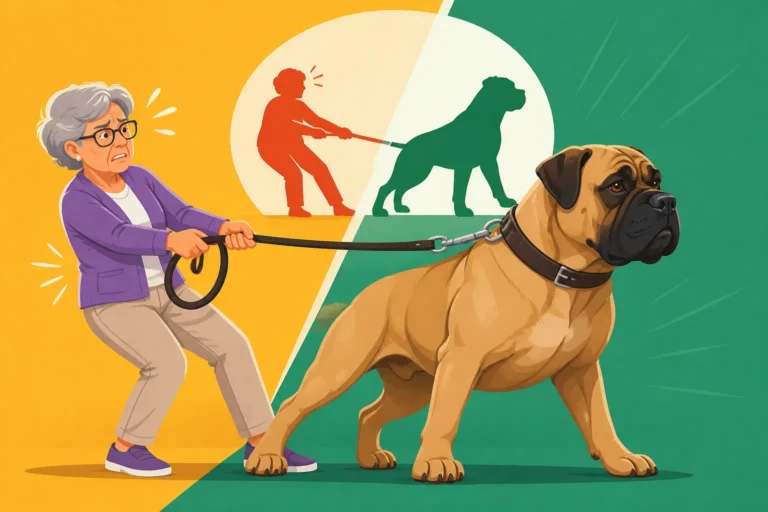
Whether a Bullmastiff Mix Keeps the Guarding Instinct
A Bullmastiff mix may retain some guarding tendencies, but there is no dependable way to predict how strong they will be from breed labels alone. A mix might watch visitors closely, bark at unfamiliar sounds, or simply greet everyone as a friend. This guide explains what influences those behaviors and how to encourage calm, safe responses at home.
What people mean by a Bullmastiff mix’s guarding instinct
Guarding can describe several different behaviors
“Guarding instinct” is often used as if it means one clear trait. In practice, owners may be describing very different things: noticing a stranger, barking at a noise, standing between a family member and a visitor, guarding food or a resting spot, or reacting defensively when frightened. Those behaviors have different causes and need different responses.
A dog that watches someone approach the front door but settles when introduced is not necessarily showing the same behavior as a dog that lunges or snaps. The first might be alert and cautious; the second may be over-aroused, fearful, frustrated, or guarding a particular space. The distinction matters because encouraging one behavior can accidentally intensify another.
Bullmastiffs were developed as estate dogs, but their history does not mean every individual is a trained protector or will behave predictably around perceived threats. The history is useful context, not a forecast for a particular dog. For background, see The Bullmastiff Was Built to Catch Poachers in the Dark and A Bullmastiff Was Bred to Hold a Man, Not Bite Him.
A mixed-breed dog can inherit tendencies, not a guaranteed role
A Bullmastiff mix may inherit physical features or behavioral tendencies from either parent, but ancestry does not work like a simple checklist. Even puppies from the same litter can differ in confidence, sociability, sensitivity to sound, and comfort with unfamiliar people. A dog with a Bullmastiff parent might be naturally observant, or it might be outgoing and unconcerned about visitors.
The other parent’s breed can offer clues, but not certainty. A mix with a herding, guarding, or terrier-type breed may show different patterns of alertness or reactivity than a mix with a more socially easygoing breed. Still, the individual dog’s parents, early experiences, health, and adult environment all matter. A breed label should never be treated as a behavioral diagnosis.
It also helps to separate inherited predisposition from learned behavior. A dog might begin barking when people pass the window, then learn that barking makes them disappear. Over time, that response can become more frequent, regardless of whether the dog started out with a strong guarding tendency. The historical question of whether guarding behavior persists is explored in Whether the Holding Instinct Survives in a Bullmastiff.
What affects guarding behavior in a Bullmastiff mix
Genetics, early experiences, and environment all play a part
Genes can influence how readily a dog notices movement, how quickly it becomes startled, or how comfortable it feels with unfamiliar people. But genetics are only part of the picture. Puppyhood experiences, socialization, training, health, and the dog’s day-to-day surroundings can shape how those tendencies appear.
Socialization is not about making a dog greet every person or tolerate every situation. It means helping the dog experience ordinary sights, sounds, people, and places in a safe, manageable way. A puppy who learns that visitors arrive calmly and do not force contact may have an easier time settling than one who is repeatedly overwhelmed, restrained, or encouraged to rush toward people.
A dog’s current environment also matters. A Bullmastiff mix living behind a busy street-facing window may have many chances to rehearse barking at passersby. One living in a quieter home, with a chance to move away from the door and a predictable visitor routine, may have fewer reasons to stay on alert. For more on territory-related behavior, read How Territorial a Bullmastiff Is.
Fear and discomfort can look like protectiveness
People sometimes describe a dog as “protective” when it is actually uncomfortable. A dog that stiffens when a guest leans over it, barks when someone enters quickly, or hides behind its owner may be asking for space rather than trying to defend the household. Assuming the dog is being brave or possessive can lead people to push it into situations it cannot handle.
Watch the whole body rather than focusing only on barking. A loose posture, brief interest, and ability to turn away are different from a rigid body, fixed stare, repeated retreat, growling, or inability to disengage. These signs do not tell you the exact cause by themselves, but they can show that the dog needs more distance or a calmer setup.
Pain or illness can also change a dog’s tolerance. A dog with sore joints may react when someone reaches toward its bed, while a dog with an ear problem may startle when touched near its head. If behavior changes suddenly, arrange a veterinary check rather than assuming the dog has become more protective. To understand how dogs may assess unfamiliar people, see How a Bullmastiff Decides Someone Is a Threat.
| What you notice | Possible explanation | Helpful first response |
|---|---|---|
| Briefly watches a visitor, then relaxes | Alertness or cautious interest | Give the dog space and reward calm settling |
| Barks repeatedly at people outside | Arousal, habit, or window-triggered behavior | Block the view and reward quiet attention elsewhere |
| Hides, stiffens, or growls when approached | Fear, discomfort, or a request for distance | Stop the approach and create more space |
| Guards food, toys, or a resting place | Resource guarding or concern about losing access | Avoid taking items by force and seek qualified guidance |
| Behavior appears suddenly or worsens | Possible pain, illness, stress, or a change in routine | Start with a veterinary assessment |
How to manage visitors and everyday situations safely
Set up introductions before the door opens
A calm visitor routine is easier to teach before the dog is already excited at the entrance. Start with a leash, a gate, or a separate comfortable room if needed. Ask visitors to avoid looming over the dog, reaching toward its face, making prolonged eye contact, or insisting on a greeting. The dog should have room to move away.
For some dogs, the best introduction is no direct greeting at all. They may feel more comfortable observing a person from a distance while enjoying a treat, resting behind a barrier, or staying on a mat. That is not a failure of socialization. The goal is a safe, relaxed dog—not a dog that accepts hands-on attention from every guest.
Practice the routine with people the dog knows before relying on it during a busy gathering. If you use a gate or other household barrier, check that it is stable and appropriate for a large, powerful dog. When comparing gates or other home-management supplies on Chewy, pay attention to the measurements, installation method, and whether the setup suits the doorway or room where you plan to use it. Product selection does not replace supervision or training.
For a step-by-step approach to low-pressure greetings, see How to Introduce a Bullmastiff to a New Person. If the dog has already growled or snapped at guests, do not use repeated visits as an experiment; get help from a qualified reward-based trainer or veterinary behavior professional.
Teach calm choices instead of encouraging confrontation
Reward the behaviors you want to see: looking at a visitor and then turning away, moving to a mat, checking in with you, or settling behind a barrier. Use treats, toys, or other rewards your dog genuinely values. Keep early practice short enough that the dog can succeed, and increase difficulty gradually rather than starting with a crowded room.
Avoid deliberately provoking barking or encouraging the dog to intimidate people. Also avoid punishing growling. A growl is useful information that the dog is uncomfortable; suppressing the warning without changing the underlying feeling can make the situation less predictable. Instead, create distance, end the interaction, and work on the trigger in manageable steps.
Practical supplies can make training easier, but they are not a substitute for a plan. If you are looking at treat pouches, long-lasting enrichment, or a well-fitted walking harness on Chewy, choose items that fit your dog’s size and intended use, and introduce unfamiliar gear gradually. A dog that is worried about visitors may benefit more from a quiet retreat and predictable routine than from more equipment.
How to assess an individual mix and get help
Look at the dog in front of you, not just the breed mix
If you are choosing a puppy, ask about both parents’ behavior around visitors, handling, unfamiliar dogs, and ordinary household activity. Ask what the breeder or rescue has observed, how puppies have been exposed to new experiences, and whether there is a plan to take the dog back if circumstances change. Answers should be specific and realistic; no one can promise that a puppy will grow into a reliable guard dog or a universally social adult.
For an adult rescue dog, ask about observed behavior in a home, not only how the dog acted in a kennel or during one meeting. Find out whether it has lived with visitors, children, other pets, or frequent deliveries, and whether any guarding incidents have been documented. A single calm introduction is encouraging but cannot establish how the dog will behave in every setting.
When possible, observe how the dog recovers after a surprise or new experience. Can it settle again? Does it accept distance? Can it take food or respond to a familiar cue? These observations are more useful than trying to provoke a reaction. Breed background and health are worth considering together; Whether a Bullmastiff Mix Is Healthier covers why mixed ancestry is not an automatic guarantee of better health.
Know when to bring in a professional
Seek professional help if the dog has bitten, lunged at people, guarded doorways or household members, or is becoming harder to redirect. The same applies if you feel unsure about managing a visitor safely. A veterinarian can check for medical contributors, while a qualified reward-based trainer or veterinary behavior professional can assess the dog’s triggers and build a management and training plan.
Until you have that plan, use distance and barriers to prevent rehearsals of the risky behavior. Keep the dog separated from visitors when you cannot actively supervise, and do not ask guests—especially children—to test whether the dog is “over it.” If there is a bite history, discuss appropriate safety measures with your veterinarian and behavior professional. A muzzle may be part of a carefully taught safety plan, but it should be introduced positively and never used to force a dog into an overwhelming interaction.
A Bullmastiff mix can be watchful, sociable, cautious, or some combination depending on the individual. The safest expectation is neither “this dog will guard us” nor “mixes do not guard.” Observe the dog’s behavior, give it choices, reward calm responses, and seek help early when worry or aggression appears. Those habits are more reliable than trying to predict adult behavior from a breed label.
Disclaimer
This article is for general informational purposes only and does not constitute professional advice. Laws, prices and regulations vary by location and change over time. Consult a qualified professional for guidance on your specific situation.