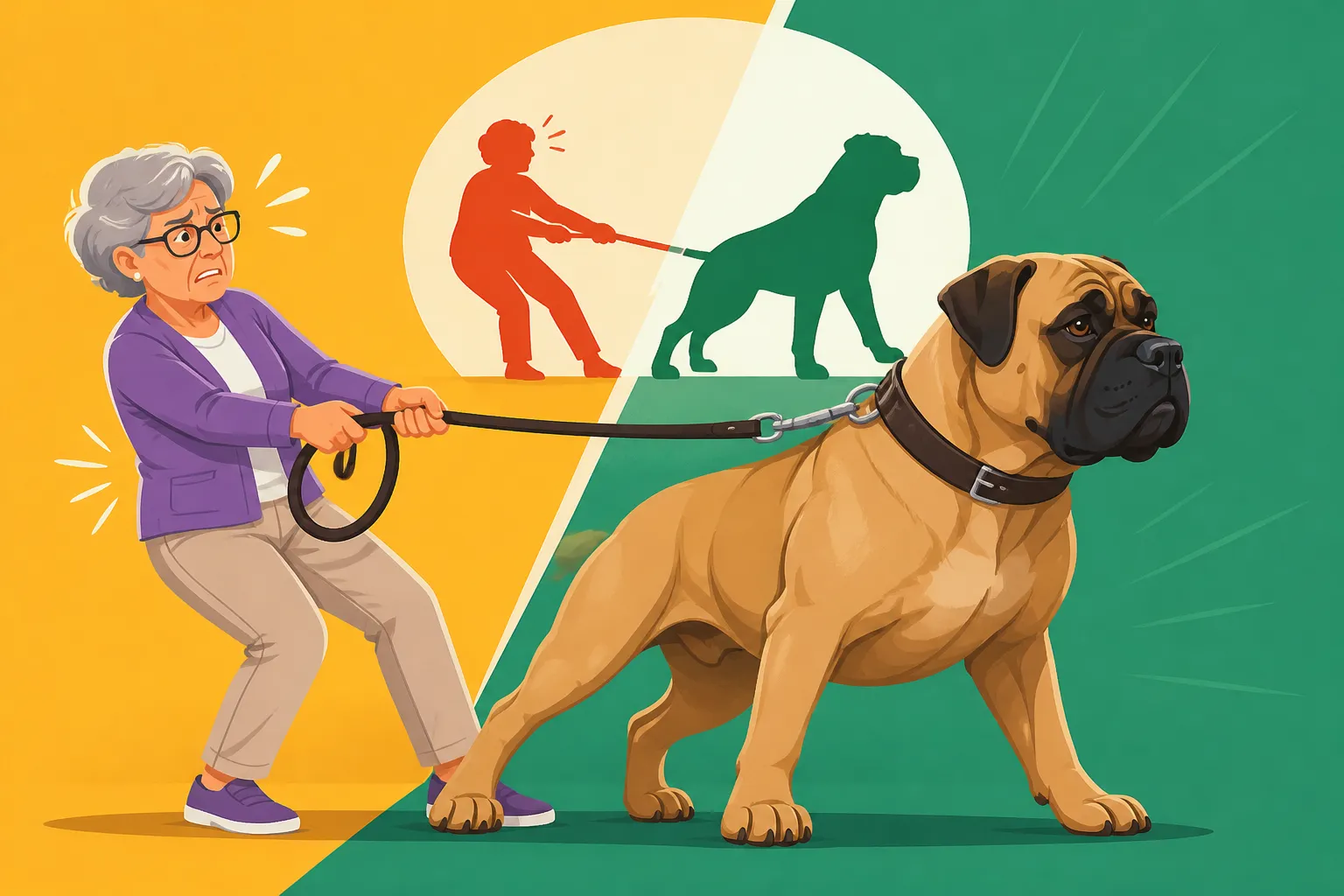
Whether an Older Owner Can Hold a Bullmastiff’s Leash
An older adult can live happily with a Bullmastiff, but controlling one on leash is a separate question from loving the breed. A startled, pulling dog can challenge someone’s balance even if it is calm at home. This guide helps you assess your strength, steadiness, training plan, and equipment before deciding whether walking a Bullmastiff is a safe, practical fit.
The real question is control, not age
A Bullmastiff’s weight is only part of the challenge
Bullmastiffs are powerful, heavy dogs, and an adult may weigh as much as or more than the person holding the leash. But weight alone does not determine whether an owner can manage one. A calm, well-trained dog that walks on a loose leash may be easier to handle than a lighter dog that lunges, bolts after wildlife, or reacts to other dogs.
The harder question is what happens when the walk stops being ordinary. A squirrel darts across the path. A delivery truck rattles by. Another dog appears around a parked car. Even a friendly Bullmastiff can move suddenly, and a person who is caught off balance may not have time to brace or adjust their grip.
Think about your own walking conditions, too. A level, familiar path with room to step aside is different from a crowded sidewalk, a steep driveway, or slick winter pavement. If you live somewhere with narrow footpaths or frequent off-leash dogs, those details matter as much as the dog’s size. For background on the breed’s build, How Much a Bullmastiff Weighs is a useful companion read.
Consider your balance, joints, and recovery from a fall
There is no age at which someone automatically becomes too old to walk a Bullmastiff. What matters is individual ability: grip strength, balance, reaction time, mobility, and confidence. Someone who walks comfortably and can recover their footing may be a safer handler than a younger person with an injury or limited experience.
Be candid about conditions that could make a sudden pull especially risky. Arthritis in the hands, shoulder or back problems, osteoporosis, dizziness, reduced vision, or a history of falls can change the consequences of losing control. This is not a judgment about anyone’s independence. It is a practical way to avoid an injury that could affect both you and the dog.
Ask yourself: if the dog lunged once, could I stay upright, keep hold of the leash, and move to a safer position? If the honest answer is “I’m not sure,” test the situation with a qualified trainer before committing to a puppy or adult dog. A Bullmastiff’s strength is not something to discover for the first time when you are already on the sidewalk.
How to assess whether you can handle the leash
Do a realistic trial before making a commitment
If you are considering a particular Bullmastiff, arrange a controlled meeting with the dog and its current handler. A calm visit in a yard can tell you something about temperament, but it does not show how the dog walks. Ask to observe a normal walk first, then, if the handler and trainer agree it is safe, try walking the dog in a quiet, enclosed area.
Do not test your ability by taking a powerful dog straight into a busy park. Start somewhere with good footing, few distractions, and enough space to stop safely. Notice whether you can hold the leash without leaning backward, gripping painfully, or wrapping it around your hand. Watch what happens when the dog changes direction or pauses. A trial should help you understand the dog, not push either of you into a risky situation.
A breeder, rescue group, or foster caregiver may be able to describe the dog’s leash habits, but ask for specific examples rather than a general assurance that the dog is “good.” Does it pull toward dogs? Does it rush through doorways? Can it calmly pass people? Has it ever slipped a collar or dragged someone? If you are comparing the breed with other options, Whether a Bullmastiff Suits a New Dog Owner can help you think about the broader responsibilities, too.
Look for reliable leash skills, not just a gentle personality
A Bullmastiff that is affectionate and relaxed indoors may still pull outdoors. Leash behavior takes practice, and it should be taught before the dog is physically strong enough to overpower its handler. If you are raising a puppy, start with short, low-distraction practice and build good habits as the dog grows. Why a Bullmastiff Must Be Trained Before It Is Strong explains why waiting until the dog is full-grown can make basic handling much harder.
An adult dog can learn new leash skills, but the transition should be gradual. Work with a reward-based trainer who has experience with large, powerful dogs. Ask for a plan that teaches the dog to walk without dragging, respond to a turn or stop cue, and settle when something interesting appears. Teaching a Bullmastiff to Walk on Leash offers more detail on the training process.
Temperament matters, but no dog is perfectly predictable in every situation. The goal is not to prove that a Bullmastiff will never pull; it is to establish dependable habits and know what you will do if the dog becomes distracted. If the dog repeatedly lunges, or you feel you must hang on with all your strength, pause ordinary walks and get professional help rather than hoping the behavior will fade.
Equipment can help, but it cannot replace control
Choose a leash and harness you can manage safely
A well-fitted harness may make handling more comfortable and give you a useful point of attachment, but it does not make a strong dog physically manageable by itself. Harness styles fit differently, and the best choice depends on the dog’s body, movement, and training needs. Which Harness Suits a Bullmastiff can help you compare features before choosing one.
Look for equipment that fits securely and is easy for you to put on and adjust. A leash should give you a reliable hold without being so long that the dog can build speed before reaching the end. Avoid wrapping the leash around your wrist or hand: a sudden pull can tighten it or injure your fingers. Retractable leashes are also a poor choice for a powerful dog because they can offer less immediate control and make it harder to keep a short, steady distance.
When shopping, check the product’s sizing instructions carefully and make sure you can operate the buckles and clips without straining your hands. Chewy is one place owners may compare harness styles and sizes; focus on the manufacturer’s fit guidance rather than choosing by appearance. If you are unsure how a harness should sit on a deep-chested dog, ask a trainer or veterinary professional to check the fit in person. You can also compare options at Chewy while keeping in mind that equipment should support, not substitute for, leash training.
| Option | What it can help with | What it cannot guarantee |
|---|---|---|
| Standard leash | A straightforward, steady connection when the dog walks calmly | Control of a dog that is lunging or pulling hard |
| Well-fitted harness | A comfortable attachment point and easier handling for some dogs | That the dog will not pull or slip free |
| Front-clip harness | May help some handlers redirect a dog during training | A substitute for teaching loose-leash walking |
| Retractable leash | More roaming distance in suitable settings | Reliable close control around hazards or distractions |
| Waist-attached leash | Hands-free walking in limited, carefully chosen situations | Safety for a handler who could be pulled off balance |
Practice handling before relying on gear outdoors
Before heading out, practice clipping and unclipping the leash, asking the dog to wait at the door, and moving together through a quiet space. Your hand should be able to hold the leash comfortably without pain. If a particular clip is difficult to operate, or the dog’s harness is hard to put on, that small frustration can become a safety issue when you are in a hurry.
A trainer can help you test equipment and refine your handling position. They may show you how to keep a manageable amount of leash, turn away from a distraction, and reward the dog for checking in. If the dog has a history of pulling, ask for one-on-one instruction before walking it alone. Chewy may be useful for comparing equipment once you know what style and size your trainer recommends, but fit and handling should be checked on the dog rather than guessed from a product listing.
Some owners consider attaching a leash to a belt or wearing a hands-free setup. That can be a poor match for an older handler if the dog is strong enough to pull the person off balance. Do not connect a powerful dog to your waist simply to free your hands. If you cannot safely manage a standard leash with a trained dog, changing the attachment point may not solve the underlying risk.
Build a safe walking plan before problems arise
Start with manageable routes and clear backup options
A good walking plan begins with routes you can manage, not with the longest or busiest outing. Choose familiar, well-maintained paths with room to turn around. Avoid slippery surfaces, narrow pinch points, and times when the route is crowded if those conditions make it harder to keep space around the dog.
Keep early walks short and quiet while you and the dog build a routine. Reward calm attention and stop before either of you becomes tired or frustrated. A dog that is already overexcited can be harder to redirect, and an owner who is fatigued may have less balance and grip. For more handling ideas, How to Walk a Bullmastiff That Outweighs You addresses the practical challenges of walking a large dog.
Plan what you will do if something unexpected happens. Know where you can step aside, turn back, or ask someone for help. If the dog pulls toward an approaching dog, do not count on physically overpowering it at the last second. Create distance early, use practiced cues, and avoid forcing close encounters. If you cannot make a safe path away from a trigger, it may be better to choose a different route or time.
Decide who can help when you cannot walk
Even a capable older owner benefits from a backup plan. Identify a family member, neighbor, dog walker, or trainer who can take over if you are ill, injured, or simply having a day when your balance or energy is not at its best. Discuss this arrangement before adopting, rather than assuming it will be easy to find help after the dog arrives.
If the Bullmastiff already lives with you and leash walking has become difficult, you do not have to solve everything alone. A professional dog walker who is comfortable handling large breeds may help with exercise, while a trainer can work on pulling or reactivity. The dog may also enjoy calm enrichment at home on days when a walk is not safe or practical. Whether a Bullmastiff Is Too Much Dog for Most Homes can help put the decision in the context of the whole household, not just the walk.
Be especially careful if the dog has begun pulling more than before. That change may reflect a training issue, a new trigger, discomfort, or another change worth discussing with a veterinarian or trainer. Do not assume that buying a stronger leash is the answer. Equipment can fail, and an owner should not have to fight the dog through every outing.
Making an honest, kind decision
An older owner can absolutely be a good Bullmastiff guardian when the dog’s training, the person’s physical abilities, and the household’s support plan fit together. But love for the breed cannot guarantee safe leash control. If you need to brace your body, fear being pulled down, or cannot comfortably manage the dog around ordinary distractions, that is important information—not a personal failure.
Some people find that a calm, trained adult Bullmastiff is a better match than a growing puppy whose strength and behavior are still developing. Others decide that a different dog, or sharing walks with a capable helper, is the safer choice. Either way, the most responsible decision is the one that protects the handler, the dog, and the people sharing the sidewalk.
Disclaimer
This article is for general informational purposes only and does not constitute professional advice. Laws, prices and regulations vary by location and change over time. Consult a qualified professional for guidance on your specific situation.