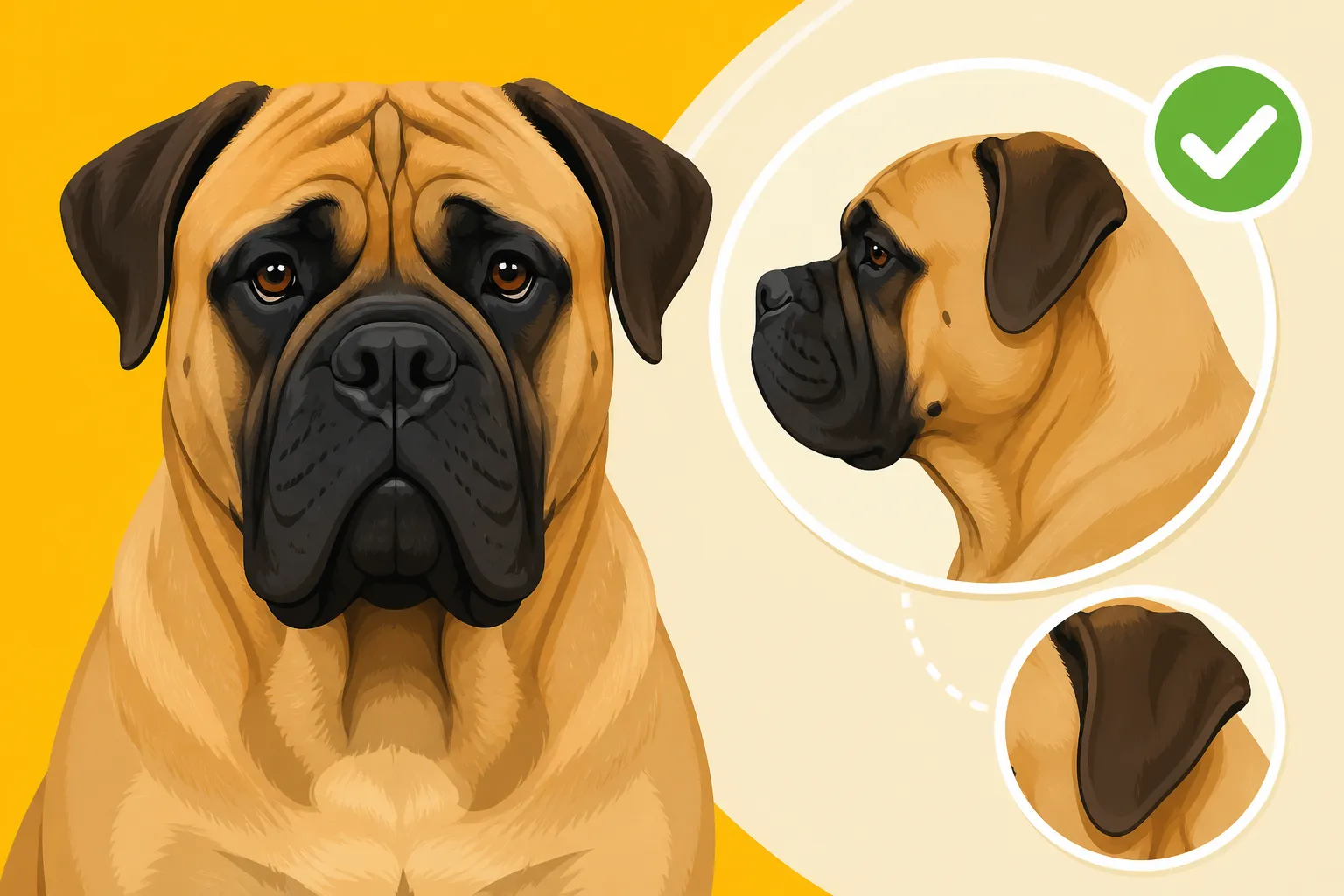
How a Bullmastiff’s Ears Should Sit
A Bullmastiff’s ears should sit high and wide on the head, fold back into a V shape, and rest close to the cheeks. They should look small beside the broad skull, not stand upright or hang loosely. If you are comparing a puppy with the breed standard—or wondering whether a change in ear position is normal—this guide explains what to look for and when to ask a vet.
The Bullmastiff ear shape and position
How a Bullmastiff’s ears should sit
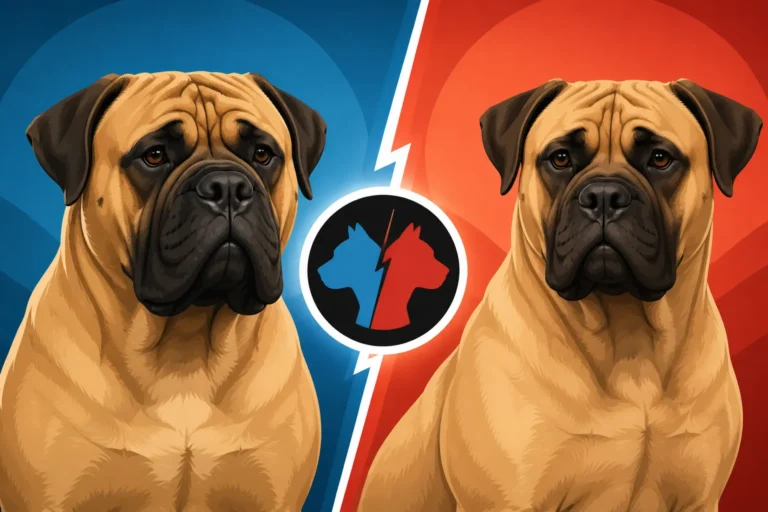
A Bullmastiff has naturally folded ears. In the breed’s characteristic outline, they are V-shaped, set high and wide on the head, and carried close to the cheeks. The fold points backward rather than forming a tall, upright triangle. From the front, the ears should look proportionate to the head and help preserve the breed’s broad, square appearance.
The phrase “set high” describes where the ears attach to the skull; it does not mean they should stick up. The ears are positioned toward the upper part of the head, with the bases spaced apart. When relaxed, the flaps lie down and back. A Bullmastiff may lift or shift them when alert, listening, or responding to a sound, but the natural resting shape remains folded.
Look at the whole head rather than judging one ear in isolation. Bullmastiffs have a broad skull, a distinctive mask, and a substantial muzzle, so the ears should fit the proportions of that head. For more context on those features, see How Broad a Bullmastiff's Skull Should Be and What a Bullmastiff's Black Mask Should Look Like.
What V-shaped and close to the cheeks mean
“V-shaped” refers to the outline created by the folded ear. It is not a precise geometric shape, and the two sides may not look perfectly identical in every photograph or at every moment. The important impression is a folded, neat ear rather than one that hangs in a long, loose flap or stands straight up.
“Close to the cheeks” means the ear rests near the side of the face instead of projecting outward. A relaxed Bullmastiff may have a little movement or variation in how the ears lie, especially while turning its head or listening. That alone does not mean anything is wrong. When assessing a dog, observe the ears when it is calm and facing forward, rather than relying on a snapshot taken during play or excitement.
The ears are generally darker than the body coat, which can make their outline easier to see on some dogs and less obvious on others. Coat color does not change the basic ear shape. If you are also comparing colors and markings, Which Colors a Bullmastiff Comes In explains the accepted coat colors, while How the British and American Bullmastiff Differ offers broader context on differences in breed presentation.
| Feature | Typical Bullmastiff appearance | What may deserve a closer look |
|---|---|---|
| Ear shape | Folded and V-shaped | Ear stands persistently upright or has an unusual shape |
| Ear position | Set high and wide on the head | Ears appear very low-set or unusually close together |
| Resting carriage | Folded back and close to the cheeks | Ears hang far from the head or look markedly different from each other |
| Relative size | Small in proportion to the broad head | Long, oversized-looking flaps that change the overall outline |
| Movement | May shift or lift briefly when alert | Sudden drooping, swelling, redness, pain, or discharge |
The table describes general appearance, not a diagnosis or a complete show evaluation. A dog’s head shape, age, expression, and momentary posture can all affect what you see.
How ear position can change with age and attention
Bullmastiff puppies and developing ears
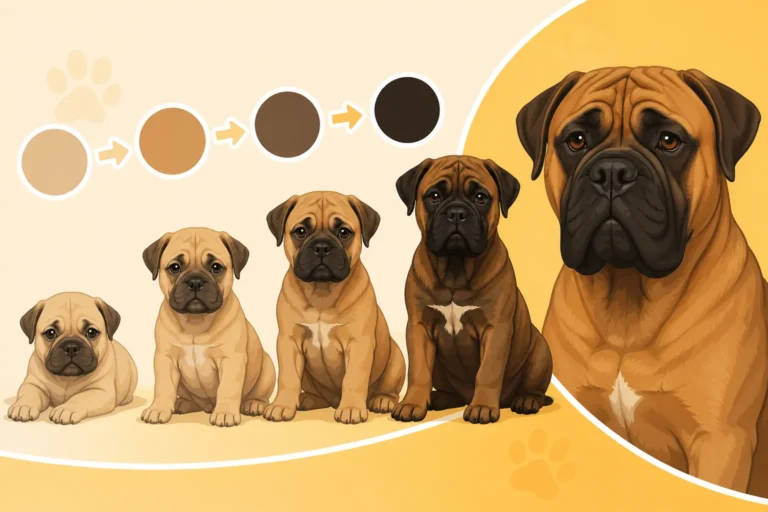
A puppy’s ears may not look as settled as an adult’s. As the head grows, the proportions can change, and a puppy may carry its ears differently while it is listening, playing, teething, or simply moving around. A single photo—especially one taken when the puppy is startled or excited—is not a reliable way to decide whether the adult ear set will match the breed standard.
If you are evaluating a puppy, ask the breeder how the ears look when the puppy is relaxed and whether you can see photos of the puppy’s parents. Those details may help you understand the family’s general type, though no photo can guarantee how a young dog will develop. The ears are only one small part of overall structure and health. What Nobody Tells You Before Buying a Bullmastiff is useful background if you are still learning what to assess before bringing one home.
Avoid trying to reshape a puppy’s ears with tape, weights, or other home methods. These approaches can irritate delicate skin and are not a substitute for veterinary advice. If an ear looks painful, injured, or suddenly different, contact a veterinarian instead of attempting to correct its position yourself.
What happens when a Bullmastiff is alert
A Bullmastiff’s ears can move when the dog hears a familiar voice, notices a visitor, or focuses on something across the room. One ear might turn first, or both may lift slightly at the base. That is ordinary movement, not a change to the dog’s permanent ear set. Once the dog relaxes, the ears should return to their natural folded carriage.
Context matters. A dog looking up at a person standing above it may hold its head and ears differently from a dog watching something at ground level. Wind, a collar, a recent nap, or even the angle of a camera can also make the ears look uneven. If you are unsure, watch your Bullmastiff through a few calm moments rather than repeatedly adjusting or handling the ears to make them look a certain way.
A lasting change is different from a brief change in expression. If one ear suddenly droops, becomes swollen, or seems sensitive, pay attention to the dog’s comfort and behavior. Scratching, head shaking, a bad smell, redness, or discharge can point to a problem that needs veterinary attention. You can read more about possible causes in Ear Infections in a Bullmastiff.
Appearance, grooming, and ear health
The breed standard is not a health check
The breed standard describes the appearance expected in the show ring; it does not tell you whether an individual dog’s ears are healthy. A Bullmastiff can have ears that differ slightly from the ideal outline and still be a comfortable, healthy companion. Conversely, ears that look perfectly placed can still develop irritation or infection.
If you are choosing a show prospect, a knowledgeable breeder or qualified judge can explain how ear set fits into the complete head and overall structure. Avoid treating one feature as proof of quality. The ear shape should be considered alongside proportions, movement, temperament, and health. How a Bullmastiff's Muzzle Length Should Be explores another feature of the head that is best understood in proportion to the rest of the dog.
Cosmetic alteration is not a way to create the breed’s natural ear carriage. Bullmastiffs are recognized for folded ears, and cutting or reshaping an ear for appearance is unnecessary and can cause pain and complications. If someone suggests altering a dog’s ears to make them look more correct, ask a veterinarian about the risks and consider seeking advice from a reputable breed professional.
Routine checks without over-cleaning
Take a quick look at your Bullmastiff’s ears during ordinary grooming. Check for redness, swelling, unusual odor, discharge, dampness, or signs that the dog is uncomfortable when the ear is touched. A calm, brief inspection is usually easier than waiting until your dog is already irritated and trying to hold a large, strong dog still for a prolonged examination.
Routine cleaning is not the same as deep cleaning. Do not push cotton swabs or other objects into the ear canal, and do not use household products or a cleaner that has not been recommended for your dog. If your Bullmastiff has recurring wax, odor, or irritation, ask your vet what to use and how often to clean. How Often a Bullmastiff's Ears Need Cleaning and What to Clean a Bullmastiff's Ears With cover those practical questions in more detail.
For basic grooming supplies, retailers such as Chewy may carry pet ear cleaners and soft pads, but the product should suit your dog and your veterinarian’s guidance. Chewy can be a convenient place to look for supplies once you know what type of cleaner is appropriate. If the ear is painful, very red, swollen, or producing discharge, skip home cleaning and call your veterinary clinic; putting liquid into an inflamed or injured ear may make the situation worse.
When to ask a vet or breeder for help
Signs that need veterinary attention
A change in ear position is more concerning when it appears suddenly or comes with other symptoms. Contact your veterinarian if your Bullmastiff has persistent head shaking, repeated scratching, tenderness, swelling, a strong odor, discharge, bleeding, or redness that does not settle. These signs can have several causes, so an examination is the best way to determine what is happening.
Do not assume that a drooping ear is simply a cosmetic quirk if it is new. Pain, irritation, injury, and other problems can affect how a dog holds an ear. Similarly, a dog that resists having one ear touched may be uncomfortable even if the ear looks fairly normal from the outside. Note when the change began and whether your dog has been swimming, bathing, or scratching; those details can help your vet assess the situation.
If your Bullmastiff is otherwise comfortable and the ears have always looked the same, a difference from the ideal breed-standard shape is not automatically an emergency. Bring it up at a regular wellness visit if you want professional guidance. For broader routine-care questions, see How Often a Bullmastiff Needs a Wellness Exam.
Questions to ask a breeder or evaluator
If you are looking at a Bullmastiff puppy, ask the breeder to describe the parents’ ear shape and show you photographs taken when they are relaxed. You can also ask whether the ears have ever had a health issue, while remembering that a normal-looking ear set does not guarantee a dog will never develop an infection or irritation.
For a show dog, ask how the ear set is being evaluated as part of the complete head—not whether the ears can be trained into a different position. A careful evaluator will consider the dog’s proportions and natural carriage, rather than promising that a puppy’s appearance can be permanently changed with a quick fix. If you are comparing a dog from another country or bloodline, How the British and American Bullmastiff Differ may help you frame questions about type and presentation.
It can also help to take a relaxed, straight-on photograph and a side view, then compare those with the breed description without forcing the dog to pose. Ask a breeder, veterinarian, or experienced breed professional to clarify anything that seems unusual. The best next step depends on whether your concern is appearance, development, or a possible health change; those are different questions and deserve different answers.
Disclaimer
This article is for general informational purposes only and does not constitute professional advice. Laws, prices and regulations vary by location and change over time. Consult a qualified professional for guidance on your specific situation.