Which Tests the American Bullmastiff Association Asks For
Choosing a Bullmastiff puppy is hard enough without trying to decode a stack of health certificates. The American Bullmastiff Association’s recommended screening tests help buyers ask better questions about the parents and litter, especially around hips, elbows, heart health, and thyroid function. Here’s what those tests can show, what they cannot promise, and how to review results before you commit.
What health tests are associated with the American Bullmastiff Association
The core screenings buyers should ask about
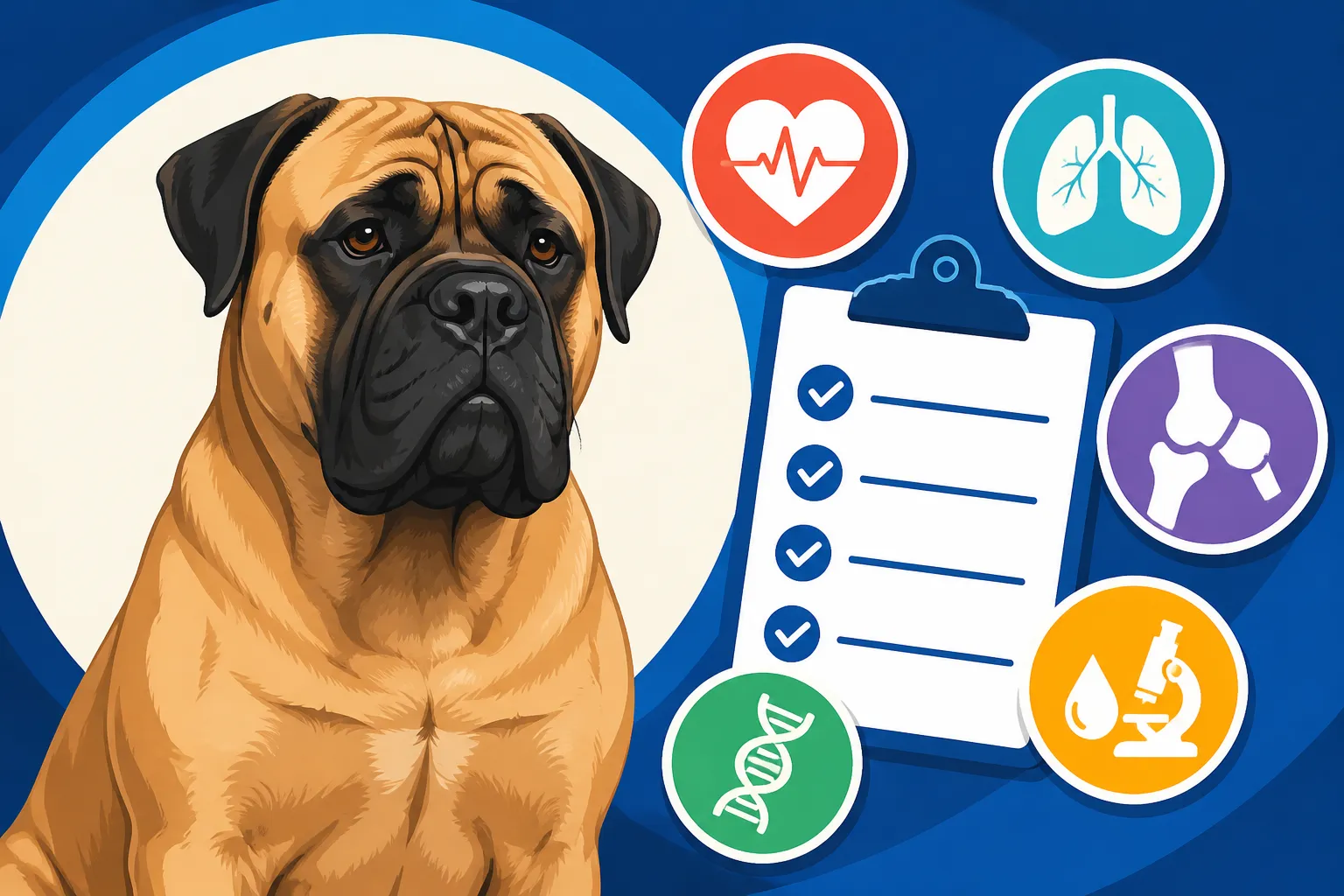
The American Bullmastiff Association, often shortened to ABA, promotes health screening so breeders can make more informed decisions. For Bullmastiffs, the main areas buyers commonly encounter in recommended testing are hip dysplasia, elbow dysplasia, cardiac disease, and thyroid problems. The details of a breeder’s program can vary, so ask which tests they completed, which organization evaluated them, and how the results were recorded.
These screenings do not certify that a puppy will never become ill. They assess specific risks in the tested dog, often a parent, and they help breeders weigh health information when deciding whether and how to breed. A clear result is useful, but it is one part of a much larger picture that includes relatives’ health, a dog’s age, physical examination findings, and honest reporting of problems in the line.
It’s also worth distinguishing club recommendations from a universal legal requirement. A breed club can set expectations or guidance for responsible breeding, but that does not mean every breeder is compelled by law to complete every test. Ask for the breeder’s actual screening plan rather than assuming that membership in a club automatically means all testing is done. For a broader overview, see Which Health Tests a Bullmastiff Breeder Should Run.
What the individual tests look for
| Screening | What it assesses | What to ask the breeder for |
|---|---|---|
| Hip evaluation | Hip joint structure and signs associated with hip dysplasia | The official result, the dog’s registered name, and evaluation details |
| Elbow evaluation | Elbow joint structure and signs associated with elbow dysplasia | The recorded result and confirmation that it belongs to the parent dog |
| Cardiac screening | Evidence of heart abnormalities, including concerns such as subaortic stenosis | What examination was performed, who performed it, and whether further testing was advised |
| Thyroid evaluation | Evidence that may support or help investigate thyroid dysfunction | The test date, laboratory or veterinary records, and whether repeat testing was recommended |
Hip and elbow evaluations usually involve imaging that is reviewed under a recognized assessment process. A breeder may describe a dog as “checked,” but that phrase alone does not tell you whether the dog had formal imaging, who evaluated it, or what the result was. Ask for paperwork rather than relying on a verbal assurance.
Cardiac screening deserves particular care because the phrase can refer to different levels of examination. A veterinarian may listen to the heart and identify a murmur, while additional assessment may be needed to investigate a suspected problem. Ask what was actually performed and whether the dog’s veterinarian or a veterinary cardiologist recommended further evaluation. A normal examination at one point in time is helpful, but it is not a lifetime guarantee.
Thyroid testing is also more than a breeder saying a dog “seems healthy.” Changes in energy, skin or coat, and body condition can have many causes, so results need to be interpreted in context by a veterinarian. Ask to see the report and whether the breeder repeats testing when a veterinarian advises it. The goal is a documented, thoughtful health history, not a reassuring phrase without supporting information.
Screening can differ from DNA testing
A physical or laboratory screening and a genetic test answer different questions. Imaging and examinations look for evidence of a condition or risk in the dog at the time of evaluation. A DNA test looks for a particular known genetic variant. Neither approach replaces a complete health history, and not every disease that affects Bullmastiffs has a simple genetic test that can predict an individual dog’s future.
Ask the breeder whether DNA testing is relevant to the specific condition they mention, and what the result means for breeding decisions. A test result should be tied to the dog’s identity and interpreted correctly; a screenshot without a name or clear documentation is difficult to evaluate. If the breeder discusses a test as proof that a puppy is “guaranteed healthy,” that is a reason to ask more questions, not less.
The same caution applies to broad claims such as “our line is clear.” Find out what was tested, which relatives were tested, and whether the statement refers to a specific disease or to general health. For more on the screening process and the limits of test results, read What a Bullmastiff Breeder Should Have Screened and Why a Bullmastiff Litter Should Be Screened.
How to review a Bullmastiff breeder’s test records
Match every result to the correct dog
A health record is only useful if you can tell whose result it is. Ask for the parent dogs’ registered names and, where available, identifying numbers that appear on their official results. This reduces the chance of confusing a dog with a similar name or reviewing a certificate belonging to another animal.
Check that the name on each report matches the sire or dam named in the litter information. Look for the test type, date, evaluating organization or professional, and final result. If you receive a cropped image that cuts off identifying details, ask politely for a complete copy. Responsible breeders should understand why a buyer wants records they can actually verify.
You do not need to be an expert in veterinary interpretation. Your job is to gather the documents, notice what is missing, and ask the breeder to explain them. If an answer seems unclear, ask your veterinarian to help you understand what the report does and does not say. For related buyer questions, see What Health Results a Bullmastiff Breeder Should Show.
Ask about the family history, not only the parents
A clean result in both parents does not erase health concerns in close relatives. Ask whether the breeder knows of hip or elbow problems, heart conditions, thyroid disease, cancers, or other significant illnesses in parents, siblings, grandparents, and previous offspring. Honest breeders may not have every detail about every dog, but they should be willing to discuss what they know and say plainly when information is incomplete.
Cancer history can be especially difficult to interpret. There is no simple screening result that can guarantee a Bullmastiff will not develop cancer, and a family history is not the same as a prediction for one puppy. Still, a breeder who tracks health outcomes over time may be better positioned to make informed breeding choices. You can explore this issue further in Whether a Bullmastiff Breeder Publishes Cancer History.
When asking about a health problem, keep the question neutral and specific. Instead of “Are there any bad health problems in your dogs?” try “Have any close relatives had diagnosed heart disease, hip or elbow problems, thyroid disease, or cancer, and what do you know about their ages and diagnoses?” That wording makes it easier to get concrete information without turning the conversation into an accusation.
Don’t treat one certificate as a puppy guarantee
Health screening is a risk-management tool, not a promise. A puppy can inherit a complicated mix of traits, and some conditions become apparent only as a dog matures. A puppy’s veterinary examination is important, but it cannot establish every future joint, heart, thyroid, or cancer outcome.
Think of the records as one part of a breeder’s overall approach. Consider whether the breeder provides complete documentation, answers questions consistently, explains uncertainty honestly, and takes responsibility for dogs they have bred. A healthy-looking puppy in a photo, or a parent described as “strong and sound,” cannot replace the relevant test results.
Be cautious if a breeder claims that a single test proves a puppy cannot develop a condition, or pressures you to pay a deposit before answering reasonable health questions. A good match should give you time to review the information. The companion guide Which Questions to Ask a Bullmastiff Breeder can help you prepare for that conversation.
What to do when results are missing or unclear
Get a clear explanation before placing a deposit
If a breeder says the parents were screened but has not provided the paperwork, ask which tests were done and request copies of the results. If only some tests were completed, ask why. There may be a specific explanation, but you should be able to understand the plan and make your decision with the facts in front of you.
If a report uses terminology you do not recognize, ask the breeder to explain it in plain language. Then, if anything remains uncertain, show it to your veterinarian. For heart concerns, ask whether the recorded examination is enough to answer your question or whether the dog had additional evaluation. For joint results, ask how the assessment was performed and whether the result is final or preliminary.
A breeder should not dismiss every concern with “the vet said it’s fine” if the question is about a formal result or a known family history. At the same time, one incomplete record does not automatically prove that a breeder is irresponsible. Look at the whole pattern: transparency, consistency, willingness to follow up, and the quality of care provided to the dogs.
Consider screening throughout the dog’s life
Some health checks matter after a puppy comes home, too. Your veterinarian can recommend a schedule based on the dog’s age, family history, physical examination, and any symptoms. A routine wellness visit is a chance to discuss heart sounds, body condition, movement, skin and coat changes, and whether additional testing is appropriate.
Share the breeder’s records with your veterinarian rather than leaving them in an email folder you may forget about. Keep copies of test certificates, vaccination and medical records, and notes about changes you notice. If you use Chewy to order veterinarian-recommended supplies or prescribed products, keep the veterinary instructions and product details with your dog’s health records. Ordering something conveniently does not replace an examination or a clinician’s guidance.
If a vet recommends follow-up testing or treatment, ask what the next step is, why it is needed, and what signs should prompt a call sooner. Chewy may be one option for obtaining a product your veterinarian has approved, but the diagnosis and treatment plan should come from your veterinary team. Keep the breeder informed about significant diagnoses, particularly when a condition may matter to the health history of the litter or line.
Read the contract alongside the health information
A health guarantee or puppy contract can explain what the breeder agrees to do if a diagnosed condition appears. Read it carefully before signing, and ask what the terms mean in practical situations. Pay attention to the steps required to notify the breeder, the records you must provide, and whether the agreement describes any limits or conditions.
A contract cannot make a puppy’s health predictable, and it should not be treated as a substitute for good screening. It is one part of a responsible purchase alongside documented test results, an open discussion of family history, and a relationship with a veterinarian. Ask for clarification before you sign rather than hoping you can sort out ambiguous terms later. For more detail, see What a Bullmastiff Breeder Contract Requires.
The strongest sign of a thoughtful breeder is not a claim that their dogs have no health risks. It is a willingness to show the relevant records, explain what the tests mean, discuss what they do not establish, and talk openly about health history. That gives you a more realistic basis for choosing a puppy and preparing for the care a Bullmastiff may need.
Disclaimer
This article is for general informational purposes only and does not constitute professional advice. Laws, prices and regulations vary by location and change over time. Consult a qualified professional for guidance on your specific situation.