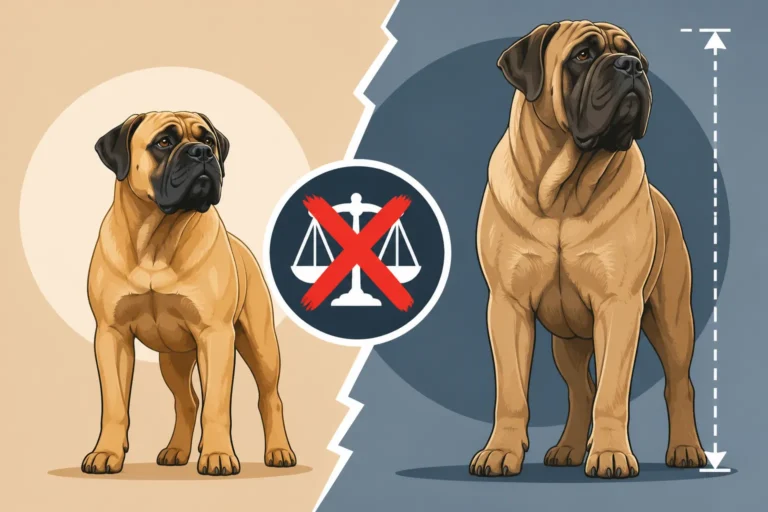
Whether a Bullmastiff Is Related to the Rottweiler
A Bullmastiff and a Rottweiler can look related at a glance: both are powerful, broad-headed dogs with a history of working alongside people. But the Bullmastiff was not bred from the Rottweiler, and the two breeds developed for different jobs in different places. This guide explains what they share, where their histories diverge, and what their similarities do—and do not—tell you.
Is a Bullmastiff related to a Rottweiler?
The short answer is that the Bullmastiff and Rottweiler are related in a broad, historical sense as large working dogs with some mastiff-type ancestry, but one is not a direct ancestor of the other. They developed as distinct breeds in different parts of Europe, shaped by different needs.
That distinction matters because “related” can mean several things. It might mean two breeds share a close, documented ancestor, or it might simply mean they belong to a broad group of sturdy dogs with similar physical traits. For the Bullmastiff and Rottweiler, the second meaning is the safer one.
Their histories point to separate origins
The Bullmastiff was developed in England for gamekeepers who needed a strong dog to find and hold poachers. The dog had to be substantial and brave, but also able to move across an estate and work with a handler. Its history is commonly described as a blend of Mastiff and Bulldog ancestry, though breed development was not necessarily as neat as a fixed recipe. For more on that background, see Which Breeds Went Into the Bullmastiff and The Bullmastiff Is Sixty Percent Mastiff and Forty Percent Bulldog.
The Rottweiler’s roots are associated with the German town of Rottweil. Its earlier working roles included driving cattle and guarding property, and it became known as a capable all-purpose farm and working dog. Stories of Roman drover dogs are often mentioned when describing its history, but that does not mean the modern Rottweiler is simply an unchanged Roman dog. Like other established breeds, it took shape over time through working needs and selective breeding.
These different jobs help explain why the breeds can feel alike in some ways without sharing a close, recent family tree. Both needed physical confidence and the ability to work around people. But the Bullmastiff was developed as a quiet estate guardian that could catch and hold a person, while the Rottweiler’s traditional work included moving livestock and guarding.
Shared type is not the same as direct ancestry
People sometimes use “Molosser” as a broad label for muscular, large-bodied dogs with a history of guarding or other demanding work. The Bullmastiff is commonly placed within this broad group, and the Rottweiler is often discussed alongside other large working breeds. But a shared category does not prove that one modern breed came directly from another. You can read more about the label in Whether the Bullmastiff Is a Molosser.
A useful analogy is to think of the breeds as distant relatives in a large family, rather than as parent and offspring. Their wider ancestry may overlap in the long history of European working dogs, but that is not the same as evidence that the Bullmastiff was developed from the Rottweiler, or that the Rottweiler came from the Bullmastiff.
That’s why appearance alone is a poor guide to breed history. A broad head, strong body, or protective reputation can show that dogs were selected for some similar practical qualities. Those traits do not establish a direct genetic connection.
Why the two breeds can look and feel similar
Both breeds are large, powerful dogs with a strong presence. When someone sees a dark, muscular dog standing alert beside its family, it’s easy to assume that it must be closely related to another breed with a similar outline. Yet body shape and temperament are influenced by many generations of selection, and similar working demands can produce similar-looking dogs even when their histories are separate.
Similarities in size and build
Bullmastiffs and Rottweilers are both substantial dogs, though individual size and build vary. A Bullmastiff often has a heavy, broad appearance, a short coat, and a dark mask. A Rottweiler is also solidly built, usually with distinctive tan markings and a powerful frame. Both can look imposing, and both need owners who can manage a large dog calmly and safely.
Their size does not mean that their needs are identical. A Bullmastiff’s build and short muzzle can make heat management especially important; strenuous activity in warm weather deserves care. Rottweilers also need sensible exercise and conditioning, but their activity tolerance and individual health needs should be assessed dog by dog. A breed’s general appearance is not a substitute for paying attention to the dog in front of you.
When comparing them, focus on more than height, weight, or head shape. Ask about energy level, socialization, health, and the dog’s behavior in ordinary situations: meeting visitors, walking on leash, settling indoors, and sharing space with other animals. Those everyday details usually matter more to a household than whether two breeds look similar in a photograph.
Similarities in guarding reputation
Both Bullmastiffs and Rottweilers are often described as protective. That reputation can lead people to assume that the breeds will react in the same way to strangers or that every dog will instinctively know how to guard a home. Neither assumption is reliable. Individual temperament, breeding, early experiences, training, and management all influence how a dog behaves.
A well-socialized dog can be watchful without being encouraged to threaten people. That distinction is important in a home where delivery workers, neighbors, children’s friends, or visiting relatives come and go. For a Bullmastiff, teaching calm routines around visitors is more useful than trying to make the dog “more protective.” Clear boundaries and thoughtful introductions help prevent confusion for both the dog and the people at the door.
A dog’s size can also make ordinary behavior feel more intense. A friendly Bullmastiff leaning against a guest or a Rottweiler stepping close to its owner may be responding in a way that seems harmless to the family but intimidating to someone unfamiliar with large dogs. Consistent training, supervision, and management are part of responsible ownership, regardless of which breed you choose. The Bullmastiff’s original work and its modern household role are explored in The Household a Bullmastiff Was Built For.
The important differences between a Bullmastiff and a Rottweiler
Knowing that the breeds have different origins is useful, but it won’t tell you which one is a better fit for your home. Their working histories offer context, not a guarantee of personality. A thoughtful comparison should include their purpose, physical needs, training, and the realities of daily care.
| Feature | Bullmastiff | Rottweiler |
|---|---|---|
| Historical development | Developed in England for gamekeepers and estate work | Developed in Germany as a working dog associated with livestock, property, and general farm duties |
| Traditional working role | Finding and holding poachers with a handler | Driving cattle and guarding property, among other working roles |
| Appearance | Broad, powerful build; short coat; typically a dark facial mask | Strong, substantial build; typically black with tan markings |
| Family fit | Depends on the individual dog, training, and household management | Depends on the individual dog, training, and household management |
| Key care consideration | Heat awareness and managing a heavy body | Appropriate exercise, training, and ongoing physical conditioning |
| What similarity means | Similar working-dog traits do not prove direct descent | Similar working-dog traits do not prove direct descent |
Different jobs shaped different strengths
A Bullmastiff’s traditional task called for close cooperation with a gamekeeper. The dog needed to be physically capable of stopping someone, but the goal was to restrain rather than pursue and injure. That history helps explain why the breed is often described as deliberate and quiet, although no description can predict every individual dog.
The Rottweiler’s historic work was broader in a different way. The breed was associated with livestock handling and property protection, roles that called for a strong, capable dog able to work around a handler. Today, Rottweilers may also be seen in a range of working and companion roles. A dog’s suitability for any job depends on its temperament, physical health, training, and the experience of the people handling it.
These histories should not be turned into simple personality promises. It would be misleading to assume that every Bullmastiff will be calm with every visitor or that every Rottweiler will naturally know how to manage livestock. Breed history can offer clues about likely tendencies, but good breeding, socialization, training, and individual temperament all matter.
Similar needs, different day-to-day considerations
Both breeds benefit from early, reward-based training and steady socialization. Because each can become large and strong, it’s much easier to teach leash manners, calm greetings, and comfortable handling while the dog is young than to wait until pulling or jumping has become difficult to manage. Short, consistent practice is generally more useful than harsh correction, which can create fear or conflict rather than reliable cooperation.
Their physical routines should be tailored to the individual. A Bullmastiff is not automatically a high-mileage exercise partner, and pushing a heavy dog to keep up in hot weather can be risky. Rottweilers need regular movement and engagement, but exercise should still be appropriate for the dog’s age, condition, and health. For broader comparisons with other large working breeds, see The Bullmastiff Against the Mastiff and How a Bullmastiff Differs From a Cane Corso.
Daily logistics count, too. Think about how you’ll safely transport a large dog, whether your floors are slippery, where the dog will rest, and who can handle the leash. A retailer such as Chewy can be one place to compare practical supplies like large-dog beds, food storage, or grooming tools, but equipment cannot replace training or advice from your veterinarian.
Choosing between the breeds without relying on labels
If you’re deciding between a Bullmastiff and a Rottweiler, the most useful question is not which breed is “better.” It is which individual dog—and which breed’s common needs—fits your household, experience, schedule, and environment.
Look beyond the breed name
Start with the dog’s temperament and background. If you’re considering a puppy, ask the breeder about the parents’ behavior, health screening, and the way puppies are raised and introduced to everyday experiences. If you’re considering an adult dog, ask how it behaves around strangers, children, other dogs, handling, and time alone. A rescue organization may be able to describe the dog’s known history and what support it needs in a new home.
Be especially honest about your ability to manage a large, strong dog. Can you keep a leash secure if the dog becomes distracted? Are all household members comfortable following the same rules? Can you supervise introductions and give the dog a quiet place to settle? These practical questions are more revealing than a breed’s reputation for being protective or gentle.
Also consider climate and routine. A Bullmastiff owner should plan carefully for warm weather and avoid treating the dog’s size as proof that it needs strenuous exercise. For either breed, the right activity level should account for age and health. If you are comparing breeds as possible family companions, What Nobody Tells You Before Buying a Bullmastiff can help you think through the less glamorous parts of ownership as well as the appealing ones.
Build a care plan around the dog you bring home
Before bringing home either breed, arrange veterinary care and ask what preventive care is appropriate for that dog. Plan for routine grooming, nail care, dental care, exercise, training, and the costs of feeding and supplies. Large dogs can require substantial beds, secure equipment, and a vehicle setup that makes travel comfortable and safe.
It can help to make a simple list of likely needs before you shop: food recommended for the dog’s age and condition, a sturdy leash and well-fitted walking equipment, cleaning supplies, and a resting spot that supports the dog’s body. Chewy is one option for comparing food and basic supplies, but follow your veterinarian’s guidance when choosing a diet, especially for a puppy or a dog with a medical concern. The best food or equipment is not necessarily the most heavily advertised; it is what suits that dog safely and consistently.
Finally, avoid choosing a dog because you expect it to guard your home. A stable companion who can settle, be handled, and welcome guests appropriately is easier to live with than a dog encouraged to make its own decisions about who belongs. If you’re weighing Bullmastiff ownership, Why the Bullmastiff Is in the Working Group offers more context for understanding the breed’s background without confusing historic purpose with a promise about an individual dog.
What to remember about their relationship
The Bullmastiff and Rottweiler share some broad characteristics: both are powerful working breeds, both have a history connected to guarding or other demanding tasks, and both can look imposing. Those similarities are real, but they do not show that one breed descended directly from the other.
The Bullmastiff developed in England for gamekeeper work; the Rottweiler developed through a separate German working-dog history. Their distant ancestry may overlap in the broader history of European dogs, but their modern breed identities and traditional roles are distinct. If you’re deciding whether to live with one, focus on the particular dog, its background, and the care and training you can provide—not just on a family-tree label or a protective reputation.
Chewy can be useful for comparing everyday supplies once you know what your dog needs, while your veterinarian and a responsible breeder or rescue can help with decisions specific to the dog’s health and behavior. Those practical details will have a much greater effect on daily life than the question of whether the breeds are closely related.
Disclaimer
This article is for general informational purposes only and does not constitute professional advice. Laws, prices and regulations vary by location and change over time. Consult a qualified professional for guidance on your specific situation.