The Outline a Gamekeeper Wanted in a Bullmastiff
A gamekeeper needed a Bullmastiff that could move quickly through dark, uneven country, catch a trespasser and hold him without mauling him. That job called for more than sheer size: the dog had to be powerful, balanced and steady under pressure. This guide explains the working outline behind the breed and how it differs from simply looking big.
The working job shaped the Bullmastiff’s outline
A dog built for pursuit, not display
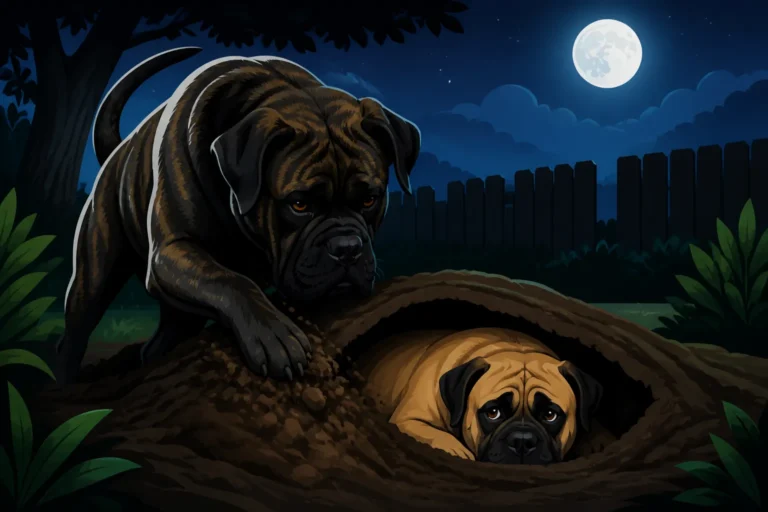
The Bullmastiff developed in Britain as a gamekeeper’s working dog. Its task was to help confront poachers on large estates, often at night. A dog that was too slow, too cumbersome or too difficult to control would be a poor fit for that work, however imposing it looked.
That purpose helps explain the breed’s characteristic combination of strength and mobility. The dog needed enough substance to overpower and restrain a person, but it also had to cover ground and turn with purpose. The ideal was not a lumbering giant. It was a strong, close-working dog with the balance to move decisively.
The working role also puts the breed’s history into perspective. A Bullmastiff was not meant to attack indiscriminately or kill a person; its job was to stop and hold. For more on that distinction, see Why the Bullmastiff Was Bred Not to Kill and A Bullmastiff Was Bred to Hold a Man, Not Bite Him.
Strength had to come with control
A gamekeeper working at night could not rely on a dog’s size alone. The dog needed the physical confidence to close distance and the temperament to respond to its handler. A powerful animal that could not be guided safely would create a serious risk rather than solve a problem.
That is why the historical ideal is better understood as controlled power. The Bullmastiff’s substantial body supported the work, while its balance and responsiveness made that body useful. Its presence could be intimidating, but the job called for a dog that could restrain rather than simply lash out.
This working purpose is useful context when looking at the modern breed. A broad head or heavy frame may catch the eye, but neither tells the whole story. The outline should suggest a dog that is strong and capable of movement, not one whose mass overwhelms its balance. The breed’s early purpose is explored further in The Bullmastiff Was Built to Catch Poachers in the Dark and How a Gamekeeper Used a Bullmastiff on a Poacher.
The shape a gamekeeper needed
A sturdy body with useful proportions
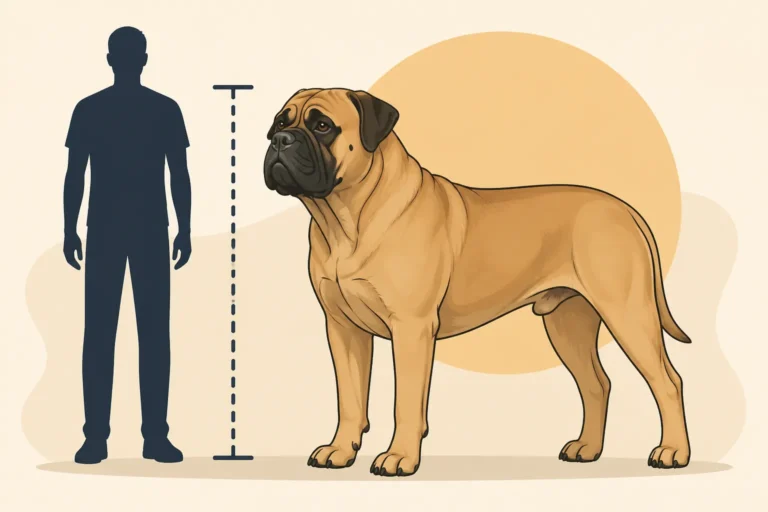
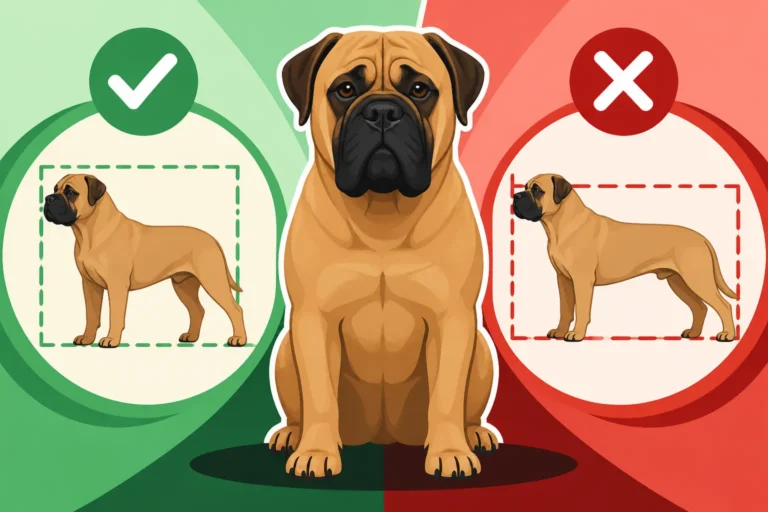
The Bullmastiff’s traditional outline is powerful and compact-looking, with substance carried on a body that remains balanced. The dog should not appear fragile or narrow, but nor should it look so heavy that moving efficiently seems difficult. Its proportions matter as much as its size.
A strong chest and well-developed body contribute to the impression of power. A relatively short, firm back helps create a compact silhouette, while sound legs provide the support needed for steady movement. Taken together, these features make the dog look capable of setting off quickly, stopping and changing direction rather than merely standing impressively in a photograph.
The word square is sometimes used to describe the Bullmastiff’s general proportions, but it should not be taken as a demand for a rigid geometric shape. The goal is a balanced outline, not an exact box. A dog can be muscular and substantial without appearing overbuilt, and a slightly different appearance from one individual to another does not automatically mean that the dog is poorly formed.
Substance without cumbersome bulk
It is easy to mistake “more massive” for “more correct.” A very heavy Bullmastiff may look imposing, but excess bulk can obscure the balanced, active outline that made the breed useful. Size does not replace sound construction. A dog still needs to stand and move comfortably, with its weight carried by a body that appears coordinated.
This distinction matters in everyday life, too. An owner may admire a powerful dog and still need to consider whether that dog can walk comfortably, rise from a bed and move around the home without struggling. A functional outline is not just a historical idea; it also affects practical movement and care.
For example, imagine two dogs standing side by side. One has a strong chest, a firm-looking back and legs that appear to support its body evenly. The other is visibly heavier but looks awkward when it turns or gets up. The first may present a more convincing picture of useful strength, even if the second seems larger. Breed type is not simply a contest in weight or bulk.
| Feature | Functional impression | What to look for |
|---|---|---|
| Overall balance | Strong but mobile | Substance without an awkward, overloaded appearance |
| Chest and body | Power and stamina | A well-developed body in proportion to the rest of the dog |
| Back | Compact support | A firm-looking outline rather than an excessively long or weak-looking back |
| Legs and feet | Stable movement | Support that appears coordinated with the dog’s size |
| Head | Distinctive breed character | Strength and expression without losing the dog’s overall balance |
| Gait | Practical movement | A dog that moves with purpose rather than seeming labored |
A head made for the job, not a caricature
The Bullmastiff’s head is one of its most recognizable features. It is broad and powerful-looking, with a short muzzle and the breed’s characteristic dark mask. Those features contribute strongly to the dog’s expression and distinctive appearance.
But a memorable head should still fit the dog. When the head looks exaggerated in relation to the body, or when the dog’s overall balance is lost in pursuit of a more dramatic appearance, the outline can stop looking functional. The working image is a strong dog whose features belong together—not a collection of oversized parts.
A gamekeeper would have needed a dog that could work, not merely attract attention. In a modern setting, the same principle is helpful when assessing photographs, breeder descriptions or show-ring appearances. Ask whether the entire dog looks balanced, including its head, neck, body and limbs. A head viewed on its own cannot tell you whether the dog has a useful overall outline.
Reading the outline in motion
Standing shape only tells part of the story
A still photograph can show proportion and general substance, but it cannot reveal how easily a dog moves. When possible, watch a Bullmastiff walk at a comfortable pace and turn. Look for a dog that appears coordinated and steady, rather than one that has to make conspicuous effort to move its own body.
The movement does not need to look frantic or showy. The historical job was not a sprinting contest across a racetrack. What matters is the impression of controlled, purposeful movement: the dog should be able to cover ground and change direction without looking unbalanced. A relaxed, deliberate walk can still show whether the body works together.
If you are visiting a breeder or meeting an adult dog, observe the dog standing, walking and getting up from rest. Those ordinary moments can be more informative than a posed photograph. Notice whether the dog carries itself comfortably and whether its legs and body appear to work as a unit.
Don’t confuse a slow manner with poor structure
Bullmastiffs are often described as calm or deliberate. A dog that is not constantly racing around may still be physically capable and well balanced. The working outline is about being able to move when needed, not about being permanently energetic.
At the same time, an owner should not dismiss obvious difficulty as “just the breed.” Reluctance to rise, an unusually stiff gait or discomfort during ordinary movement deserves attention, especially if it is new or worsening. The breed’s substantial build makes sensible weight management and routine care important. Helpful related reading includes What a Bullmastiff's Chest Should Be Like and How Broad a Bullmastiff's Skull Should Be.
For a puppy, avoid judging the eventual outline from a single awkward growth phase. Young dogs change rapidly, and their proportions can look temporarily uneven as they grow. Instead, ask about the parents’ health and structure, and discuss appropriate growth, exercise and feeding with a veterinarian. Advice on development is also covered in Why a Bullmastiff Puppy Should Be Kept Lean.
What the historical outline means for a modern Bullmastiff
A breed picture, not a guarantee of health or temperament
A dog’s silhouette can help you understand its type, but appearance alone cannot predict everything about its health, behavior or suitability for a household. Two Bullmastiffs with similar outlines can differ in confidence, sociability, training needs and medical history. A good match depends on more than whether a dog looks like the classic image.
When choosing a puppy, ask the breeder how they assess health and temperament, and request clear information about the parents. A thoughtful breeder should be willing to discuss the dogs’ strengths and limitations, rather than relying only on impressive photographs or claims about size. The questions in What a Bullmastiff Breeder Should Have Screened and Which Questions to Ask a Bullmastiff Breeder can help make that conversation more useful.
For current owners, the historical outline is a reminder to value comfortable function over extra bulk. Keep the dog at a healthy weight as advised by your veterinarian, provide regular low-impact activity appropriate to its age and condition, and pay attention to changes in mobility. If you are gathering everyday supplies such as a suitable lead, grooming tools or cleaning products, retailers such as Chewy may be one place to compare options; choose items for fit and practicality rather than appearance alone.
Practical care for a powerful, close-coated dog
A Bullmastiff’s short coat is relatively straightforward to maintain, but its size makes ordinary tasks worth planning. A well-fitted collar or harness, sturdy walking equipment and a comfortable place to rest can make day-to-day handling easier. If you shop through Chewy or another retailer, check sizing carefully and consider how the item will work as the dog grows or ages.
The breed’s face and lips may need regular wiping, particularly after drinking or meals. Having a washable cloth nearby can save a lot of frustration when drool ends up on the floor, furniture or a visitor’s trousers. A small supply of practical cleaning items from Chewy can be useful, but the important part is choosing materials that are safe for the dog and easy to wash.
And while the Bullmastiff’s outline may look robust, that does not mean it is suited to every kind of activity or weather. Take care with heat, avoid pushing a dog to exercise beyond its comfort, and ask a veterinarian for guidance if movement changes. The historical ideal was a capable working dog—not an animal expected to ignore fatigue or discomfort. For related guidance, see Why Eighty Degrees Is Dangerous for a Bullmastiff and Bedding and Joints for a Hundred and Thirty Pound Bullmastiff.
The gamekeeper’s Bullmastiff was meant to combine strength, balance and restraint. That remains a more useful way to picture the breed than “the biggest dog in the field”: substance mattered, but so did movement, proportion and control. When you look at a Bullmastiff, consider the whole outline and how comfortably the dog carries it.
Disclaimer
This article is for general informational purposes only and does not constitute professional advice. Laws, prices and regulations vary by location and change over time. Consult a qualified professional for guidance on your specific situation.