Whether a Maskless Bullmastiff Can Be Shown
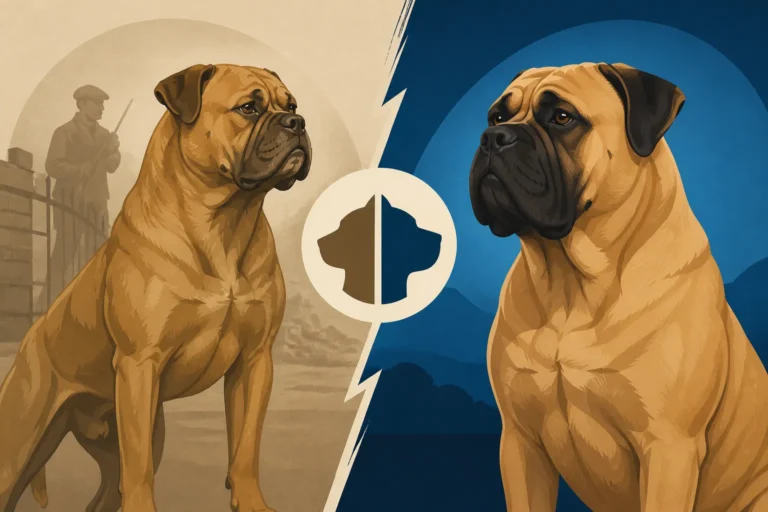
A Bullmastiff with little or no visible black mask can raise an uncomfortable question for an owner: is the dog still allowed in a conformation show, or will a judge dismiss it? The answer depends on the show’s rules and the dog’s appearance, but a missing mask does depart from the breed standard. Here’s how to understand the distinction between being eligible to enter and meeting the standard in the ring.
What the Bullmastiff black mask means
It is a facial marking, not a separate coat color
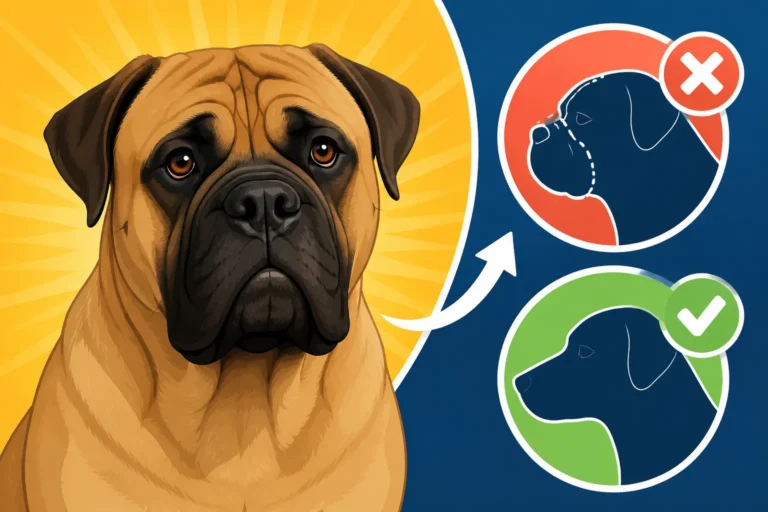
Bullmastiffs come in fawn, red, and brindle. The black mask is a dark marking on the muzzle and around the eyes; it does not turn the dog’s entire face or body black. A mask can look bold and clearly defined, or softer and less dramatic, depending on the individual dog’s coloring. The breed’s permitted coat colors are covered in Fawn, Red or Brindle: the Only Colors a Bullmastiff Comes In.
The mask matters because it is part of the breed’s expected appearance, not because it changes the dog’s personality or makes the dog more of a Bullmastiff. It can help give the face the characteristic expression many people associate with the breed, but a dog’s temperament should be assessed on its own—not guessed from the darkness of its markings. For more on that distinction, see Whether Coat Color Predicts a Bullmastiff's Temperament.
A pale face is not always a truly maskless face
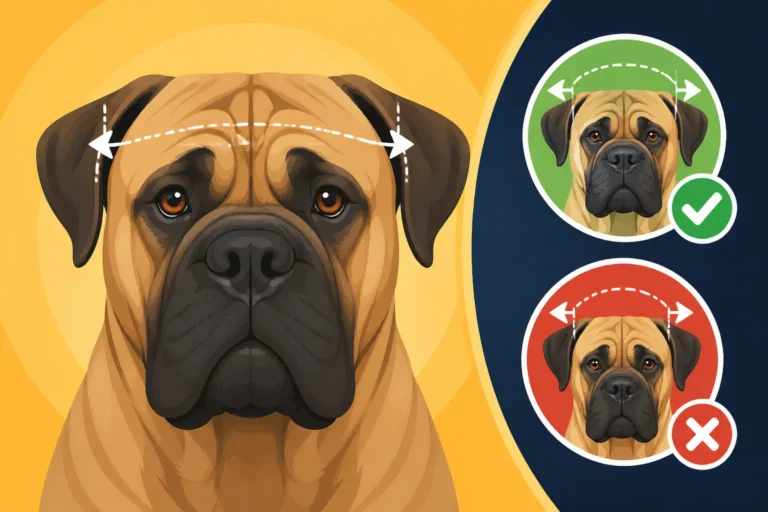
Owners sometimes use “maskless” to describe several different appearances. A Bullmastiff may have a dark muzzle but lighter markings around the eyes, a mask that blends into a red or brindle coat, or a mask that is simply less striking than expected. Those are not necessarily the same as having no dark facial mask at all.
Lighting and photographs can also be misleading. A sunlit picture may wash out dark markings, while shadows can make the muzzle look darker than it is. If show eligibility is the concern, assess the dog in ordinary, even light and compare its markings with the relevant breed standard. What a Bullmastiff's Black Mask Should Look Like offers a useful description of the feature to look for.
The mask is separate from the dog’s underlying health
A light or absent mask does not, by itself, tell you whether a Bullmastiff is healthy. It also does not establish anything about the dog’s pedigree, parentage, or quality as a companion. Conformation judging evaluates a dog against a written standard; it is not a general verdict on the dog’s worth or suitability for family life.
If you are choosing a puppy, focus on the whole picture: health information, temperament, responsible breeding practices, and the breeder’s willingness to answer questions. A facial marking alone cannot substitute for those checks. The breed standard’s expectations for the mask are explained further in The Black Mask Every Bullmastiff Must Have.
Can a maskless Bullmastiff enter a show?
Entry eligibility is not the same as matching the standard
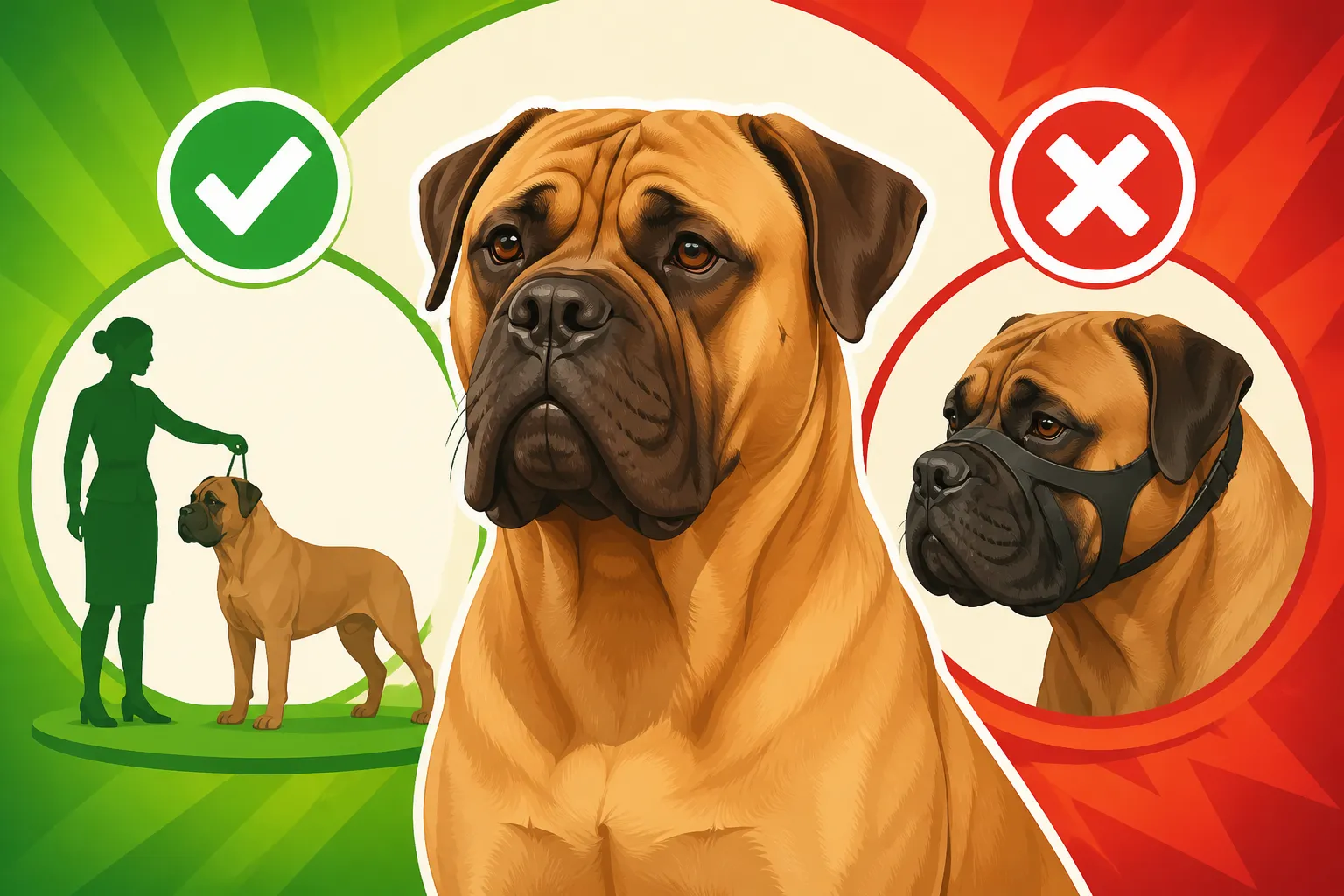
In many conformation settings, a dog can be eligible to enter even if it has a feature that does not closely match the breed standard. Entry requirements and judging criteria are different things. A dog may be accepted into a class, then assessed against the standard alongside the other dogs.
That distinction is important: “Can I enter?” and “Will a judge consider this dog a strong example of the breed?” are not identical questions. A missing or very weak mask may count against the dog in the ring because the standard describes the black mask as essential. But that does not automatically mean every show will refuse the entry. The show’s governing organization, class rules, and breed standard determine the specific requirements.
| Question | What it means | What to check |
|---|---|---|
| Can the dog be entered? | Whether the event accepts the dog in that class | Entry rules and registration requirements |
| Does the dog match the standard? | How closely its features align with the breed description | The standard used by that registry |
| How much will the mask matter? | How the judge weighs the feature in the full assessment | The wording of the standard and the judge’s evaluation |
| Is the dog suitable for breeding? | A broader decision involving health, temperament, and other factors | Advice from qualified breed and veterinary professionals |
Before paying an entry fee or making plans, contact the show organizer or the relevant breed club. Ask which Bullmastiff standard applies and whether the dog’s particular appearance affects entry. If possible, describe the markings clearly or ask an experienced Bullmastiff exhibitor to look at the dog in person.
A missing mask is a breed-standard concern, not a reason to assume automatic disqualification
The word “essential” in a breed description signals that the feature is important. It does not necessarily mean that every dog lacking it is automatically barred from every event. Standards and event rules are not interchangeable, and the effect of a deviation can vary with the wording used by the organization.
A judge’s task is to evaluate the dog as a whole while considering the breed standard. A maskless appearance can be a meaningful departure, but judging is not always a simple pass-or-fail checklist in which one trait alone determines the outcome. The judge may consider overall type, movement, structure, condition, and other characteristics as well.
For that reason, it is safer to avoid categorical claims such as “a maskless Bullmastiff can never be shown” or “the mask never matters.” The practical answer is narrower: the dog may be able to enter, but a clearly absent mask is likely to be a disadvantage in a conformation evaluation. The standard’s expectations are also discussed in Why a Bullmastiff Must Have a Black Mask.
How to assess your Bullmastiff’s mask
Look at the dog in natural, even light
Start by checking the face in daylight without harsh sun or deep shadows. Look at the muzzle and the area around the eyes, rather than relying on a single photograph. A mask may be subtle and blend with the surrounding coat, especially in a dog whose coloring is not sharply contrasting.
If you are unsure, take a few clear photographs from the front and side in consistent lighting. Then ask a knowledgeable Bullmastiff breeder, breed-club member, or experienced exhibitor for an opinion. Someone familiar with the standard can often distinguish a weak mask from a genuinely absent one more reliably than an owner looking at a puppy’s face every day.
Consider age and changes in appearance
Puppies can change as their coats develop, so an early photograph may not show exactly how the adult dog will look. That does not mean a missing mask will necessarily appear later, or that a faint one will become strongly defined. Avoid making a show or breeding decision on the assumption that the dog’s markings will change in a particular way.
Age can also affect facial appearance. Dark areas may look less pronounced as a dog’s face grays, and coat changes can alter the contrast between the mask and the rest of the head. For related information, see How a Bullmastiff Puppy's Color Changes and When a Bullmastiff's Mask Starts Going Gray. If you are assessing a young dog for a future show, ask an experienced person to evaluate its current features rather than treating possible future changes as a guarantee.
Separate show goals from everyday ownership
It is understandable to feel disappointed if you hoped to show a dog and later learned that one feature may count against it. Still, a conformation result does not decide whether the dog is loving, healthy, trainable, or a wonderful companion. Many people enjoy dog shows as a hobby, but a dog does not need a show title to be a valued member of the household.
If showing remains important to you, get an informed opinion before entering and confirm the rules with the event organizer. If the dog is not a close match for the standard, you may decide that entering is still worthwhile as a learning experience—or that you would rather enjoy other activities with your Bullmastiff. Both are reasonable choices.
Practical steps before entering
Confirm the rules with the right people
Use this sequence to avoid spending time and money based on a guess:
- Identify the registry or show organization. Different events may use different standards or entry requirements.
- Read the Bullmastiff standard used by that event. Find the section describing color and facial markings.
- Ask the show organizer about entry eligibility. Be specific that the dog has a weak or absent mask.
- Get an experienced visual assessment. A breeder or exhibitor familiar with the breed can help you describe what you are seeing.
- Decide what you want from the event. A first show can be useful experience even when winning is not the main goal.
If you plan to show regularly, build a relationship with local breed-club members and attend events as a spectator first. Watching how Bullmastiffs are presented and evaluated can make the written standard easier to understand. It also gives you a chance to ask questions before committing to an entry.
Keep the dog’s welfare and confidence in view
Show preparation should be comfortable and positive for the dog. Help your Bullmastiff get used to being examined, standing briefly, walking on a lead, and spending time around unfamiliar people and dogs. Do not punish or pressure the dog over a facial marking that cannot be trained or altered.
If the dog seems uncomfortable in a crowded environment, take a break or leave. A show is optional; your Bullmastiff’s wellbeing is not. And if your interest is in breeding, do not base that decision on appearance alone. Seek appropriate veterinary guidance and learn what health screening and responsible breeding involve. A show result—or a judge’s opinion of the mask—cannot replace those considerations.
Ultimately, a Bullmastiff with no visible black mask may be able to enter some conformation events, but the missing feature is a departure from the breed standard and can count against the dog in judging. Confirm the particular show’s rules, get an informed assessment of the dog’s markings, and remember that show suitability is only one small part of what makes a Bullmastiff a good companion.
Disclaimer
This article is for general informational purposes only and does not constitute professional advice. Laws, prices and regulations vary by location and change over time. Consult a qualified professional for guidance on your specific situation.