Why the Bullmastiff Standard Stops Short of Mastiff Height
A Bullmastiff can look enormous beside most dogs, yet its breed standard sets a lower height range than the English Mastiff’s. That difference is intentional: the Bullmastiff was developed as a powerful, mobile estate dog, not simply a taller version of a Mastiff. This guide explains what the height limits mean, why they matter, and how to judge a Bullmastiff’s build beyond the tape measure.
What the Bullmastiff height standard says
How tall a Bullmastiff is expected to be
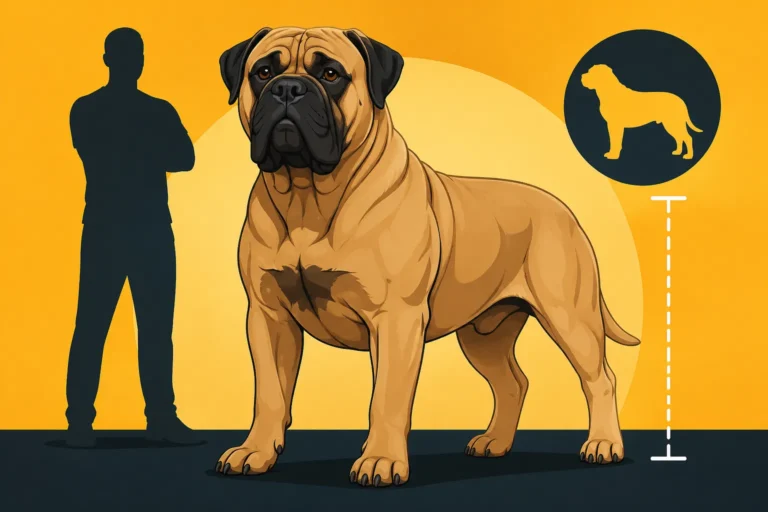
In the American Kennel Club standard, adult male Bullmastiffs stand 25 to 27 inches at the shoulder, while adult females stand 24 to 26 inches. The measurement is taken from the ground to the highest point of the shoulder blades, not to the top of the head. A dog may look taller when alert, standing on uneven ground, or carrying its head high, but those details don’t change the formal measurement.
The height range works alongside a weight range: males are generally described as 110 to 130 pounds, and females as 100 to 120 pounds. That combination matters. A Bullmastiff is meant to be substantial and muscular, but the standard doesn’t ask for height at any cost. A tall, narrow dog and a shorter, heavily built dog can both fall short of the intended balance in different ways. For a closer look at the measurements together, see How Tall a Bullmastiff Stands and How Much a Bullmastiff Weighs.
Height is also only one part of a breed standard. A show judge evaluates the whole dog, including proportion, movement, muscle, head, temperament, and soundness. A dog at the top of the height range isn’t automatically better than one nearer the middle. Nor does standing at the maximum height make a dog more representative if its structure or movement is poor.
How that compares with the Mastiff
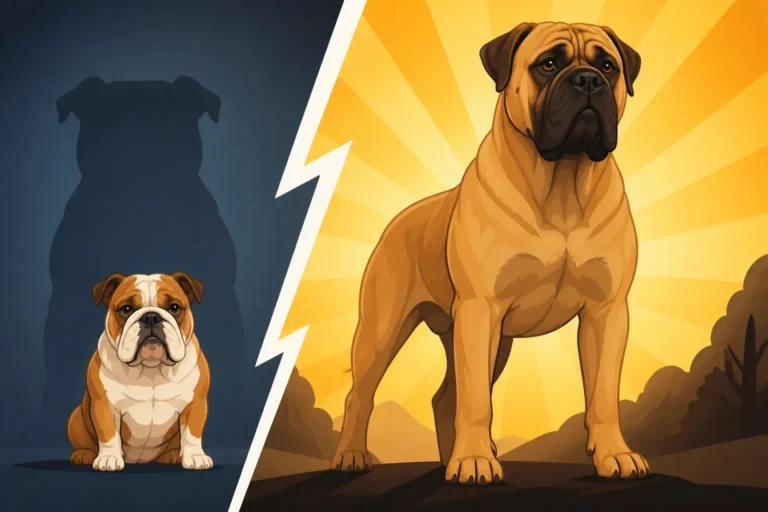
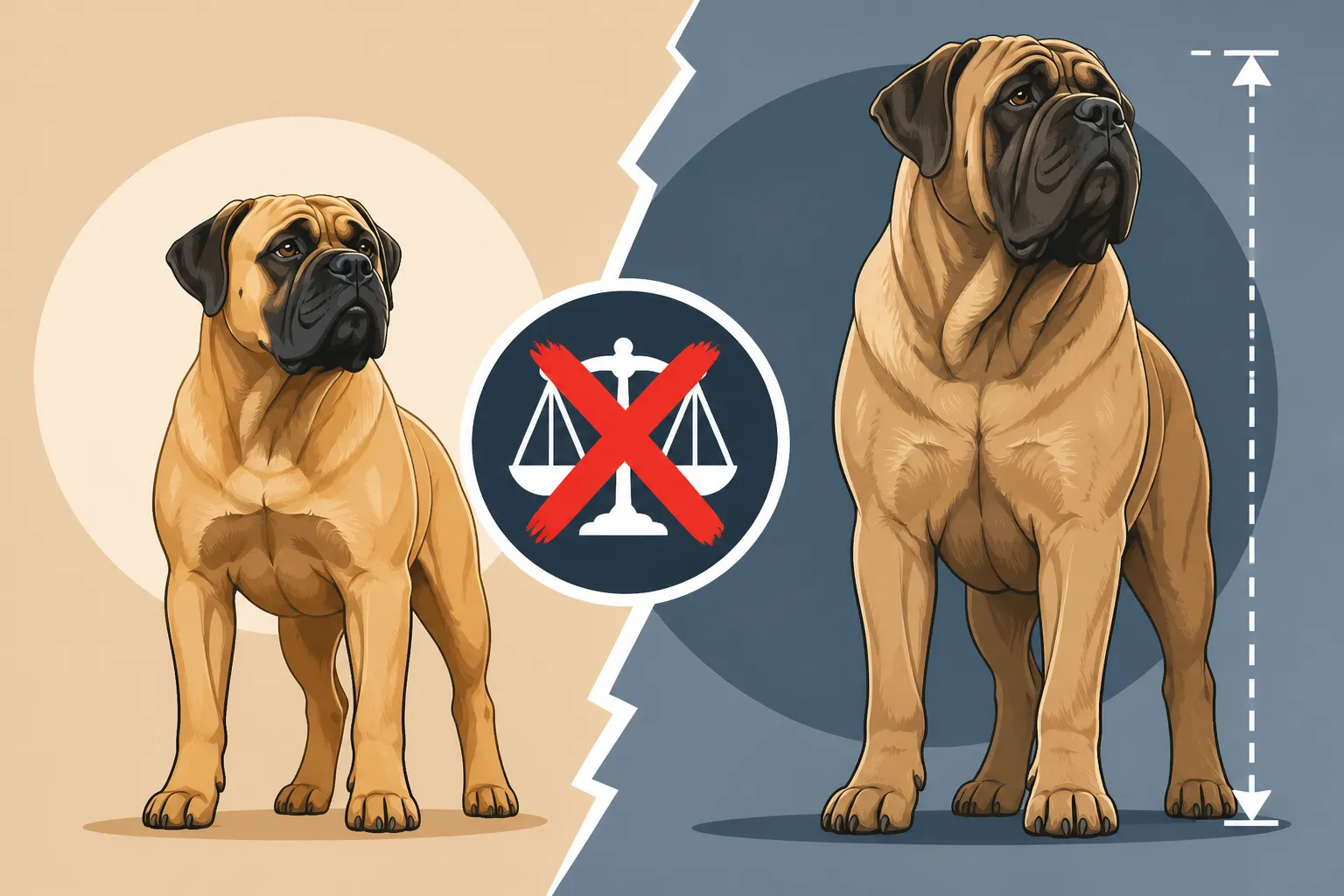
The English Mastiff’s height standard is higher. Under the AKC standard, adult males are at least 30 inches at the shoulder, and adult females are at least 27.5 inches. Those figures describe a different breed with a different overall outline and history. A Bullmastiff may be heavy and imposing, but it is not supposed to match a Mastiff’s height.
| Breed | Typical AKC height guidance | What the comparison means |
|---|---|---|
| Bullmastiff male | 25 to 27 inches | A compact, powerful working mastiff |
| Bullmastiff female | 24 to 26 inches | Slightly smaller in the standard, but still strongly built |
| English Mastiff male | At least 30 inches | A taller breed with a different standard and outline |
| English Mastiff female | At least 27.5 inches | Taller minimum height than the Bullmastiff range |
These figures are not a promise that every individual dog will look exactly alike. Age, sex, genetics, condition, posture, and the way a dog is measured all affect what an owner sees. Breed standards also come from specific kennel organizations, so wording and measurement details can vary by country. If you’re comparing a dog with a show standard, check which organization’s standard is being used.
It’s easy to assume that a taller dog is automatically a more impressive or more desirable one. In practice, the Bullmastiff standard favors a specific kind of presence: broad, powerful, and substantial without the extra height associated with the English Mastiff. The distinction is part of what makes the Bullmastiff its own breed, rather than a smaller example of another one. The article How the Bullmastiff Differs From a Mastiff explores more of those differences.
Why the Bullmastiff standard stops short
The breed was built for a particular job
The Bullmastiff’s history helps explain its proportions. The breed is associated with English gamekeepers who needed a dog able to patrol estates and apprehend poachers. The dog needed power and courage, but it also needed to move across ground and respond to a fast-changing situation. A very tall, heavy body would not necessarily make that job easier.
That history isn’t a claim that every modern Bullmastiff is a working dog, or that every historical dog looked identical to today’s breed. It does help explain why the standard describes a strong, athletic animal rather than rewarding maximum size. The ideal is not simply “more dog.” It is a dog whose strength, balance, and movement work together. For more background on the original role, see The Bullmastiff Was Built to Catch Poachers in the Dark.
A taller dog can be impressive when standing still, but height alone says little about whether it can move comfortably or efficiently. The Bullmastiff was meant to have enough substance to hold and control, with enough mobility to cover ground. That balance helps explain why the standard doesn’t chase the height of a Mastiff. Why a Bullmastiff Was Bred Light Enough to Run looks more closely at that working balance.
Why not just breed a bigger Bullmastiff
Breeding for height alone can shift more than a dog’s silhouette. It may affect proportions, leverage, movement, and the physical demands placed on joints. A taller dog is not necessarily unhealthy, and a dog near the top of the standard is not automatically unsound. The concern is the idea that bigger must always be better, regardless of how the dog is put together.
A responsible standard gives breeders and judges a shared description of the breed’s intended type. It can help discourage a trend toward extremes, whether that means excessive height, excessive weight, or a body that looks powerful but moves poorly. The aim is not to make every Bullmastiff identical; it is to preserve recognizable structure and function while allowing for normal variation.
This is particularly relevant for a breed already known for its large frame. Adding height without considering the rest of the dog could produce a Bullmastiff that looks dramatic in a photo but is less balanced in everyday movement. The practical question is not merely “How tall is the dog?” but “Does its height fit its frame, and can it move comfortably?” The linked article Why a Mastiff Alone Was Too Slow for the Job offers related historical context on why the Bullmastiff’s development did not simply favor the largest possible body.
How height fits into the Bullmastiff’s overall build
Height is not the same as size or substance
People often use “big” to mean several different things: tall, heavy, broad, muscular, or simply imposing. Those traits don’t always go together. A Bullmastiff can be relatively short compared with an English Mastiff and still be a very heavy, deep-bodied dog. Its broad chest, substantial bone, muscular neck, and large head contribute to the impression of size as much as its height does.
That’s why a scale reading or a quick glance at the shoulder doesn’t tell the whole story. A dog’s weight should be considered alongside its condition and structure. A heavy dog may be muscular, overweight, or simply built on a large frame; those are not interchangeable. For a more detailed look at what the breed’s weight can mean in context, see A Hundred and Thirty Pounds of Bullmastiff, Measured.
Proportion is another part of the picture. The Bullmastiff should look powerful without appearing awkward or excessively coarse. The body, legs, chest, and head need to read as parts of one balanced animal. A dog may meet the height range but still have proportions that don’t match the breed’s intended outline. Whether a Bullmastiff Should Look Square explores that outline in more detail.
What owners should look for at home
For a pet owner, the standard is useful background, not a daily scorecard. You don’t need to measure your dog repeatedly to prove it is the right height. What matters more in everyday life is whether the dog moves comfortably, maintains a healthy body condition, and can manage normal activities without obvious strain. If you have concerns about growth, weight, or movement, your veterinarian can assess your individual dog.
Puppies also change quickly, and a young Bullmastiff can look temporarily out of proportion as different parts of the body grow at different rates. A puppy with long-looking legs one month may look more substantial later. Comparing a growing dog with a finished adult—or trying to predict adult size from one snapshot—can create needless worry. Ask your breeder or veterinarian about your dog’s growth and condition rather than trying to force a puppy toward a particular height or weight.
If you are choosing a puppy, look beyond claims that one is “the biggest” or “the tallest.” Ask about the parents’ structure, movement, health screening, and temperament. A reputable breeder should be able to talk about the dogs as individuals, not just advertise size. If you’re considering a dog that appears unusually tall or heavy, Whether an Oversized Bullmastiff Can Be Shown can help clarify how a standard relates to showing—but it’s still worth separating show eligibility from health and suitability as a companion.
What the height limit means for judging and ownership
A standard is a guide, not a health diagnosis
A breed standard describes the desired type for a breed, especially in the context of judging and breeding. It does not diagnose a dog’s health or determine whether that dog will be a good companion. Falling a little outside a height range does not, by itself, tell you how healthy, comfortable, or well behaved an individual dog is.
Likewise, meeting the height range doesn’t guarantee good health. A Bullmastiff can be within the standard and still need veterinary care, appropriate exercise, weight management, and routine screening. The standard is one reference point among many, not a substitute for evaluating the dog in front of you.
When a dog is measured, small differences can come from posture, uneven flooring, measurement technique, or the dog’s willingness to stand square. If the result matters for a show or breeding decision, have an experienced person measure the dog correctly. For everyday ownership, a small measurement difference is usually less useful than observing how the dog walks, rises, plays, and rests.
Why size claims deserve a closer look
Words such as “giant,” “extra-large,” or “oversized” can sound appealing, especially to someone who wants a particularly imposing dog. But these are not automatically signs of superior breeding. A breeder who puts all the emphasis on exceptional height or weight may be selling an image rather than explaining how the dogs are bred for soundness, temperament, and health.
Ask specific questions instead. How do the parents move? What health evaluations have they had? What is their temperament like in ordinary situations? Does the breeder discuss the limits of the breed and the work involved in raising a large dog? Those answers are more useful than a promise that a puppy will outgrow the standard.
If you already own a Bullmastiff who is taller or smaller than expected, there is no need to label the dog a failure. The standard describes a desired range; it doesn’t change your dog’s individual needs or value as a companion. A dog’s comfort, care, and relationship with its family matter far more at home than whether it would be an ideal show-ring example. You can also read Whether a Small Bullmastiff Is Faulted for another perspective on how standards are applied to size.
Disclaimer
This article is for general informational purposes only and does not constitute professional advice. Laws, prices and regulations vary by location and change over time. Consult a qualified professional for guidance on your specific situation.