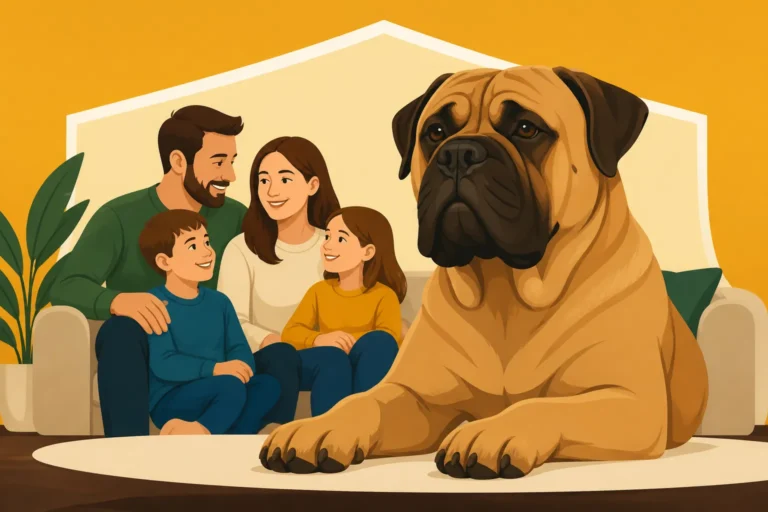
How a Bullmastiff Ends Up in Breed Rescue
A Bullmastiff usually ends up in breed rescue because a person’s circumstances change, the dog’s needs outgrow the home, or a shelter needs help placing a large, powerful breed. That does not automatically mean the dog was abused or dangerous. This guide explains the common routes into rescue, what happens next, and how to assess a Bullmastiff before adopting.
The common routes into Bullmastiff rescue
An owner can no longer manage the dog’s needs
A Bullmastiff may be surrendered when an owner’s health, housing, finances, or family situation changes. A move to housing that restricts large dogs, a new baby, a divorce, or the death of the person who cared for the dog can all make a previously stable home impossible. Sometimes the owner still loves the dog but cannot safely handle a strong animal or meet its daily needs.
Size can turn ordinary problems into difficult ones. A dog that pulls toward another dog, struggles to get into a car, or needs help standing may be manageable for one household and overwhelming for another. In a small apartment, a Bullmastiff’s bulk, drool, and need for cool indoor space may also become harder to accommodate. A family facing these realities may contact a rescue before the situation becomes an emergency.
Financial pressure can matter, too. Food, routine veterinary care, medications, and unexpected treatment can be substantial expenses for a giant breed. When costs collide with job loss or a major household bill, some owners look for a placement that can provide ongoing care. That is one reason it helps to understand What a Bullmastiff Costs Over Its Lifetime before bringing one home.
A shelter or animal-control agency asks for breed-specific help
Some Bullmastiffs arrive at a shelter as strays, are found wandering, or are taken in after an animal-control call. If no owner comes forward, a shelter may contact a breed rescue or a volunteer with experience handling large dogs. Breed-specific volunteers can often offer a more suitable foster setting and a better-informed assessment than a crowded shelter can provide.
A Bullmastiff’s appearance may also complicate identification. A dog may be described as a Mastiff mix, a Boxer mix, or simply a large brindle dog, especially if its history is unknown. Breed rescue groups may help assess whether the dog is likely to be a Bullmastiff or a mix and whether their foster network is equipped for its needs. Identification is not always certain, so a rescue may describe the dog as a possible Bullmastiff rather than make a firm claim.
Rescue is not a single, standardized system. One organization may take direct owner surrenders; another may pull dogs from municipal shelters; some do both. If you are trying to understand the process in your area, Where Bullmastiff Rescues Operate can help you think about what kinds of organizations to look for and what services may differ.
Why a Bullmastiff may need a new home
A mismatch in training, handling, or household expectations
A Bullmastiff can be quiet and affectionate at home, but its size means basic manners matter. A dog that jumps up, barges through a doorway, or pulls hard on leash can be difficult to manage, even if it has no history of aggression. If training did not begin early or was inconsistent, an owner may feel unable to cope once the dog reaches adult size.
A mismatch can also develop between the dog and other animals. Some Bullmastiffs live well with other dogs, while others may struggle with particular dogs, especially in close quarters. A household may discover that its dog cannot safely share space with a resident pet, or that managing separate areas is more than the family can sustain. Rescue staff will often ask specific questions about the dog’s behavior rather than assume every Bullmastiff will fit the same home.
Children and visitors can add another layer. A dog may be friendly but clumsy, excitable, or uncomfortable with handling. An owner may decide that careful supervision is no longer realistic after a change in household routine. A rescue’s job is not to label every placement problem as a “bad dog” problem; it is to learn what has happened and identify a home that can manage the dog safely. Prospective adopters can also review Whether a Bullmastiff Suits a Family and Whether a Toddler Is Safe Around a Bullmastiff's Bulk when considering household fit.
Health needs, aging, or an unexpected life change
Medical needs can lead to surrender when a dog requires ongoing treatment, mobility support, or frequent appointments that the owner can no longer provide. An older Bullmastiff may need help rising, a non-slip path across a slippery floor, or a car ramp for veterinary visits. A young dog may need treatment for an injury or a condition that was not apparent when it was first adopted.
Health history is not always complete when a dog enters rescue. Shelter records may be limited, previous veterinary records may be unavailable, and a dog found as a stray may have no known background. Rescuers may arrange an examination and share what they learn, but an initial check cannot reveal every condition. Ask what has been assessed and what still needs follow-up. For example, Whether a Rescue Bullmastiff's Heart Has Been Checked is a useful question to raise, particularly if the history is unclear.
A life change can happen quickly, while finding an appropriate placement can take time. A responsible owner may work with a rescue to arrange a planned surrender rather than leave the dog with someone unprepared. If you are also comparing adoption with purchasing, remember that a rescue dog’s known history, support needs, and medical follow-up can differ from one case to another. Adopting a Bullmastiff From Rescue offers a related starting point for thinking through that decision.
What happens after a Bullmastiff enters rescue
Intake, foster care, and assessment
When a rescue accepts a dog, volunteers generally gather as much history as possible: age, prior homes, veterinary care, behavior around people and animals, training, and any known triggers. The rescue may also ask why the dog is being placed and what has or has not worked. Honest detail is valuable. Saying that a dog is uncomfortable around unfamiliar dogs, for instance, helps a foster family plan introductions safely.
The dog may then stay in a foster home, a boarding setting, or another temporary placement. A foster home can reveal things that are hard to judge in a shelter: whether the dog settles indoors, how it behaves when left alone, whether it is house-trained, and how it responds to everyday sounds. These observations are helpful, but they are still a snapshot. A dog may act differently after moving again, once it has settled, or in a new environment.
Rescues may arrange veterinary care, vaccinations, identification, or treatment based on the dog’s needs and available records. They may also evaluate handling, leash skills, and compatibility with other animals. An assessment is not a guarantee that the dog will behave identically in every home. It is a way to give adopters a more informed picture and to match the dog with a realistic household.
Why a dog’s history may be incomplete
A rescue may know the dog’s most recent home but not its full history. Previous owners may have moved without passing along records, or the dog may have changed hands several times. A stray dog’s age, training background, and medical history may be uncertain. Even when an owner provides information, it is usually a description rather than a complete account of every situation the dog has encountered.
Age estimates can be imperfect, especially when a dog’s records are missing. A veterinarian may estimate age from physical signs, but that is not the same as knowing a birth date. Ask whether the age is documented or estimated, and what the estimate is based on. The guide Whether a Bullmastiff's Age Is Known can help frame that conversation.
It is also reasonable to ask what the rescue has not been able to confirm. For instance: Has the dog lived with cats, or is that unknown? Has the dog been left alone for a full workday? Has it ever had a complete veterinary history? Clear answers—including “we don’t know yet”—are more useful than broad assurances. For related background on what records and health information to discuss, see What Health Results a Bullmastiff Breeder Should Show; although it concerns breeders, the questions about documentation and transparency are useful points of comparison.
| What to ask the rescue | Why it matters | What a helpful answer might include |
|---|---|---|
| Why did the dog enter rescue? | Circumstances may explain the dog’s needs or behavior | Owner surrender, shelter transfer, stray intake, or another known route |
| What is known about the dog’s health? | Follow-up care may be needed after adoption | Veterinary records, recent examination, medications, and unresolved concerns |
| How does the dog behave around other animals? | Compatibility affects household safety and planning | Specific observed behaviors and whether introductions have been attempted |
| What is known about training and time alone? | The transition may involve house-training or separation support | What foster carers have observed and what remains untested |
| What support is available after adoption? | A new home may need help during adjustment | Contact process, return policy, or guidance for common transition issues |
How to decide whether a rescue Bullmastiff is right for you
Ask practical questions and look for specific answers
Before adopting, ask about the dog’s daily routine, behavior on leash, comfort with handling, experience around children, and reactions to other dogs. Ask what the foster family has seen directly and what comes from an earlier owner’s account. There is a meaningful difference between “the dog has lived with a cat for years” and “the dog has not yet been tested with cats.”
Discuss health care in concrete terms. Ask for the records the rescue has, whether the dog is taking medication, whether a veterinarian has recommended follow-up, and whether there are known mobility or breathing concerns. If the answer is incomplete, find out how you can arrange an independent veterinary examination and what information will be transferred. A rescue adoption may involve an adoption fee, but the fee does not tell you everything about what care the dog has received. What a Bullmastiff Rescue Adoption Fee Covers and What a Bullmastiff Rescue Charges are relevant reads when you want to understand the financial side without assuming every organization handles costs the same way.
Be candid about your own limits. If you live in a walk-up, have a small vehicle, work long hours, or have another dog, say so. A good match depends on fit, not on persuading a rescue that your home can manage every dog. A rescue may recommend a different Bullmastiff, ask for additional preparation, or decide that a particular placement is not appropriate. That can be disappointing, but it is better than creating a second disruption for the dog.
Prepare for settling in rather than expecting instant gratitude
A rescue Bullmastiff may be affectionate from the first day, or it may need time and quiet before showing its usual personality. Moving homes can disrupt sleep, appetite, house-training, and confidence. Keep the first days predictable: provide a calm resting place, use a secure leash and well-fitted equipment, and avoid overwhelming the dog with visitors or busy outings.
Set up the home for a large dog before arrival. Check that the dog can move comfortably through doorways, reach a suitable resting area, and get outside without navigating slippery floors or steep stairs it cannot manage. Store food securely and establish consistent meal and walking routines. If you need a familiar food or basic supplies while arranging the transition, retailers such as Chewy may be one option to check, but follow the rescue or veterinarian’s guidance when changing food or managing a medical diet.
Give the dog time to learn household expectations without relying on force. Reward calm behavior, keep early training sessions manageable, and use barriers or separate rooms where introductions need to be gradual. If the rescue recommends a qualified trainer or veterinary assessment, treat that advice as part of the placement plan rather than a sign that adoption has failed. Chewy may also be useful for routine supplies such as a sturdy bed or cleaning products, while the rescue can tell you which items the dog already knows. A slow transition, clear communication, and realistic expectations help reduce avoidable stress for everyone.
Disclaimer
This article is for general informational purposes only and does not constitute professional advice. Laws, prices and regulations vary by location and change over time. Consult a qualified professional for guidance on your specific situation.