Whether a Reverse Brindle Bullmastiff Is Standard
A reverse brindle Bullmastiff can look almost black from across the yard, which makes it easy to wonder whether the coat is outside the breed standard. The key is the pattern: reverse brindle is still brindle, not a separate recognized color. This guide explains what the term means, how standards treat the pattern, and what to check when assessing a puppy or adult dog.
What reverse brindle means on a Bullmastiff
Brindle is a coat pattern, not a single shade
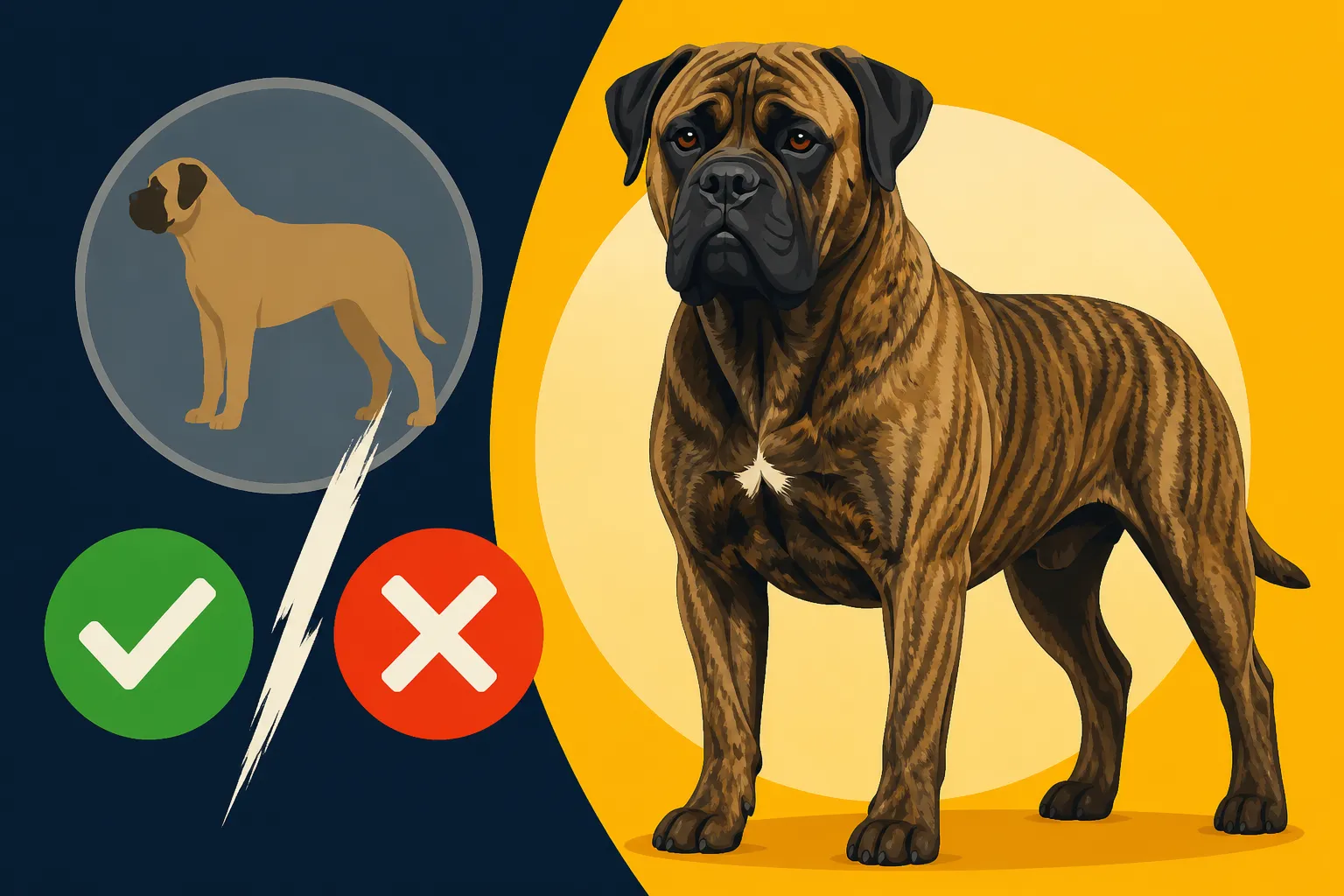
A brindle coat has darker stripes or streaks over a lighter background. On a Bullmastiff, the background may be fawn, red, or another shade, while the darker markings range from subtle to pronounced. The pattern can be fine and close together or broad enough to make the dog look dark overall.
“Reverse brindle” is a familiar descriptive term for a dog whose dark striping is so dense that it visually dominates the lighter background. It can be hard to see the lighter base color at first glance, especially on the shoulders, back, and sides. In brighter light, or when you look closely at the coat, the brindle pattern may become easier to distinguish.
The word “reverse” does not mean the dog has a separate coat color or a different kind of brindle. It describes how the pattern appears to the eye. That distinction matters if you are comparing a dog with a written breed standard, because standards generally list brindle rather than treating reverse brindle as its own category. For a wider overview of accepted coat colors, see Which Colors a Bullmastiff Comes In.
Why a reverse brindle can look nearly black
When dark markings cover much of the visible coat, the dog can look black at a distance or in a photograph. Shadow, indoor lighting, a phone camera, and the angle of the coat can exaggerate that impression. A Bullmastiff may appear almost solid dark in one picture and clearly striped in another.
Look at more than one area of the body. The brindle may show most clearly on the sides, legs, or shoulders, while the back appears darker. A photo taken in direct sun can also wash out the lighter areas, while a dim indoor photo can swallow them entirely. If you are evaluating a puppy, ask to see clear photographs in natural light and, if possible, see the dog in person.
Coat color can also shift in how it looks as a dog grows. Puppies may develop a more defined appearance as their coat changes, and individual markings may be easier to see at some ages than others. A breeder can describe what they have observed in the puppy and its relatives, but avoid treating a single early photo as a definitive guide to the adult coat.
How reverse brindle differs from other colors
The easiest way to separate the terms is to think of brindle as the pattern and fawn or red as possible descriptions of the lighter ground color. Reverse brindle describes a high-contrast visual effect, where dark markings dominate. It is not the same as a uniformly black coat, and it should not be confused with a solid-colored dog simply because the pattern is difficult to see.
| Coat description | What it generally describes | How it may look |
|---|---|---|
| Fawn | A lighter tan or golden ground color | The body may look relatively light |
| Red | A deeper reddish ground color | The coat may appear warm or rich in tone |
| Brindle | Dark stripes over a lighter ground color | Both the stripes and ground color are visible |
| Reverse brindle | Brindle with dense, visually dominant dark markings | The dog may look very dark until you inspect the coat closely |
| Solid black | A coat that appears uniformly black rather than visibly brindled | Does not describe a brindle pattern |
This table is a practical description, not a substitute for a registry’s exact wording. Breed standards and judging rules are written by the relevant kennel organization, so check the standard used where the dog will be registered or shown. To compare the broader color terms, Fawn, Red or Brindle: the Only Colors a Bullmastiff Comes In explains how the breed’s main color descriptions are used.
Is a reverse brindle Bullmastiff standard
The pattern is generally included under brindle
A reverse brindle Bullmastiff is generally considered standard in color when the coat is genuinely brindle. The standard typically lists brindle as an accepted color; it does not need to list every visual variation of brindle separately. Since reverse brindle describes a dense or dark-looking brindle pattern, the label itself does not make a dog nonstandard.
That does not mean every dog with a dark coat is automatically a reverse brindle. The relevant question is whether the coat shows a brindle pattern, even if the pattern is subtle. When a dog looks uniformly black in person as well as in photographs, ask a knowledgeable breeder or breed specialist to assess the coat rather than relying on the label used in an advertisement.
There can be small differences in wording between breed organizations and countries. If you are buying a puppy as a companion, the practical point is that “reverse brindle” is a descriptive term, not a separate breed-recognized color category. If you intend to show the dog, consult the current standard and rules of the organization where you plan to compete, and ask an experienced Bullmastiff breeder or judge how that organization applies them.
Color does not replace the rest of the standard
A Bullmastiff’s coat color is only one part of its overall assessment. The breed standard also describes structure, movement, proportions, head, expression, and other features. A striking reverse brindle pattern cannot make up for unrelated structural faults, and a less dramatic coat does not make an otherwise excellent dog less worthy as a companion.
Bullmastiffs are expected to have a black mask, which gives the face its characteristic dark appearance. That facial mask is separate from the brindle pattern on the body. For a closer look at this feature, see The Black Mask Every Bullmastiff Must Have. If you are comparing puppies, pay attention to the whole dog rather than letting coat contrast become the only thing you notice.
White markings are another detail people often ask about. Breed standards may allow a small white mark on the chest, while extensive white markings or other unusual features may be assessed differently under a particular registry’s rules. Do not assume that every marking means a dog is unhealthy or that every dark coat is a fault. For questions about a specific dog, the exact standard and an informed in-person assessment matter more than a color name in a listing.
Showing, registration, and companion ownership are different questions
A dog can be a wonderful family companion whether or not it is considered ideal for the show ring. Show eligibility depends on the relevant organization’s written rules and the dog’s overall conformation, not simply on whether an owner calls its coat “reverse brindle.” Registration paperwork and show classification are also separate matters: confirm any registry questions directly with the breeder or the relevant kennel organization.
If you are choosing a puppy, it is reasonable to ask the breeder how they describe the coat and whether the puppy’s registration documents use a particular color designation. A responsible breeder should be able to explain the terminology without making exaggerated claims such as “rare means better” or implying that coat color predicts temperament, health, or quality.
For a broader sense of how the breed standard describes the dog’s shape and proportions, A Hundred and Thirty Pounds of Bullmastiff, Measured offers useful context. Color is one visible trait, but a healthy, well-raised dog and a good match for your household should carry much more weight in your decision.
How to assess a reverse brindle coat in real life
Examine the coat in natural light
Start by looking at the dog outdoors or near a bright window, where the light is even. Check the sides, legs, shoulders, and chest rather than judging from the darkest part of the back. Move around the dog and look from different angles. Brindle markings can appear to vanish in shadow and reappear when the coat catches the light.
If you are meeting a puppy, ask to see its littermates and, when possible, the parents. This can help you understand the range of patterns in that family, though it does not guarantee exactly how an individual puppy’s coat will look as an adult. Ask the breeder to describe what they see rather than prompting them to confirm a particular label.
When buying remotely, request several recent photographs or a short video in natural light. A listing photo with heavy contrast or warm indoor lighting can make the coat look very different from what you see in person. It is perfectly fair to ask, “Can you show me the brindle markings in daylight?” A clear answer is more useful than a sales phrase about a rare or unusually valuable color.
Keep coat care simple and consistent
A Bullmastiff’s short coat usually does not require elaborate grooming, but brushing helps remove loose hair and gives you a chance to notice changes in the skin or coat. A soft brush or grooming mitt is often enough for routine care. If you are assembling basic supplies, Chewy may be one place to compare common grooming tools, but choose an item that feels comfortable for your dog and suits its coat.
During brushing, look for irritation, scabs, bumps, or areas where the hair seems to be thinning. A change in coat appearance is not automatically a color-standard issue. If you notice persistent itching, redness, odor, or a new skin problem, ask your veterinarian rather than trying to diagnose it by appearance alone. For routine coat-care guidance, Why a Bullmastiff's Coat Takes Ten Minutes a Week covers the breed’s basic grooming needs.
Use a gentle, dog-appropriate shampoo only when a bath is needed, and rinse thoroughly. A reverse brindle coat does not require special color-enhancing products. Avoid using dye or cosmetic treatments to make the markings seem darker or more dramatic; those products can irritate skin and do not change whether a coat fits the breed standard. Chewy may also carry general bathing supplies, but a basic, suitable product is more sensible than buying something just because it promises to intensify coat color.
Ask better questions than “Is this color rare”
Color can be an appealing first impression, but good questions about a Bullmastiff puppy should reach well beyond appearance. Ask about the parents’ health screening, the puppy’s early socialization, the breeder’s approach to matching homes, and what support is available after the puppy goes home. For a focused list of breeder questions, see Which Questions to Ask a Bullmastiff Breeder.
Be cautious if a seller uses “rare reverse brindle” to justify pressure, unusually strong claims, or a price premium without being able to explain the dog’s background and care. The term itself describes a coat appearance; it does not establish health, temperament, pedigree quality, or suitability for your home. Ask for clear records and make decisions based on the breeder’s practices and the puppy’s needs, not just an eye-catching pattern.
If you already live with a reverse brindle Bullmastiff, you do not need to prove the coat’s category every time someone calls the dog black. You can simply explain that the dark appearance comes from dense brindle markings. If you are uncertain about show eligibility, seek an informed evaluation under the rules that apply to your country or registry. And if you are shopping for everyday care items, Chewy can be one practical source to browse, alongside local pet shops and veterinary recommendations.
What reverse brindle means for choosing a Bullmastiff
Prioritize health, temperament, and fit
A dramatic coat is memorable, but it tells you very little about whether a Bullmastiff will suit your household. Consider the dog’s temperament, the breeder’s practices, your ability to manage a very large dog, and the realities of exercise, training, grooming, and veterinary care. A calm-looking puppy still needs consistent socialization and training as it grows into a powerful adult.
Ask the breeder what health evaluations are appropriate for the breed and request documentation rather than relying on verbal assurances. A responsible conversation should include both strengths and known concerns in the breeding line. For a wider checklist of health considerations, What Health Results a Bullmastiff Breeder Should Show is a helpful companion topic.
It is also worth thinking about the day-to-day details: where the dog will sleep, how you will manage car travel, and whether every family member can safely handle the dog on a leash. A reverse brindle pattern may be the feature that first catches your eye, but the best choice is a dog whose needs and temperament fit your life.
Keep the color label in perspective
In ordinary conversation, “reverse brindle” is a useful way to describe a Bullmastiff whose dark stripes dominate its coat. In the show-standard context, it is usually understood as a form of brindle rather than as an independent color category. The exact assessment still depends on the written standard and the organization involved.
If you are evaluating a particular dog, confirm that the coat is visibly brindled rather than relying only on a listing label. Look in natural light, ask for clear photographs, and speak with a knowledgeable breeder if the distinction matters for registration or showing. For a companion home, focus on the dog’s health and suitability rather than whether the pattern earns a particular name.
A reverse brindle Bullmastiff can be striking, but the pattern is only one small part of what makes the breed distinctive. Learn the standard, ask thoughtful questions, and choose the dog for the whole package—not just the way its coat looks in a photograph.
Disclaimer
This article is for general informational purposes only and does not constitute professional advice. Laws, prices and regulations vary by location and change over time. Consult a qualified professional for guidance on your specific situation.