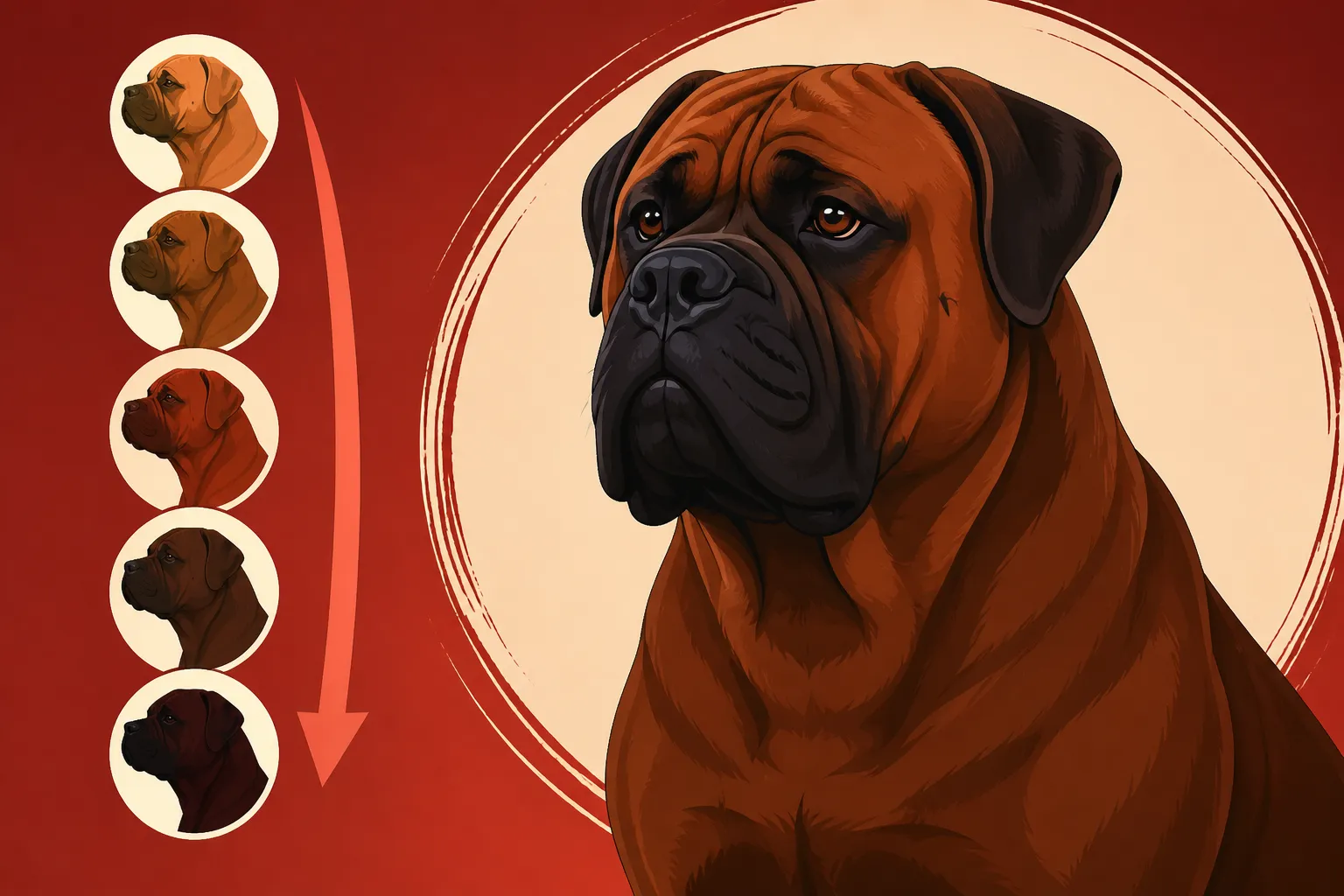
How Dark a Red Bullmastiff Can Be
A red Bullmastiff can be a pale, warm red or a deep mahogany shade; the breed standard does not set a precise darkest-red limit. That makes online photos and casual descriptions confusing, especially when a dark mask or shaded coat makes a dog look almost black. This guide explains what counts as red, what it does not, and how to assess the color fairly.
How dark can a red Bullmastiff be
There is no exact darkest-red cutoff
Bullmastiff standards recognize red as one of the breed’s accepted colors, alongside fawn and brindle. They do not give a numerical shade range or define a specific point at which a red coat becomes “too dark.” In everyday descriptions, red may mean anything from a light coppery tone to a rich, deep mahogany.
So if you have seen a Bullmastiff with a very dark reddish-brown coat, that can still be described as red. The most useful question is whether the coat reads as a clear red shade overall, rather than whether it matches a particular sample photo. A single image cannot establish a hard boundary that the standard itself does not define.
For a broader look at the recognized colors and how they are described, see Which Colors a Bullmastiff Comes In and Fawn, Red or Brindle: the Only Colors a Bullmastiff Comes In.
Color names are descriptions, not precise measurements
Words like mahogany, rust, copper, and deep red help people describe what they see, but they are not exact color codes. Two people may look at the same dog and choose different words, especially under different lighting or against different backgrounds.
That’s why a breeder, owner, or judge might call a coat dark red while someone else calls it reddish brown. The disagreement does not necessarily mean one person is wrong. The dog’s coat can sit between familiar labels, and photos can exaggerate the difference.
The standard’s broader color categories are more useful than trying to assign a precise shade name. For a detailed discussion of the difference between those categories, read Fawn, Red or Brindle: the Only Colors a Bullmastiff Comes In.
| What you see | How to think about it |
|---|---|
| Warm red or copper across most of the coat | Often described as red |
| Deep reddish-brown or mahogany coat | May still be described as dark red |
| Clear stripes across a lighter or red ground color | Indicates brindle patterning rather than a solid red coat |
| Dark muzzle and shading around the eyes | Usually relates to the black mask, not the body color |
| A photo that looks almost brown or black | Check the coat in natural light before drawing conclusions |
Red, brindle, and the black mask are easy to confuse
A dark mask does not make the body coat black
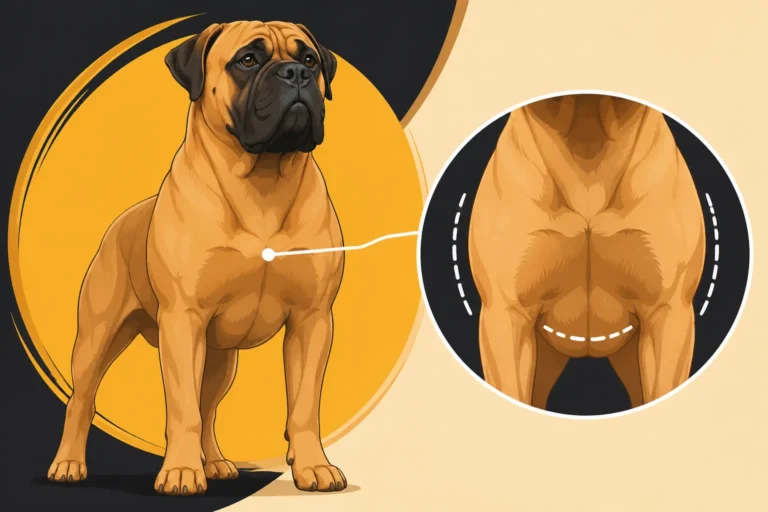
Bullmastiffs are known for their dark facial mask. It covers the muzzle and shades toward the eyes, so a dog may look especially dark in a close-up portrait. Dark ears, shadows under the neck, and deep-colored facial folds can add to that impression.
When judging coat color, look at the dog’s shoulders, sides, back, and legs rather than relying on the face. A dark mask can contrast strongly with a red body, but it does not mean the dog has a black body coat. What a Bullmastiff's Black Mask Should Look Like explains the mask in more detail.
This distinction matters when you compare dogs online. A portrait with a dark mask filling much of the frame can make the whole dog seem darker than it is. A photo taken from the side in even daylight gives a better sense of the body coat.
Brindle is a pattern, not simply a darker red
A red Bullmastiff may look dark because the underlying red shade is deep. Brindle is different: it refers to a pattern of darker striping over a lighter ground color. Depending on the coat and the light, those stripes may be easy to spot or subtle.
If you see clear, repeated stripes on the body, the dog may be brindle rather than solid red, even if the overall impression is very dark. In low light, or in a photo with heavy shadows, those stripes can disappear and leave the coat looking like one dark color. Why Brindle Was the Original Bullmastiff Color offers additional context about the brindle pattern.
A dark coat is not automatically brindle, and a red coat is not automatically light. Look for the pattern itself instead of using darkness as the deciding factor. When the markings are subtle, a clear outdoor view is more helpful than a heavily edited or tightly cropped image.
How to judge a red Bullmastiff’s color fairly
Check the coat in natural, even light
Indoor lighting can shift how red appears. Warm bulbs may make a coat look more orange or brown, while deep shadows can make it seem almost black. Direct sunlight can also create glare that hides the coat’s true tone.
If you are assessing a puppy or adult dog, try to see the coat outdoors in soft daylight. Look at more than one area of the body and, if possible, view the dog in person rather than relying on a phone screen. Screens vary in brightness and color settings, and photos may have been adjusted before they were posted.
A useful approach is to compare the coat in several ordinary settings: standing in open shade, walking in daylight, and indoors near a window. You are not looking for a perfect match to a picture. You are checking whether the overall coat appears red, fawn, or patterned with brindle.
Remember that age and presentation can affect appearance
Puppies can look different as they mature. Their coats may seem to change as they grow, and the balance between body color, facial mask, and shading can become easier to assess over time. That does not mean every puppy will change dramatically; it simply means an early photo may not show the adult appearance clearly. See How a Bullmastiff Puppy's Color Changes for more on coat development.
Grooming and coat condition also affect what you notice. Dust, loose hair, or a dull-looking coat can make the color seem less clear. Regular brushing helps remove loose hair and surface debris. If you are looking for routine grooming supplies, Chewy is one retailer where owners may compare dog brushes, but the right tool depends on the individual coat and your dog’s comfort.
If a coat seems unusually dull, patchy, or different from the dog’s usual appearance, color alone cannot explain why. Skin irritation, parasites, nutrition, or other health issues may affect coat condition, so ask your veterinarian if you notice a sudden or persistent change. For basic bathing supplies, owners can also compare dog-specific shampoos at Chewy, while following their veterinarian’s advice if the dog has sensitive skin.
When you are checking product labels, avoid assuming that a shampoo can make a red coat darker or more “correct.” Grooming products clean the coat; they do not change a dog’s inherited coat color. Chewy listings can be a convenient place to read product details, but suitability matters more than claims about enhancing color.
What dark red does and does not tell you
A deep shade is not a separate breed type
A dark red Bullmastiff is still a Bullmastiff, not a special variety with its own build or temperament. Coat color alone does not establish how large, athletic, healthy, or suitable a dog will be for a particular home. When choosing a puppy, focus on the breeder’s practices, the dog’s health, and the temperament of the puppy and its relatives rather than choosing by shade alone.
Color also does not predict whether a dog will be gentle, protective, outgoing, or reserved. Individual temperament is shaped by many factors, including inherited traits, early experiences, and training. For more on this point, see Whether Coat Color Predicts a Bullmastiff's Temperament.
Likewise, a dark red coat is not evidence that a dog is a crossbreed. Coat shades can vary within the accepted colors, and photos often make that variation look more dramatic. If you have questions about a dog’s pedigree or registration, ask the breeder for documentation rather than trying to answer those questions from coat color.
Black is not simply the darkest version of red
A very dark red coat can appear brown or nearly black in a photograph, but that does not make it a black Bullmastiff. The recognized color descriptions focus on red, fawn, and brindle, with the characteristic black mask. A dark muzzle should not be confused with a solid black body coat.
If someone describes a dog as “almost black,” ask what they mean: a deep mahogany body, a prominent mask, brindle striping, or simply a dark photograph. Those are different observations. Whether a Bullmastiff Can Be Black looks more closely at this distinction.
Ultimately, a red Bullmastiff can be quite dark, including a deep mahogany shade, without there being a precise standard-defined darkest point. Assess the body coat separately from the mask, look for actual brindle striping, and view the dog in natural light. That will tell you more than a color label or a single online photo.
Disclaimer
This article is for general informational purposes only and does not constitute professional advice. Laws, prices and regulations vary by location and change over time. Consult a qualified professional for guidance on your specific situation.