What a Bullmastiff’s Bite Should Be
A Bullmastiff’s bite can look a little different from the textbook ideal, and that can leave owners wondering whether a slight underbite is normal or a reason to worry. This guide explains the breed’s expected bite, how to tell conformation from a dental problem, what may change as a puppy grows, and when a veterinarian should examine the teeth.
What a Bullmastiff bite should look like
The breed standard allows some variation
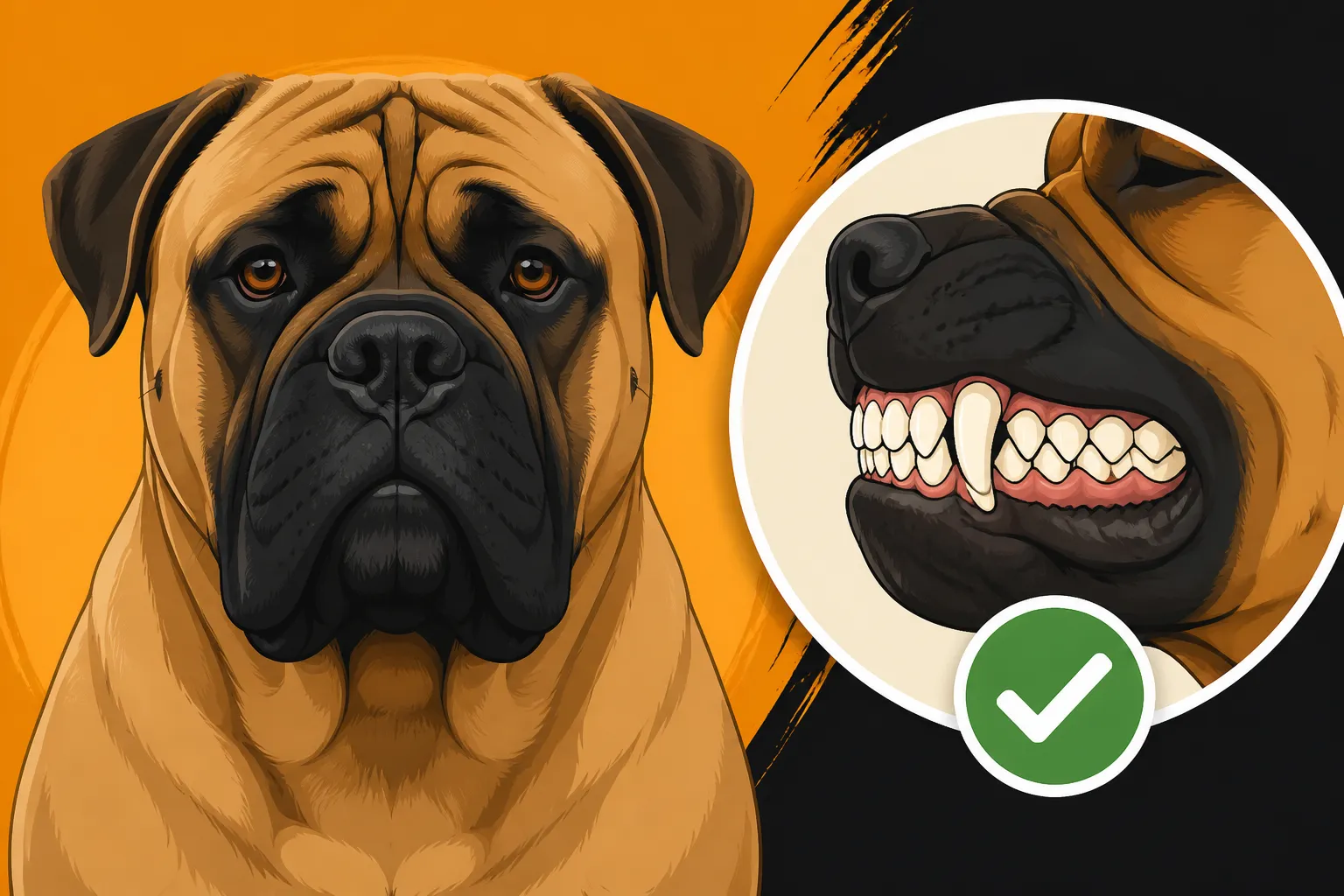
Bullmastiff breed standards generally describe a level bite or allow a slight undershot bite. A level bite means the upper and lower front teeth meet edge to edge. An undershot bite means the lower jaw extends forward enough that the lower front teeth sit ahead of the upper front teeth. The precise wording can differ by registry, so anyone assessing a dog for a show should check the standard used by that registry.
The important distinction is between a slight undershot bite and an exaggerated one. A small difference in how the front teeth meet may fit within the breed’s accepted variation, while a pronounced jaw mismatch can affect how the teeth line up and function. A dog’s appearance alone does not tell you whether its mouth is comfortable or healthy.
The Bullmastiff’s broad head and short muzzle contribute to its characteristic facial shape, but those features do not mean every tooth should be crowded or pressing into soft tissue. If you are also trying to understand how the muzzle is supposed to look, What a Bullmastiff's Muzzle Length Should Be covers that feature separately. For the specific question of whether a lower jaw that projects forward is acceptable, see Whether a Bullmastiff's Undershot Jaw Is Allowed.
Strong teeth should be well placed, not just impressive-looking
A Bullmastiff’s teeth are expected to be strong and reasonably well placed. The breed description also refers to large canines set apart from one another. But “strong” does not mean teeth should be so crowded, tilted, or misaligned that they injure the gums, palate, lips, or tongue. Healthy function matters more than a dramatic-looking jaw.
When you look at your dog’s mouth, notice whether the lips close comfortably and whether the teeth seem to contact the surrounding tissue. A tooth that repeatedly rubs or punctures the roof of the mouth, for example, deserves veterinary attention even if the dog’s bite otherwise resembles a breed-standard shape. Dogs often carry on eating despite discomfort, so normal appetite alone cannot rule out a problem.
It is also useful to separate bite conformation from bite force. The way teeth meet describes alignment; it does not tell you how forcefully a dog can bite. Those are different questions, and dramatic claims about bite force can be misleading when they are not based on a consistent measurement method. For more on that distinction, read What a Bullmastiff's Bite Force Is.
| What you notice | What it may mean | Practical next step |
|---|---|---|
| Front teeth meet edge to edge | A level bite | Keep up routine mouth checks and dental care |
| Lower front teeth sit just ahead of upper front teeth | A slight undershot bite may be within breed variation | Ask your vet to assess comfort and tooth contact at a routine exam |
| A tooth presses into the palate, gums, lip, or tongue | Possible painful or damaging contact | Arrange a veterinary dental assessment |
| A jaw or tooth position changes noticeably | Growth, injury, or dental disease may be involved | Have a veterinarian examine the mouth |
| Broken, loose, discolored, or persistently painful teeth | A dental problem may be present | Contact your veterinarian rather than waiting for a routine visit |
How a Bullmastiff puppy’s bite can change
Puppy teeth and adult teeth do not arrive all at once
A puppy’s mouth changes considerably as baby teeth fall out and adult teeth come in. During this transition, the front teeth and jaw relationship can look uneven for a while. Adult teeth commonly emerge over several months, with the full set generally in place by around six to seven months, though individual dogs vary.
That temporary change is one reason not to judge a young Bullmastiff’s final bite from a single glance. A puppy may have a small gap, a tooth that appears out of line, or a jaw that looks different as the head grows. Still, “it’s probably teething” should not be used to dismiss a tooth that is clearly digging into tissue or causing obvious discomfort.
Your veterinarian can check whether baby teeth are falling out as expected and whether adult teeth have room to come in. This is particularly helpful when a puppy has a crowded mouth, persistent baby teeth beside emerging adult teeth, or a noticeable change in how the jaws meet. A calm mouth check during a normal appointment can give you a useful baseline as your puppy matures.
Watch the trend, not just one snapshot
If you are concerned about alignment, make a note of what you see and when you saw it. You might notice that the lower front teeth have gradually moved ahead of the upper ones, or that one canine seems to touch the lip when your puppy closes its mouth. A dated photo taken from the same angle can help you describe a change at an appointment, but it cannot replace an exam.
Avoid repeatedly prying open a young dog’s mouth to inspect it if that makes the puppy struggle or become fearful. Instead, practise brief, gentle handling around the muzzle and lips when your dog is relaxed. Reward calm cooperation, and stop if the puppy becomes stressed. These short experiences can make future brushing and veterinary examinations easier.
A bite that looks different from a picture online is not automatically abnormal. Breed standards describe ideal or accepted features for a breed; a veterinarian’s role is to assess the individual dog’s health, comfort, and function. If you are considering a puppy from a breeder, ask what health checks are performed and whether the puppy has had a veterinary examination. You can also read What a Bullmastiff's Teeth Need Brushing for ongoing oral care.
When bite alignment may be a health concern
Look for signs of pain or injury
Some dental problems are easy to miss because dogs may keep eating even when their mouths hurt. Look for changes such as chewing on one side, dropping food, hesitating over hard treats, pulling away when the muzzle is touched, or rubbing the face. Persistent bad breath, bleeding gums, swelling, a broken tooth, or a tooth that appears loose also warrants attention.
Pay attention to contact between teeth and soft tissue. A lower canine that presses into the upper gum or a tooth that repeatedly catches the lip can cause irritation or an injury. A marked change in the bite after rough play, a fall, or another possible impact should also be checked, since trauma can affect teeth and jaw alignment.
If your Bullmastiff suddenly starts drooling more than usual, refuses food, or seems unable to close the mouth normally, do not assume it is simply a breed trait. Sudden changes deserve a call to your veterinary clinic, especially if your dog seems distressed. The veterinarian can decide whether the issue needs prompt examination and whether dental imaging or referral is appropriate.
A veterinary exam is more useful than a home diagnosis
A vet will look at the teeth, gums, jaw movement, and the way the teeth meet. They may ask when you first noticed the difference, whether it has changed, and whether your dog eats and chews normally. If the dog is young, the vet can also assess whether adult teeth are erupting properly and whether any retained baby teeth need attention.
Do not try to file, pull, or push a tooth into place at home. Tooth enamel and the structures inside the tooth can be damaged, and a dog may react suddenly if a painful area is touched. Any dental treatment should be planned by a veterinarian, who can assess the cause and discuss suitable options for that particular dog.
A slight undershot appearance without pain or harmful tooth contact may simply be a feature to monitor. A pronounced mismatch, painful contact, or a sudden change is different: it deserves a professional assessment. The goal is not to make every Bullmastiff’s mouth look identical, but to keep the mouth comfortable and functional.
Keeping a Bullmastiff’s teeth healthy
Build a simple routine your dog will tolerate
Regular mouth checks help you notice changes, while tooth brushing is one of the most useful habits for supporting dental health. Start slowly: let your dog sniff the toothbrush, touch the lips briefly, and reward calm behaviour. Gradually work toward brushing the outer surfaces of the teeth with toothpaste made for dogs. Human toothpaste is not designed to be swallowed and should not be used for this purpose.
Consistency matters more than turning each session into a long struggle. A few calm moments can be a better start than trying to brush every tooth at once. If your dog resists, pauses, or becomes uncomfortable, stop and try a gentler step another time. For more on establishing a routine, see Whether a Bullmastiff's Teeth Need Brushing.
Dental products can be an addition to brushing, not a substitute for veterinary care. If you are comparing dog toothbrushes, toothpaste, or dental chews, Chewy is one place owners may browse; check the product label carefully and ask your vet whether a particular item suits your dog. Size and chewing style matter, and a hard chew that seems durable may not be appropriate for every dog.
Pay attention to food getting caught
A crowded mouth or unusual tooth position can sometimes make food collect in places that are awkward to reach. If you notice food repeatedly trapped between teeth, persistent odor, or irritation around a particular area, mention it during an exam. Do not dig at a tight space with a sharp object or force your dog’s mouth open to remove something you cannot safely reach.
Some dogs tolerate a soft toothbrush better than a finger brush, while others need a gradual introduction to any mouth handling. You can compare dog-safe brushes and toothpaste through retailers such as Chewy, but the best choice is one your dog will accept and that fits the veterinarian’s guidance. Whether a Bullmastiff's Bite Traps Food discusses this issue in more detail.
Dental chews may help some dogs, but they should be chosen with supervision and with your dog’s mouth in mind. If the bite is already painful or a tooth is loose or broken, do not offer a hard chew as a way to “clean” the area. Get veterinary advice first. When you shop for dental products at Chewy or elsewhere, use the product’s size guidance and ask your clinic if you are unsure whether it is suitable.
Disclaimer
This article is for general informational purposes only and does not constitute professional advice. Laws, prices and regulations vary by location and change over time. Consult a qualified professional for guidance on your specific situation.