How the British and American Bullmastiff Differ
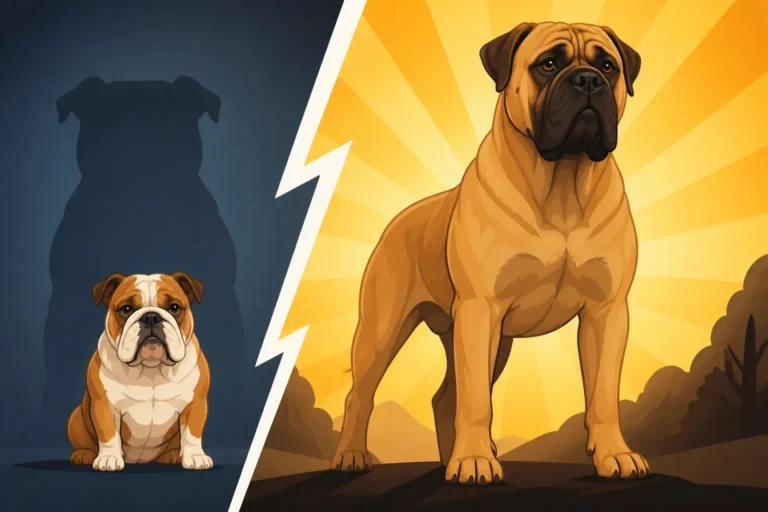
A British and an American Bullmastiff can look different in photos, especially when one is a lean adolescent and the other a mature, heavy-boned adult. But they are not separate breeds, and there is no simple rule that one country’s dogs are always bigger, calmer, or healthier. This guide explains what actually varies—and what to check when comparing individual dogs.
The British and American Bullmastiff Are the Same Breed
There is no official national split
The Bullmastiff developed in Britain, and the breed was later established in other countries, including the United States. Today, “British Bullmastiff” and “American Bullmastiff” are usually informal labels for dogs bred or shown in those places. They do not identify two officially recognized varieties with distinct temperaments or body types.
Both come from the same breed background. The familiar history of crossing Mastiff-type dogs with Bulldogs helps explain the Bullmastiff’s strength and distinctive outline, but dogs on either side of the Atlantic remain Bullmastiffs. For a closer look at that background, see Which Breeds Went Into the Bullmastiff.
It’s easy to see why the national labels stick around. People notice differences in show photos, breeder descriptions, and individual dogs they meet. But those impressions can be shaped by age, sex, conditioning, family lines, and photography just as much as by where a dog was bred.
Breed standards are similar, with differences in wording
Breed standards describe the ideal dog for conformation judging. The United Kingdom’s Kennel Club standard and the American Kennel Club standard use their own wording and judging conventions, but they describe the same recognizable breed: a powerful, balanced dog with a broad head, short coat, and black mask.
Some descriptions emphasize slightly different details or express measurements differently. That can matter in a show ring, where judges assess how closely a dog matches their organization’s standard. It does not mean an American-bred dog automatically has a different structure from a British-bred dog, or that a dog from Britain is automatically a better example of the breed.
A standard is also not a promise that every dog from a country will look alike. Two puppies from the same litter can develop into noticeably different adults. If you are comparing dogs, look at the individual’s proportions and movement rather than assuming that a label tells the whole story.
Comparing Size, Shape, and Appearance
Height and weight do not create two distinct types
British and American Bullmastiffs are both large, muscular dogs. Their standards give height and weight guidance, and the measurements are broadly comparable once you account for the different units used. Small differences in how standards list or frame measurements should not be treated as proof of two separate body types.
There is substantial variation among individuals. Sex, age, genetics, and body condition all affect what a particular dog weighs and how substantial it looks. A young dog may still be filling out, while an older dog may have gained weight that makes it appear larger without being healthier. For breed-wide context, see How Tall a Bullmastiff Stands and How Much a Bullmastiff Weighs.
When assessing a dog, don’t use bulk as the only measure of quality. A healthy Bullmastiff should be strong and well-muscled, not simply as heavy as possible. If a breeder focuses mostly on extreme size, ask about movement, soundness, and health as well as weight.
| Feature | British-bred Bullmastiff | American-bred Bullmastiff | What matters most |
|---|---|---|---|
| Breed identity | Bullmastiff | Bullmastiff | They are the same breed |
| General build | Powerful, balanced, muscular | Powerful, balanced, muscular | Evaluate the individual dog’s proportions |
| Size | Large; standards provide height and weight guidance | Large; standards provide height and weight guidance | Sex, age, and body condition affect measurements |
| Coat | Short coat in accepted breed colors | Short coat in accepted breed colors | Color does not establish a national type |
| Mask | Characteristic black mask | Characteristic black mask | Check the dog against the relevant standard |
| Temperament | Individual and upbringing matter | Individual and upbringing matter | Breeding, socialization, and training shape behavior |
Coat color and the black mask are not national markers
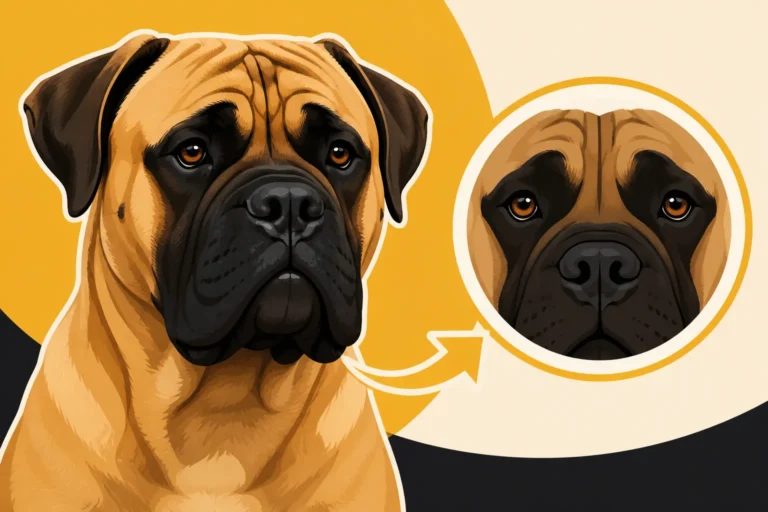
Bullmastiffs are commonly seen in fawn, red, and brindle shades, and the breed’s black mask is a familiar feature. The precise wording about color and permissible markings can differ between kennel-club standards, but color alone does not tell you whether a dog is British or American. It also does not predict a dog’s temperament.
A brindle dog is not automatically from a British line, and a fawn dog is not automatically American. Those assumptions can take hold when someone has seen more examples of one color in a particular local show or breeder circle, but they are not a reliable way to identify a dog’s origin. For more on appearance, see Which Colors a Bullmastiff Comes In and What a Bullmastiff's Black Mask Should Look Like.
If you are evaluating a puppy, ask the breeder how the puppy is registered and what the parents’ pedigrees show. That gives you more useful information than trying to infer a country or lineage from a photograph. Be cautious of anyone presenting an unusual color as proof of a special national type.
Temperament, Health, and Everyday Life
A country label cannot predict personality
Bullmastiffs are often described as steady, devoted, and protective, but those broad descriptions should not be mistaken for a guarantee about an individual dog. One may greet visitors calmly after a careful introduction; another may need more time and management. Experiences, socialization, health, and training all play a part.
A puppy raised in the United States does not come with a predictable personality simply because of its country of origin. The same is true of a puppy from Britain. Ask how the breeder raises young dogs, what the parents are like in everyday situations, and how they respond to new people and environments. Those conversations are more useful than asking whether a line is “American” or “British” as if either label settles the question.
Daily needs also have more to do with the individual dog and the breed’s size than its country. A Bullmastiff needs thoughtful training, comfortable resting space, and food suited to its age and condition. If you are choosing supplies, read the product dimensions and feeding guidance rather than relying on labels that simply say “large breed.” Retail listings, including those on Chewy, can help you compare dimensions and product details, but your dog’s measurements and your veterinarian’s advice should guide the choice.
Health comes from the dog and its family line, not its passport
Neither national label guarantees better health. A responsible breeder should be able to discuss relevant health screening, the health of the parents, and known issues in the family. Ask for records and clear explanations, not just a reassuring claim that the line is “healthy.”
For a large, heavy dog, it is sensible to ask how the breeder approaches soundness and responsible growth as well as inherited health concerns. Learn what testing is relevant to the breed, and ask what the results mean for the puppy you are considering. What a Bullmastiff Breeder Should Have Screened offers a useful starting point for those questions.
Health and welfare continue after the puppy comes home. Keep the dog at a healthy weight, arrange routine veterinary care, and bring up changes in movement, energy, or appetite rather than dismissing them as part of being a big dog. If you are comparing food options on Chewy or elsewhere, check the complete label and discuss a diet change with your veterinarian, especially for a puppy that is still growing.
Choosing Between a British-Bred and American-Bred Dog
Compare breeders and individual dogs, not national reputations
If you are deciding between puppies from different countries, start with practical questions. Who bred the litter? What health records are available? How are the puppies being raised? What support does the breeder offer after placement? How well do the parents’ temperaments and living conditions fit what you want in a dog?
A reliable breeder should be willing to talk about strengths and limitations without insisting that every dog in their country is superior. Ask to see documentation, and take time to understand the contract and the breeder’s plans for a puppy that cannot remain with its original family. A useful companion question list is What Nobody Tells You Before Buying a Bullmastiff.
Consider the realities of bringing a dog home from far away, too. Travel arrangements, the timing of pickup, communication with the breeder, and access to follow-up support all matter. An overseas pedigree may be meaningful to you, but it is not automatically worth the extra complexity if you cannot assess the breeder and the dog’s welfare carefully.
Match the dog to your home and expectations
A Bullmastiff’s size affects daily life regardless of where it was bred. Think about whether you can safely handle the dog on a leash, make room for it to rest, manage introductions with visitors, and keep up with ordinary care. A large dog can be gentle and still knock into someone or take up most of a sofa without realizing it.
If you are new to the breed, speak with owners and breeders about the realities of living with one rather than focusing only on appearance. Whether a Bullmastiff Suits a Family can help you consider household fit, while The Bullmastiff Against the Mastiff is useful if your comparison is actually between breeds rather than between countries.
For equipment, measure the dog and the space it will use. That applies to beds, crates, harnesses, and vehicle access. Chewy’s listings, like those of other retailers, can make it easier to compare stated product dimensions, but check that measurements against the dog and the room or vehicle you have. A label such as “giant breed” is not a substitute for measuring.
Ultimately, “British” and “American” are best treated as clues about a dog’s breeding location or registry context—not as shorthand for a guaranteed size, personality, or level of health. Compare the individual dog, the breeder’s practices, and the documented family history. Those details will tell you far more about the Bullmastiff in front of you than the country name alone.
Disclaimer
This article is for general informational purposes only and does not constitute professional advice. Laws, prices and regulations vary by location and change over time. Consult a qualified professional for guidance on your specific situation.