Whether Bullmastiffs Worked in Mines or Quarries
Bullmastiffs are strongly associated with English gamekeepers and estate work, but they are not known as a breed developed for mines or quarries. The short answer is that there is no good evidence of Bullmastiffs being used regularly as mining or quarry dogs. Here’s what their documented working history tells us, and why the confusion is understandable.
Did Bullmastiffs Work in Mines or Quarries
The Bullmastiff’s best-established historical role was as a gamekeeper’s dog on large English estates. Its purpose was to help catch poachers, not to work underground or haul material in an industrial setting. That does not prove that no individual Bullmastiff ever visited a quarry or mining settlement, but it is different from saying the breed had a recognized job in those industries.
The distinction matters because popular accounts sometimes describe the Bullmastiff broadly as a “working dog” or “guard dog.” Those labels are accurate in a general sense, but they can make it sound as though the breed had a long record in every kind of labor involving dogs.
The evidence points to estate work
Bullmastiffs took shape in nineteenth-century England, where gamekeepers needed a powerful dog capable of working quietly at night. The dog’s most familiar task was to help stop a poacher and hold the person until the keeper arrived. That history is tied to country estates and game preservation, rather than to industrial workplaces.
The particular job helps explain the breed’s reputation. Gamekeepers wanted a dog that could move through estate grounds, notice a stranger, and physically restrain someone without the uncontrolled attack associated with a dog bred to kill. The Bullmastiff’s background is explored further in What a Gamekeeper Needed a Night Dog For and How a Bullmastiff Was Sent After a Poacher.
The social and legal setting also mattered. Poaching and game laws shaped the work expected of estate keepers, while the size and layout of an estate created a different working environment from a mine or quarry. What English Game Laws Had to Do With the Bullmastiff offers more context on that estate-based history.
A working breed does not mean an industrial breed
“Working dog” is a broad category, not a record of one specific occupation. A breed can be considered a working breed because people developed it for practical tasks, even if those tasks were not mining, quarrying, herding, or pulling carts. The Bullmastiff’s historic work was practical and demanding, but it centered on guarding and apprehending on estates.
That broad label can easily invite assumptions. A reader may see “working dog,” imagine a strong, sturdy animal, and conclude that the Bullmastiff must have been used in mines or quarries too. But physical suitability is not proof of historical use. Breed history depends on evidence of a repeated, recognized role—not simply on whether a dog could have performed some version of it.
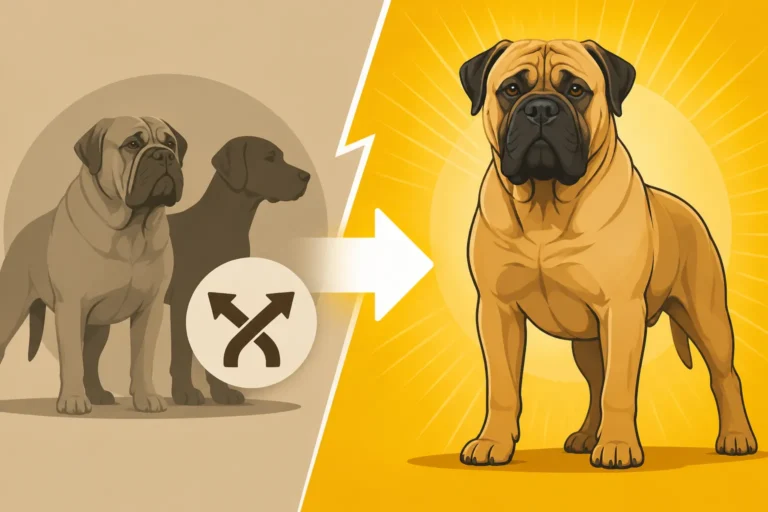
The Bullmastiff’s breed background also makes the estate connection clearer. Its development drew on dogs selected for size, power, and the ability to work in close contact with a person. For more on those origins, see Which Breeds Went Into the Bullmastiff, Why a Mastiff Alone Was Too Slow for the Job, and Why a Bulldog Alone Was Too Small for the Job.
Why the Mine and Quarry Story Sounds Plausible
It is easy to picture a Bullmastiff beside a mine entrance or a quarry yard. The breed is imposing, protective, and physically capable. In a period when dogs were often kept around homes, farms, workshops, and industrial sites, an individual dog could certainly have lived near workers or been used for local guarding.
But a plausible scenario is not the same as a documented breed occupation. The surviving public story of the Bullmastiff centers on gamekeepers and estate work. There is no widely established tradition of Bullmastiffs being specifically bred, trained, or commonly employed for underground mining or quarry labor.
Dogs had many jobs around industrial sites
Dogs have served practical roles in many kinds of human communities. Around workplaces, they might guard property, discourage intruders, catch vermin, or simply live with workers and their families. Mines and quarries were no exception to the broader pattern of people keeping dogs near where they lived and worked.
Those roles should not be mixed together. A dog guarding a cottage near a colliery is not necessarily a mine dog. A dog seen in a quarry yard may be a worker’s companion or a property guardian, rather than an animal trained for quarry work. And work underground, where space, ventilation, footing, and safety are serious concerns, would not automatically suit a very large, heavy dog.
The same distinction applies to individual Bullmastiffs. One may have been kept near a mine or stoneworks without the breed having a recognized industrial function. Historical anecdotes can preserve personal stories, but they do not by themselves establish that the breed was commonly used in that occupation.
The physical demands were not a natural match
Bullmastiffs were bred for a specific kind of physical work: close-range movement, alertness, and the ability to restrain a person. That is quite different from hauling loads, navigating narrow underground passages, or working among active extraction equipment. Their size and strength might be useful for deterrence, but those traits alone do not make them suitable for every industrial task.
A dog working underground would face practical challenges that an estate dog would not. Confined passages, poor visibility, uneven surfaces, dust, noise, and moving machinery can create hazards for animals and people alike. A dog’s ability to guard a building or property does not establish that it would have been sent into the mine itself.
Quarries present a different environment, often open to the sky but still full of hazards such as steep drops, loose stone, heavy equipment, and vehicle traffic. A Bullmastiff might be able to guard a yard in some circumstances, but that possibility is not evidence of a standard quarry role. It is more accurate to describe such use as possible for an individual dog than typical of the breed.
What We Can and Cannot Say About Bullmastiffs at Worksites
When asking whether Bullmastiffs worked in mines or quarries, it helps to separate three claims: a dog could have been present, an individual dog might have guarded a site, and the breed was regularly used for that industry. The first two are plausible. The third is not supported by the breed’s commonly documented history.
| Claim | What can reasonably be said |
|---|---|
| Bullmastiffs were developed for mining | There is no established evidence for this |
| A Bullmastiff may have lived near a mine or quarry | Possible, as with many dogs kept by local families |
| An individual Bullmastiff may have guarded a site | Plausible, but not proof of a standard breed role |
| The breed’s best-known historical work was estate-based | Yes, especially gamekeeper work |
| Bullmastiffs were commonly sent underground | There is no well-established record of this |
Absence of a recorded role is not proof of absence
Working-class and local histories are not always preserved in the same detail as breed-club histories or accounts of estate management. A particular dog’s story may never have been written down, or it may survive only in family memory. So it would be too absolute to claim that no Bullmastiff ever appeared at a mine or quarry.
At the same time, careful historical writing should not turn “perhaps” into “yes.” If there is no strong evidence that a breed was routinely employed in an industry, the responsible answer is that the role is not established. That leaves room for isolated cases without presenting them as a defining part of the Bullmastiff’s heritage.
This is especially useful when reading breed descriptions online. A brief phrase like “used for guarding” can lose its original context as it is repeated. Over time, readers may assume that “guarding” meant guarding mines, factories, farms, and every other kind of property. In the Bullmastiff’s case, the clearest historic context remains the gamekeeper’s estate.
Their later identity does not rewrite their origins
The Bullmastiff’s classification as a working breed reflects its development and practical purpose. It does not mean every modern Bullmastiff is suited to professional guarding, nor does it mean that mines and quarries were part of the breed’s original job description. Breed identity and individual temperament are not the same thing.
The breed’s recognition and later development also help explain why older, loosely described accounts can be confusing. The Bullmastiff emerged from a working cross rather than appearing as a fully standardized breed from the beginning. If you are interested in how its identity changed over time, see When the Bullmastiff Stopped Being a Crossbreed and Why the Bullmastiff Counts as a Working Dog.
There are also differences between a breed’s historical role and the life of a modern household dog. A contemporary Bullmastiff may be a companion, a calm presence at home, or a property guardian in the everyday sense. That does not make it a mine worker, and it does not mean owners should try to recreate dangerous historical jobs.
The Most Accurate Answer
The most accurate answer is that Bullmastiffs are not known as dogs bred or commonly used to work in mines or quarries. Their established historical role is much more closely connected to English estates, gamekeepers, and the work of stopping poachers. Individual dogs may have lived or guarded near industrial sites, but that possibility should not be confused with a documented industry-wide role.
A quick way to evaluate the claim
When you encounter a claim that Bullmastiffs worked in a particular occupation, ask what it actually says. Does it describe a well-established breed purpose, a local anecdote, or merely a plausible use based on the dog’s size? Those are different kinds of evidence, even if a short breed profile makes them sound equally certain.
It also helps to look for the setting and task. An account of a Bullmastiff on an estate, walking with a keeper or helping restrain a poacher, fits the breed’s familiar history. A claim that the breed was “used in mines” needs more detail: where, when, by whom, and doing what? Without that context, it may be a broad generalization about dogs at industrial sites rather than a documented Bullmastiff role.
For a fuller picture of the breed’s past, Why Gamekeepers Needed a Dog That Worked at Night explains the demands of its best-known work, while Whether Bullmastiffs Guarded American Estates explores how the breed’s guarding associations extended into later settings. Neither broadens the historical record into a proven mining or quarry occupation.
What owners should take from the history
For prospective owners, this history is most useful as context, not as a guide to training a dog for protection. A Bullmastiff’s strength and imposing appearance do not remove the need for calm socialization, good manners, and safe management around visitors. The breed’s origins can help explain why people associate it with guarding, but an individual dog’s behavior depends on temperament, upbringing, health, and the situation.
Modern care also bears little resemblance to the hard work of an estate dog. A Bullmastiff needs sensible exercise, comfortable rest, and attention to its size and health. Owners may find it useful to explore broader topics such as The Household a Bullmastiff Was Built For and What Nobody Tells You Before Buying a Bullmastiff before deciding whether the breed fits their home.
So, if you have heard that Bullmastiffs worked in mines or quarries, treat the claim cautiously. A dog could have been present at such a site, and an individual may have served as a guardian. But the evidence-backed, defining work of the Bullmastiff is the gamekeeper’s estate—not underground mining or quarry labor.
Disclaimer
This article is for general informational purposes only and does not constitute professional advice. Laws, prices and regulations vary by location and change over time. Consult a qualified professional for guidance on your specific situation.