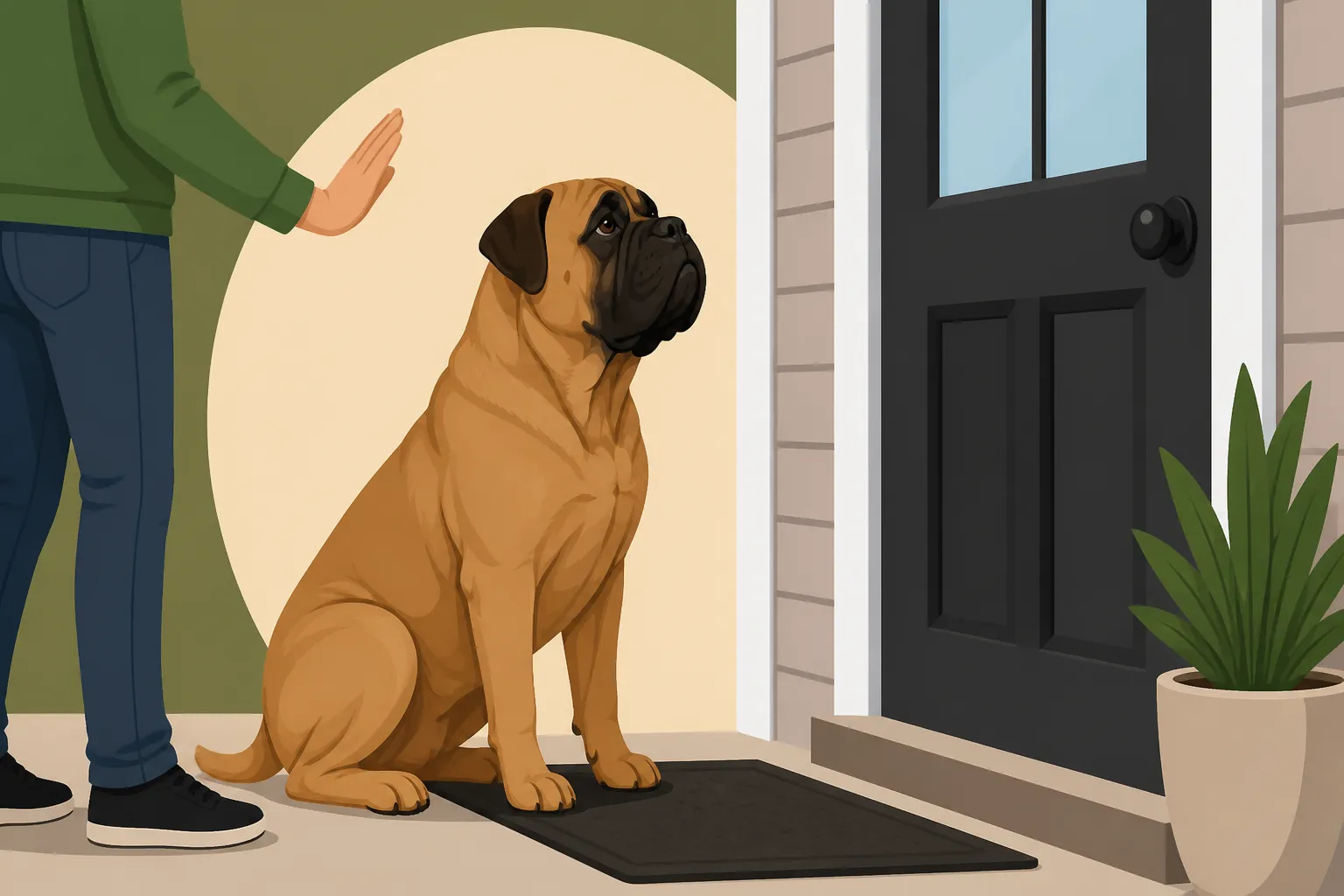
Teaching a Bullmastiff to Wait at a Door
There's nothing quite like the rush of a massive, eager Bullmastiff when that front door creaks open, is there? One moment, you're fumbling with the keys or the leash, the next, a hundred-plus pounds of pure joy (or sometimes, pure determination) is trying to barrel past you, perhaps knocking over a potted plant, a small child, or even you in their quest to explore the great beyond or greet a beloved visitor. This isn't just annoying; it's genuinely dangerous, and it's a frustration many Bullmastiff owners know all too well. This guide is here to walk you through how to teach your beloved giant to wait politely at any door, transforming those chaotic moments into calm, controlled exits and entries.
Understanding the Bullmastiff's Doorway Enthusiasm
It's easy to get exasperated when your Bullmastiff acts like the door is a personal challenge to their speed and strength. But understanding why they do it can help you approach the training with more empathy and strategic thinking. It's not usually about defiance; it's often about instinct, excitement, and a learned routine.
Why Doors Are Such a Big Deal for Bullmastiffs
For many dogs, the door isn't just a simple opening in a wall; it's a gateway to adventure, to visitors, to the smells of the outside world, or even just to another room where their favorite human might be. For a Bullmastiff, whose very nature is often one of quiet watchfulness mixed with a deep desire to be near their family, this gateway can trigger a significant burst of anticipation. They associate the jingle of keys, the grab of a leash, or the sound of a doorbell with exciting things happening.
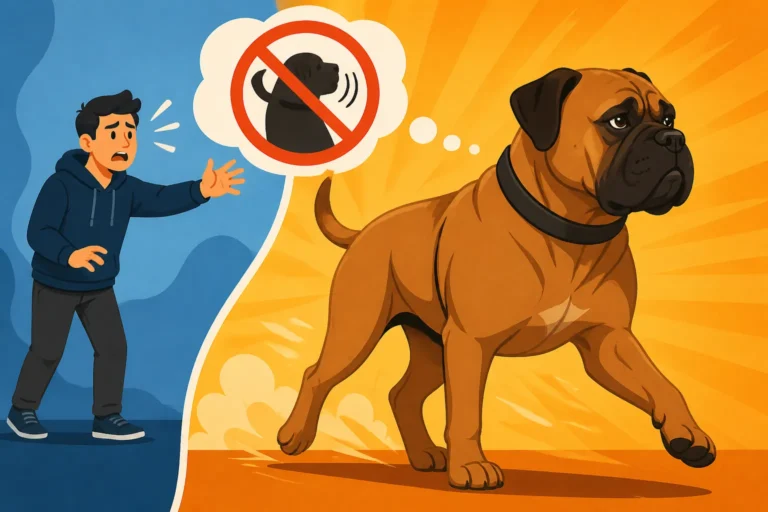
Think about it from their perspective: the door opening means a walk, a car ride, or perhaps a long-lost family member returning. Their large size, while majestic, also means they experience the world with more physical impact. A little excitement for a Chihuahua might be a slight wiggle; for a Bullmastiff, it's a full-body lurch. This isn't necessarily a malicious act, but rather an unfiltered expression of their eagerness, magnified by their impressive bulk and strength. They haven't learned the polite way to express that excitement yet, and it's our job to show them.
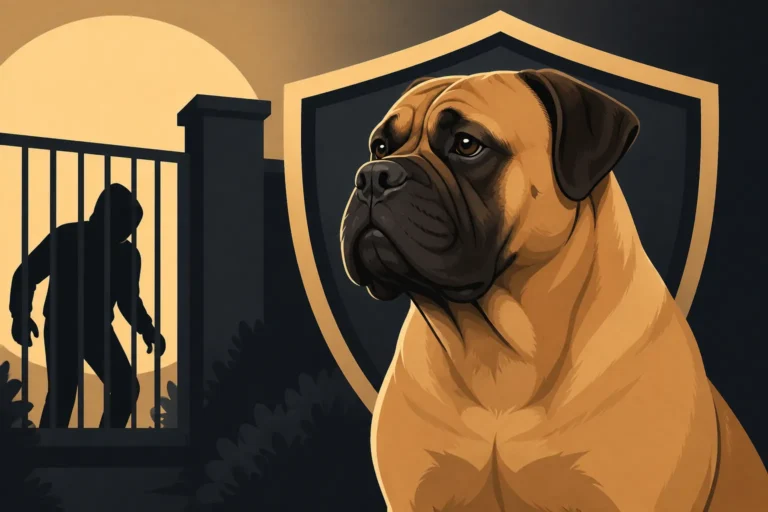
Their natural guarding instincts also play a role. While they were historically bred to hold intruders rather than attack, the sound of someone approaching the door can still activate a deep-seated awareness. They want to investigate, to meet, or to assess the situation, and the quickest way to do that is often perceived as rushing the door. This isn't guarding in an aggressive sense, but rather a keen interest in who or what is on the other side. This blend of excitement and watchful curiosity makes the door a very stimulating, and often overwhelming, threshold for them.
The Risks of an Unruly Door Greeter
The consequences of a Bullmastiff who lacks door manners can range from minor annoyances to serious safety hazards. It's crucial to acknowledge these risks so you can approach training with the necessary seriousness and consistency. After all, a Bullmastiff weighs as much as an adult human, and their enthusiasm, however well-intentioned, can cause real problems.
One of the most immediate dangers is your Bullmastiff bolting out the door and into an unsafe situation. Imagine them slipping past you and running into a busy street, or straight towards a startled neighbor or another dog. Their size and speed, even if momentary, can lead to accidents with cars, lost dog scenarios, or even unintended confrontations with other pets or people. This isn't just a worry; it's a common nightmare for owners of powerful breeds.
Beyond bolting, there's the risk of injury to people. A Bullmastiff launching itself forward, even in play or greeting, can easily knock over a child, an elderly relative, or a friend who isn't prepared for their sheer mass. Bruises, sprains, or worse can result from such an impact. You want your Bullmastiff to be a beloved member of the family, not a source of accidental injury. The sheer momentum of A Hundred and Thirty Pounds of Bullmastiff, Measured means even a gentle bump can be a serious issue.
Finally, there's the wear and tear on your home and belongings. A Bullmastiff repeatedly scratching at the door, pushing against it, or chewing the frame in their excitement can cause significant damage. This isn't just about property; it's about establishing boundaries and teaching your dog respect for their environment. An unruly door greeter is a sign that basic impulse control needs strengthening, which benefits not only door etiquette but also overall household harmony.
Laying the Foundation: Essential Pre-Door Training
Before you can tackle the door directly, it's important to ensure your Bullmastiff has a solid understanding of fundamental obedience commands and impulse control. Trying to teach "wait" at the threshold without these basics is like trying to build a roof before the walls are up – it just won't work.
Mastering Basic Impulse Control
The command "wait" is fundamentally about impulse control. Your Bullmastiff needs to learn that delaying gratification leads to rewards. This isn't just for the door; it applies to food, toys, and even greetings. Start by teaching "wait" in a calm, low-distraction environment, far away from the tempting lure of a door. Use high-value treats to make it worthwhile for your dog.
Begin by asking your Bullmastiff to sit or lie down. Hold a treat in your hand and say "wait." Slowly move the treat away from their nose. If they move, cover the treat with your hand and reset. If they stay, even for a second, praise them softly and give them the treat. Gradually increase the duration and the distance you move the treat. This teaches them that "wait" means staying put until released. Then, introduce a release word like "okay" or "free" before they get the reward. This distinction is crucial: "wait" means don't move until I say so, whereas "stay" often implies a longer duration in a specific position. For a Bullmastiff, whose massive body can be quite hard to control once momentum builds, mastering this mental discipline is paramount. Remember, Training a Bullmastiff That Weighs More Than You Do requires a strategy that relies on their brain, not brute force.
Once they understand "wait" with food, extend it to other exciting things. Ask them to "wait" before you put their food bowl down. Ask them to "wait" before you throw a toy. Make "wait" a part of their daily routine for anything they eagerly anticipate. The goal is for them to learn that a moment of calm, controlled waiting always precedes something good. This builds their patience and reinforces that you control access to the good things, not their impulsive reactions. Consistency is key here; every time they get something exciting, ask for a "wait" first.
The Power of Leash Manners Beyond the Door
Many door-dashing problems are exacerbated by poor leash manners. If your Bullmastiff already pulls like a freight train on the leash inside the house or in low-stakes areas, they're certainly going to try to drag you through the door. Effective door training begins long before you reach the threshold, by establishing a loose-leash walk as the default.
Practice walking calmly on a leash in your living room, then in the hallway, then in your yard. The moment there's tension on the leash, stop moving. Only when the leash goes slack again do you take another step. This teaches your Bullmastiff that pulling gets them nowhere, but a loose leash allows them to move forward. This might feel tedious at first, especially with a dog as powerful as a Bullmastiff, but it's essential for building control and communication. Investing time in Teaching a Bullmastiff to Walk on Leash calmly will pay dividends at the door.
Consider using a training tool that gives you more control without causing discomfort. While a flat collar can work if your Bullmastiff is already excellent on a leash, a front-clip harness or a head halter can offer a significant advantage, especially during the learning phase. These tools redirect their pulling power back towards you, making it much harder for them to forge ahead. This isn't a substitute for training, but an aid that can make the process smoother and safer for both of you.
Remember, the leash isn't just for walks; it's a valuable training tool even when you're just moving from room to room. Keep a light leash on your Bullmastiff during short training sessions indoors. This allows you to gently guide them and reinforce good manners in various situations, slowly building up their understanding that polite behavior is expected whenever the leash is on, no matter the context.
Step-by-Step Guide to Teaching Doorway Manners
Once your Bullmastiff has a solid grasp of "wait" and walks politely on a leash in low-distraction environments, you're ready to tackle the actual doors. The key is to start small, break it down into tiny steps, and celebrate every moment of calm cooperation.
Starting with Low-Stakes Doors (Interior Doors)
Don't jump straight to the front door with all its exciting stimuli. Begin with an interior door – perhaps the bathroom door, or a bedroom door – somewhere that doesn't hold the same immense allure as the gate to the outside world. This reduces the excitement and helps your Bullmastiff focus on the task at hand.
Put your Bullmastiff on a leash, even if you're just going from the kitchen to the living room. Walk them calmly towards the chosen interior door. As you approach, ask for a "sit" or "down" a few feet away from the door. Say "wait." If they hold their position, even for a second, open the door just an inch. If they lunge or try to move, immediately close the door. Don't scold, just calmly reset. Wait for them to settle, then try again. The instant they stay, praise them and perhaps even give a small, high-value treat. Repeat this many times. The idea is to teach them that the door only opens (and eventually, they only get to go through it) when they are calm and waiting.
Gradually increase the door opening. From an inch, move to a few inches, then half-way, then fully open. Each time, your Bullmastiff must remain in their "wait" position. If they break, the door closes immediately. If they stay, you praise and reward. Once the door is fully open and they are still waiting, take one step through the door yourself. If they stay, reward. Then two steps. Eventually, you should be able to walk completely through the doorway and turn to face them, with them still holding their "wait." Only then do you use your release word ("okay" or "free") and allow them to calmly walk through. This teaches them to respect the threshold and to wait for your permission to pass. For more structured online guidance, some owners find programs like those offered by BAXTER & Bella helpful for breaking down these complex behaviors into manageable steps.
Progressing to the Great Outdoors (Exterior Doors)
Once your Bullmastiff is a pro at waiting at interior doors, it's time to apply that same training to the exterior doors, but still without external distractions at first. This might be the back door to a fenced yard, or the front door when you know no one is home and there's minimal outdoor activity. The process is identical to the interior door training, but the stakes feel higher for your dog.
Again, put them on a leash. Approach the exterior door. Ask for the "sit" and "wait" a few feet back. Start by opening the door just an inch, closing it if they lunge, and rewarding if they stay. Work your way up to a fully open door, then you stepping through, and finally, them being released to come through calmly. This requires immense patience and many, many repetitions. The temptation of the outside world is powerful for a Bullmastiff, so your rewards need to be equally enticing – think small pieces of cheese, cooked chicken, or another favorite high-value treat. This training phase is critical in The First Year With a Bullmastiff Puppy, establishing good habits before they become too powerful to manage.
As they become reliable at the exterior door with no distractions, slowly introduce minor triggers. Have a family member walk past the window outside while you're at the door, but before you open it. If your Bullmastiff stays, reward. Then, have someone quietly open the gate to the yard. Then, have them knock softly on the door. Each step should be so small that your Bullmastiff can succeed. If they fail, it means you've moved too fast. Go back to an easier step and build up again. The goal is to proof the "wait" command against increasing levels of excitement and distraction.
Handling Visitors and High Excitement
The real test comes when you have actual guests arriving, or when you're genuinely trying to leave for a walk. This is where all your foundational work is put to the test. Don't be afraid to use management strategies in addition to training.
When you know a visitor is coming, have your Bullmastiff on a leash or behind a baby gate near the door. Ask them to "wait" in their "sit" or "down" position. When the doorbell rings or the knock comes, do not immediately go to the door. Wait for your Bullmastiff to offer even a brief moment of quiet or calm. Reward that calm, then slowly approach the door yourself, asking them to maintain their "wait." If they get overly excited or start barking incessantly, turn away from the door and ignore them until they settle again. This teaches them that calm behavior gets you to the door, not frantic energy.
Once you're at the door, if your Bullmastiff is still holding their "wait," you can open the door. Have the visitor wait outside for a moment while you praise and reward your dog for holding their position. Only once they are calm and you give the release word should they be allowed to greet the visitor. For particularly exuberant Bullmastiffs, or those still learning, a solid "place" command can be invaluable. Teach them to go to a designated bed or mat and stay there until released, especially when guests arrive. This keeps them out of the direct traffic flow and allows them to greet visitors politely after they've calmed down.
Common Challenges and Troubleshooting
Even with the best intentions and consistent effort, training a Bullmastiff to wait at the door isn't always a straight line. There will be setbacks, moments of frustration, and times when you wonder if they'll ever "get it." That's perfectly normal, especially with a breed known for its deliberate nature.
When Your Bullmastiff Just Won't Stay
Sometimes it feels like your Bullmastiff has ears that magically turn off when the door is involved. You've practiced "wait" a hundred times, but the moment you touch the doorknob, they forget everything. This usually means one of two things: either you've moved too fast in your training, or the reward isn't high enough to overcome the distraction.
If they consistently break their "wait" at a particular stage, go back two steps in your training. If they can't handle the door opening an inch, go back to just standing at the closed door and rewarding for calm. If they can't even manage that, go back to practicing "wait" in a completely distraction-free room with no door involvement. Build up the challenge incredibly slowly, in tiny increments. Don't increase the duration or distraction until they are 90% successful at the current step. Your Bullmastiff might be How Stubborn a Bullmastiff Is, but often what appears as stubbornness is simply a lack of clarity in their understanding, or an overwhelming environment.
Also, re-evaluate your rewards. Is a kibble really enough to stop a Bullmastiff from rushing out to chase a squirrel? Probably not. You need a "jackpot" reward for door training – something they absolutely adore. This could be tiny pieces of chicken, cheese, or even a favored squeaky toy that you use only for this high-value training. The reward needs to be worth more than the perceived reward of bursting through the door. Keep training sessions short and positive, ending on a success whenever possible to keep their motivation high.
Consistency is Key (and Why We Often Fail Here)
This is perhaps the biggest challenge for us as owners, not necessarily our dogs. Bullmastiffs thrive on consistency and routine. If one person in the household diligently enforces the "wait" command at the door, but another family member just lets the dog rush out, all your hard work can be undermined. Dogs don't generalize well; they learn what works in specific situations with specific people.
Every single person who interacts with your Bullmastiff at a door must enforce the "wait" rule, every single time. This includes children (under strict supervision), visitors, and anyone who opens the door when the dog is present. One lapse, just one time allowing them to bolt, can teach them that sometimes it's okay to rush, and that they just need to be more persistent. For a powerful dog like a Bullmastiff, that's a dangerous lesson. This might mean having a family meeting to discuss the rules, or putting up a sign by the door to remind everyone.
It's also about being consistent even when you're in a hurry. We all have those moments when we're running late, or juggling groceries, and we just want the dog to get out of the way. But those are precisely the moments when shortcuts undo weeks of training. Make it a non-negotiable rule: no Bullmastiff passes through the door without a "wait" and a release. If you can't enforce it, use a physical barrier like a baby gate, or put your dog in another room temporarily, rather than letting them practice the unwanted behavior.
Tools and Aids to Help You Succeed
While training is paramount, certain tools can significantly aid in managing a Bullmastiff's strength and enthusiasm, especially during the learning phase. These aren't crutches, but rather aids that give you better control and make the training experience more positive for both of you.
A well-fitting front-clip harness is an excellent option for leash control. Unlike traditional harnesses that allow a dog to pull with their full weight from the back, a front-clip harness has the leash attachment at the dog's chest. When your Bullmastiff pulls, they are gently redirected sideways, making it much harder for them to forge ahead. This reduces the strain on your arm and their neck, and allows you to calmly guide them. Brands like Freedom Harness or Balance Harness are popular for their ergonomic design and effectiveness. You can find a wide range of these tools on platforms like Amazon.
Another powerful tool, often misunderstood, is a head halter (like a Gentle Leader). This is not a muzzle; it allows your dog to pant, eat, and drink normally. It works by giving you control over their head. Where the head goes, the body follows. If your Bullmastiff tries to lunge, a gentle tension on the leash will turn their head towards you, breaking their forward momentum. This offers a remarkable amount of control for a large, strong dog, allowing you to easily guide them and reinforce calm behavior. Whether a Head Halter Suits a Bullmastiff is a common question, and for many owners, it's a game-changer for control and safety, especially during crucial training like door manners.
| Scenario | Owner Action (Successful) | Owner Action (Unsuccessful) | Bullmastiff Response (Likely) | Outcome |
|---|---|---|---|---|
| Approaching Door | Stops a few feet back, asks for "sit" and "wait." | Rushes to door, allows dog to get excited. | Sits calmly, eyes owner. | Calm, controlled entry/exit. |
| Door Partially Open | If dog lunges, immediately closes door; resets. If dog waits, praises and opens further. | Keeps door open despite lunging, tries to physically block. | Lunges, paws at door, tries to squeeze through. | Chaos, dog may bolt or injure self/owner. |
| Owner Steps Through | If dog breaks "wait," steps back and closes door; resets. If dog holds, praises. | Pulls dog through door or allows them to follow without release. | Holds "sit/wait," waits for release word. | Dog learns impulse control and patience. |
| Visitor Arrives | Puts dog on leash/gate, asks for "place/wait," waits for calm before opening door. | Lets dog greet visitors with unrestrained excitement at the door. | Remains calm, greets politely on release. | Pleasant, safe visitor interaction. |
| Leaving for a Walk | Uses "wait" at door, releases when calm. | Allows dog to drag them out the door in eagerness. | Waits patiently for release, walks calmly on leash. | Enjoyable, stress-free walk from the start. |
| Inconsistency | (Not applicable) | One person enforces, another lets dog bolt; sometimes allows shortcuts. | Dog becomes confused, "tests" boundaries, regresses. | Training fails, door manners remain poor. |
Remember, teaching a Bullmastiff to wait at the door is a marathon, not a sprint. There will be days of triumph and days of frustration. But with consistent effort, high-value rewards, and a firm but fair approach, your impressive companion can learn to navigate doorways with grace and control. It's an investment in their safety, your peace of mind, and the harmony of your home.
Disclaimer
This article is for general informational purposes only and does not constitute professional advice. Laws, prices and regulations vary by location and change over time. Consult a qualified professional for guidance on your specific situation.