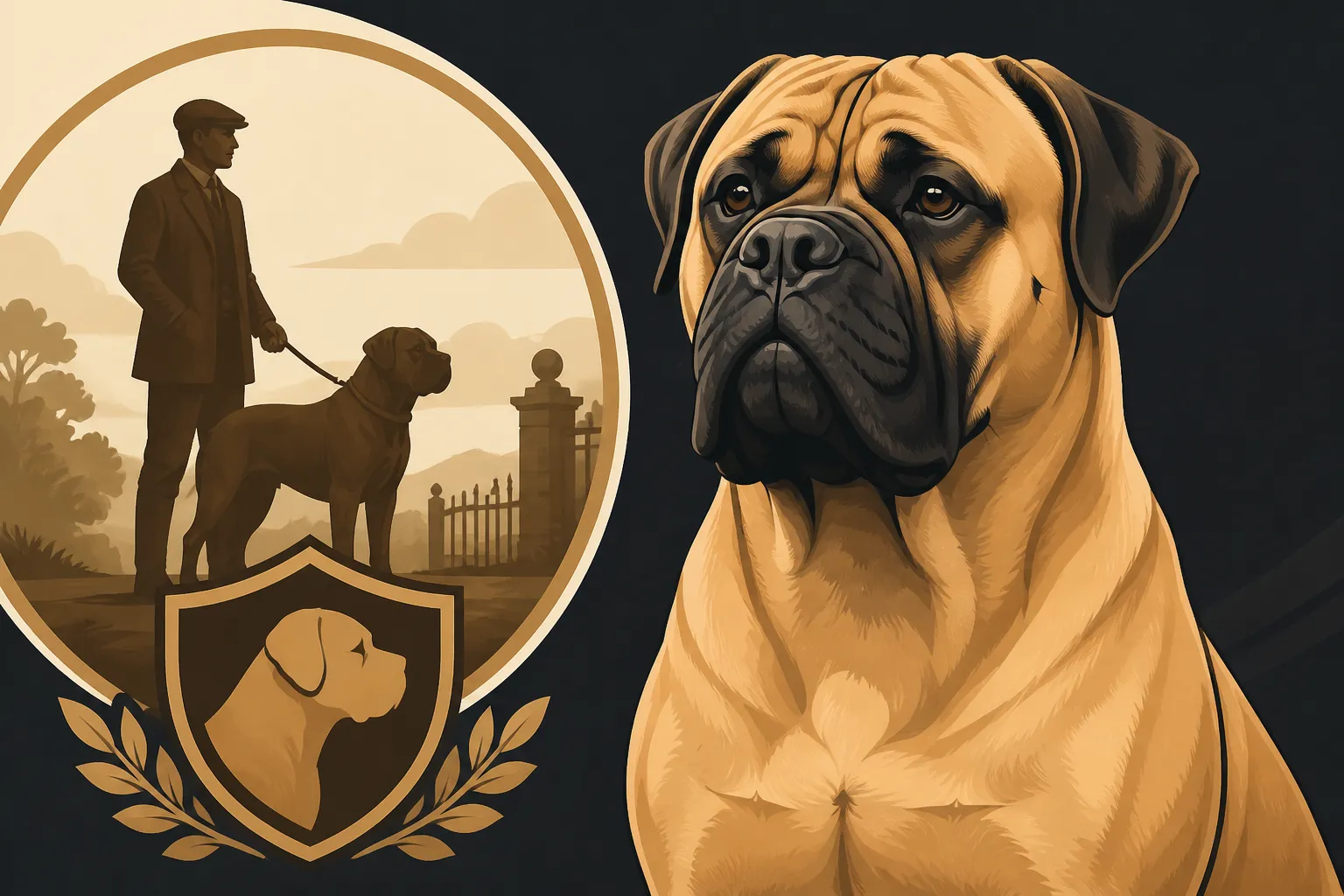
What Purity Meant for the Bullmastiff in 1924
A Bullmastiff described as “pure” in 1924 was not a dog with no Mastiff or Bulldog ancestry. The breed had been shaped from those roots, and the word meant something different: breeders were establishing a recognizable type that could be registered and bred consistently. This guide explains what purity meant at the time—and what it did not mean.
Why purity mattered in 1924
The Bullmastiff began as a working cross
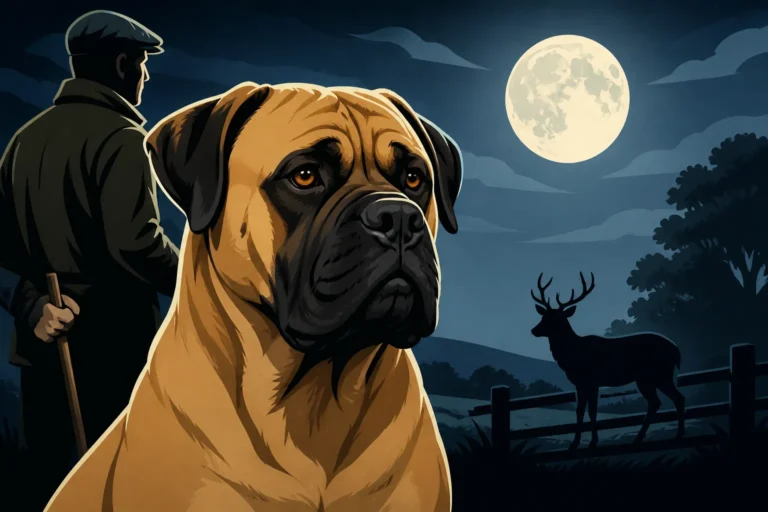
The Bullmastiff developed in England through dogs bred for a practical job: helping gamekeepers catch and restrain poachers. The work called for a dog with strength, courage, and enough speed to move across an estate, but not one bred to kill the person it caught. Mastiff and Bulldog ancestry is central to the breed’s history, though the dogs behind the earliest generations were not necessarily recorded in the kind of orderly pedigrees people might expect today.
You may have heard the often-repeated description of the Bullmastiff as roughly 60 percent Mastiff and 40 percent Bulldog. It is useful as a broad explanation of the breed’s background, but it should not be treated as a precise formula that every early breeder followed or every dog carried. The proportions were not a universal recipe guaranteeing a particular result. The dogs’ working ability and appearance mattered too.
That distinction helps make sense of what happened next. A breed can begin through crossing and later become established as a distinct population. The animals in its early history do not have to come from a long, closed line for breeders to begin selecting for a consistent type. For more background on the origins, see Which Breeds Went Into the Bullmastiff and Why the Bulldog Half Was Added to the Bullmastiff.
Registration gave a developing type a boundary
When the Kennel Club recognized the Bullmastiff in 1924, it marked an important step toward treating it as a distinct breed rather than simply a useful cross between two older breeds. Recognition gave breeders and owners a shared framework: the dogs being bred under the Bullmastiff name were expected to resemble one another in meaningful ways, and the name could be used in formal registration.
That framework helped define what “pure” could mean in the context of the time. It pointed toward dogs bred within an emerging Bullmastiff population, rather than newly produced crosses whose parents were simply a Mastiff and a Bulldog. The idea was not that the breed had never been crossed. Its history made that impossible. The idea was that the cross had developed into a recognizable breed, with an identity breeders intended to preserve.
Recognition did not instantly make every dog identical, nor did it erase variation among breeders’ lines. A standard and a registry can guide selection, but they cannot make a young breed uniform overnight. To understand the milestone itself, read When the Kennel Club Recognized the Bullmastiff. The broader transition is also covered in When the Bullmastiff Stopped Being a Crossbreed.
Purity was about a breed identity, not moral superiority
“Purebred” can sound as though a dog is more legitimate, healthier, or better than a crossbred dog. That is not what the historical label established. In 1924, the point was classification and continuity: the Bullmastiff was being recognized as a breed with a developing standard and a breeding population of its own. The label did not prove that a particular dog was superior at catching poachers, healthier than other dogs, or free of inherited problems.
It also did not mean that every dog registered as a Bullmastiff had exactly the same ancestry or came from a single, fully documented founding group. Early breed populations often include uncertainty in their records, particularly when working dogs were selected for usefulness before formal registration became the priority. Breed recognition organizes a population; it does not retroactively provide complete documentation for every ancestor.
That is why it is more accurate to describe 1924 as a turning point in the breed’s formal identity than as the moment when the Bullmastiff became genetically “pure” in a modern sense. The breed had been taking shape over time, and recognition acknowledged that process.
What breeders were trying to preserve
A recognizable working dog
Early Bullmastiff breeding was shaped by function as well as appearance. Gamekeepers needed a dog capable of moving quickly enough to intervene, strong enough to hold a person, and steady enough to work under control. The desired dog was not merely a large animal with a particular coat color. Its build and temperament were expected to support a specific kind of work.
That working purpose helps explain why the transition to a breed standard mattered. Once breeders began aiming for a consistent Bullmastiff type, they could make choices about which dogs to breed based on shared traits. A dog might be impressive in one respect but less suitable overall if it lacked the balance, soundness, or temperament breeders were trying to maintain.
The historical context matters here. The Bullmastiff was not created as an abstract show-ring shape first and given a story afterward. It developed from a practical need, then became more formally organized as a breed. The pressure to preserve a useful, recognizable dog is part of the story behind What English Game Laws Had to Do With the Bullmastiff and The Bullmastiff Was Built to Catch Poachers in the Dark.
A more consistent appearance and temperament
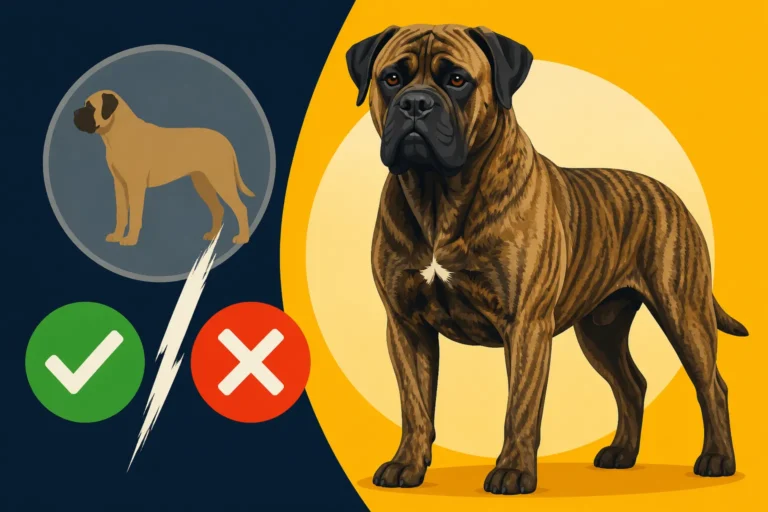
As breeders selected dogs over generations, they worked toward a type that people could identify as a Bullmastiff. That did not mean every dog had to be a carbon copy. Rather, there needed to be enough shared features that the name referred to a recognizable breed rather than a loose collection of Mastiff-Bulldog crosses.
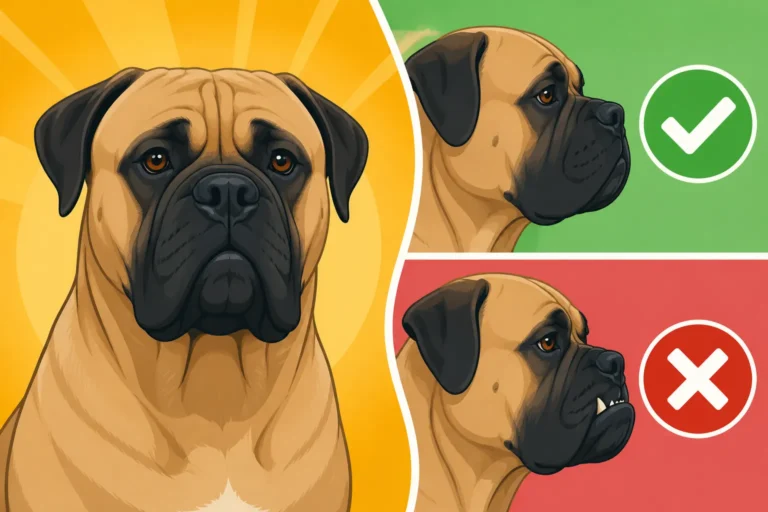
Consistency can involve several things at once: overall build, head and muzzle, coat, movement, and behavioral qualities. A written standard helps turn those preferences into guidance that breeders and judges can discuss. It also creates a common language for evaluating dogs, even though interpretation and emphasis can vary.
The same process has a practical limitation: a standard describes what breeders are aiming for, not a guarantee that every puppy will meet every ideal. A registered puppy is still an individual dog. Families considering a Bullmastiff today should look beyond a “purebred” label and ask about health testing, temperament, and the parents’ history. What a Bullmastiff Breeder Should Have Screened explains why those questions matter.
A registry and a standard were tools, not proof of perfection
A registry helps track which dogs are recognized within a breed population, while a standard describes the traits the breed should display. Those are useful tools for maintaining a shared identity. They are not a full account of every dog’s genetic history, and they do not promise that a dog will be free from disease or behavioral challenges.
This distinction is especially important for people reading historical claims online. A statement that the Bullmastiff was “made pure” in 1924 may suggest a clean, exact dividing line: before that date, crosses; after it, a completely settled breed. In reality, breed formation is usually more gradual. Recognition gives a formal milestone to a process that was already underway and continued afterward.
| Term | What it meant in the 1924 context | What it does not prove |
|---|---|---|
| Breed recognition | The Bullmastiff was formally treated as a distinct breed | That every dog looked or behaved identically |
| Registration | A dog was entered within the recognized breed system | That its entire ancestry was known in modern detail |
| Breed standard | A written guide to the desired type | That every puppy would meet every ideal |
| Purity | Breeding within an emerging Bullmastiff identity | Genetic perfection, guaranteed health, or superiority |
What purity did not mean
It did not mean the breed had no mixed ancestry
The most common misunderstanding is that a “pure Bullmastiff” must have descended from Bullmastiffs alone from the beginning of the breed’s history. But the Bullmastiff’s formation involved Mastiff and Bulldog ancestry. Its history is precisely why the word “pure” needs context: a breed can have crossbred origins and later be bred as a distinct type.
Think of a family trying to understand an old recipe that has been refined over time. The early cooks may have combined ingredients in different ways; later cooks may have settled on a recognizable version and passed it along. The fact that a recipe has a mixed origin does not mean it cannot become a tradition of its own. Likewise, the Bullmastiff’s later identity did not erase its origins.
Nor does the popular 60/40 description tell you that every Bullmastiff in 1924—or every dog behind the breed—had those exact proportions. It summarizes a commonly told account of the breed’s ancestry, rather than providing a complete genetic record for each individual. For more on that distinction, see Whether the Bullmastiff Formula Was Ever Written Down.
It did not mean every dog was genetically identical
Even within a registered breed, dogs inherit different combinations of traits from their parents. Littermates can differ in size, structure, coat, confidence, and other characteristics. A breed standard can encourage selection toward a shared type, but it cannot make inheritance perfectly predictable.
That is true now as well as it was in the breed’s early years. A pedigree can show recorded relationships, but it is not a promise that all relatives share the same health, temperament, or physical qualities. Responsible breeding involves evaluating individual dogs, choosing suitable pairings, and keeping health and welfare in view—not relying on the word “pure” as a shortcut.
For a prospective owner, the useful question is therefore not just, “Is this dog purebred?” It is also, “What do the breeder’s records tell me about the parents, their health, and their temperaments?” That question is more likely to help you understand the puppy you may bring home.
It did not mean purebred automatically meant healthier
Formal recognition and selective breeding can preserve a breed’s defining traits, but neither one guarantees good health. A breed can be clearly established and still have inherited health risks. This is one reason the historical use of “purity” should not be confused with an endorsement of health or quality.
When talking with a breeder, ask what health checks were performed, what the results showed, and whether there is a history of relevant conditions in the family. Ask to see documentation rather than relying only on a verbal assurance. A thoughtful breeder should be willing to discuss both the strengths and the concerns in their lines.
The same care applies when looking at any dog described as purebred, whether it comes from a breeder or rescue. The label tells you something about breed identity and recorded background, but it cannot answer every practical question about the individual animal.
How to understand the 1924 milestone today
Treat it as recognition of a developing breed
The most balanced way to read 1924 is as a formal milestone in the Bullmastiff’s development. The breed had roots in earlier crosses and working selection; recognition helped establish it as a separate type with a shared identity. Purity, in that setting, meant belonging to a breed that was being defined and bred consistently—not being free of mixed origins.
This reading avoids two oversimplifications. The first is that the Bullmastiff was always a fully fixed breed from its very beginning. The second is that recognition suddenly transformed a collection of crosses into perfectly uniform dogs. Breed formation is a process, and the 1924 recognition belongs within that process.
If you encounter a claim that a particular Bullmastiff is “pure” because of a date, an impressive pedigree, or a specific ancestry formula, ask what the claim actually refers to. Is it about registration? Recorded pedigree? Breed type? Historical roots? Those are related ideas, but they are not interchangeable.
Ask what the record can and cannot tell you
Historical records can reveal how a breed was named, recognized, and shaped. They may also show how breeders understood the dogs they were producing. But older records do not necessarily contain the detailed ancestry information, health testing, or genetic evidence that a modern reader might expect.
A careful account distinguishes documented facts from shorthand. For example, the 1924 recognition is a clear formal event; the exact ancestry of every early Bullmastiff is a different and more complicated question. Similarly, the 60/40 formula is a familiar description of the breed’s background, not a guaranteed measurement for each dog.
That nuance does not make the breed’s history less interesting. It makes it more honest. The Bullmastiff’s identity emerged through human choices: crossing dogs for a job, selecting for useful qualities, developing a recognizable type, and eventually recording the breed under its own name.
Use “purebred” as one detail, not the whole story
For today’s owner or buyer, breed identity can help set expectations about a dog’s likely size, appearance, and broad historical purpose. But it is only one part of a responsible decision. A Bullmastiff’s individual temperament, health, needs, and fit with your household matter far more than a label in isolation.
If you are researching a puppy, ask about the parents’ health and behavior, the breeder’s approach to raising and socializing puppies, and what support is available if the placement does not work out. If you are adopting, ask what is known about the dog’s medical and behavioral history, while recognizing that some details may be uncertain. These questions are more useful than treating “pure” as a guarantee.
In 1924, purity was about the Bullmastiff being recognized as its own breed after a history rooted in crossing and work. Understanding that difference lets you appreciate the milestone without turning it into a claim that the breed had no mixed ancestry or that every dog bearing its name is automatically alike.
Disclaimer
This article is for general informational purposes only and does not constitute professional advice. Laws, prices and regulations vary by location and change over time. Consult a qualified professional for guidance on your specific situation.