The Decade the Bullmastiff Crossed the Atlantic
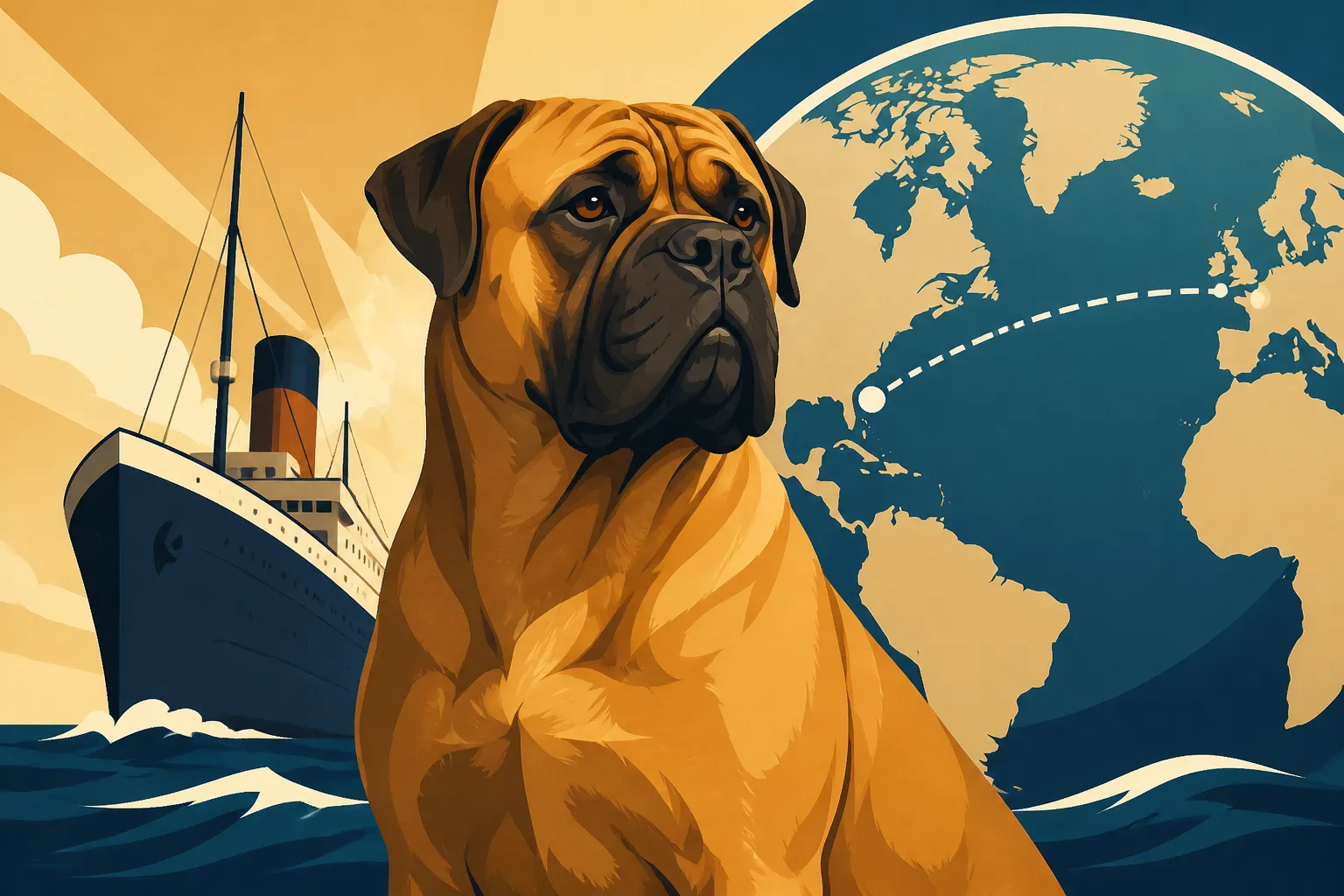
The Bullmastiff crossed the Atlantic as British breeders were establishing it as a distinct breed, but its arrival in America was not a single dramatic event with one universally cited date. The movement began in the 1920s, followed by formal American recognition in 1933. Here’s how the breed made that journey, why it attracted interest, and what its early American history does—and doesn’t—tell us.
When the Bullmastiff first reached America
The 1920s were a bridge between two breed histories
The Bullmastiff began as a British working dog, developed for gamekeepers who needed a strong, steady dog capable of stopping a poacher without mauling him. That history explains why the breed existed before it became an established show dog: its early identity came from the job it was expected to do, not from an American registry or a modern breed standard. For more on that background, see The Bullmastiff Was Built to Catch Poachers in the Dark.
By the 1920s, Bullmastiffs were beginning to cross the Atlantic. It is more accurate to think of this as a period of early imports than to picture one famous dog arriving on one confirmed day and instantly founding the American breed. Dogs could be brought over by individual owners, breeders, or people interested in a particular working type. Their arrival did not, by itself, mean that a large, organized American breeding community already existed.
The Atlantic crossing also came after the breed’s British identity had started to take shape. The Bullmastiff was recognized by the Kennel Club in Britain in 1924, a milestone that helped distinguish it as a breed rather than simply a type of mastiff-and-bulldog cross. That recognition is part of the story in When the Kennel Club Recognized the Bullmastiff. British recognition and American arrival happened close enough in time to overlap, but they were separate developments.
American recognition followed in 1933
The American Kennel Club recognized the Bullmastiff in 1933. That recognition matters because it gave the breed a formal place in American dog records and made it easier for breeders and owners to build a visible, organized population. It was not the moment the first Bullmastiff set foot in the country; it was a later milestone in the breed’s establishment there. The timeline is explored further in When the AKC Recognized the Bullmastiff.
| Milestone | What it tells us |
|---|---|
| Bullmastiffs begin arriving in America during the 1920s | Individual imports came before broad American recognition |
| British Kennel Club recognition in 1924 | The breed was being formally established in Britain |
| American Kennel Club recognition in 1933 | The breed gained formal recognition in the United States |
It is easy to compress this into “the Bullmastiff arrived in America in the 1920s and became American in 1933,” but the reality is more gradual. A breed’s presence, its organized breeding, and its registry recognition are different things. A few imported dogs can spark interest; a sustainable population requires more dogs, committed owners, breeding decisions, and time.
That distinction is useful when reading breed histories generally. The date a breed was recognized by a registry is not necessarily the date it first arrived, and early imports do not automatically mean there was already a large local population. For the Bullmastiff, the 1920s mark the start of the transatlantic story, while 1933 marks a key point in its formal American story.
Why the Bullmastiff appealed to people across the Atlantic
Its working background made it distinctive
The Bullmastiff was not simply a large dog with an imposing appearance. Its traditional role called for a combination of strength, composure, and restraint. A gamekeeper needed a dog that could confront and hold a person, not a dog that would bite indiscriminately. That practical purpose helped shape the breed’s reputation and made it stand out among other powerful dogs.
The familiar description of the Bullmastiff as roughly sixty percent Mastiff and forty percent Bulldog is a useful shorthand for its origins, but it shouldn’t be treated as a precise formula applied to every dog in every generation. Breed development was a process, not a laboratory recipe. The Mastiff contributed size and substance, while Bulldog ancestry is associated with tenacity and a more compact, powerful build. The background is covered in Which Breeds Went Into the Bullmastiff.
For American dog enthusiasts, that combination offered something distinct: a substantial guardian with a history of working closely with people. Its appeal was not only its size or its ability to deter. The breed’s working story suggested a dog bred to make decisions in a specific setting, then respond with control. That is a different image from a dog bred simply to be aggressive.
Imported dogs did not need to recreate their original job
Once in America, Bullmastiffs did not need English estates or poachers to have a place in people’s lives. Their role could change as they moved from working environments into private homes and properties. A dog that had been selected for estate work might become a companion and household guardian, with its strength and imposing presence still valued even though the original work was no longer part of everyday life.
It is tempting to assume that every early American Bullmastiff was imported specifically to guard an estate. Some may have been valued for that purpose, but an individual dog’s reason for being imported could vary. People may have been interested in the breed’s appearance, temperament, working ability, or breeding potential. To explore the estate-guarding question without assuming that every dog had the same role, see Whether Bullmastiffs Guarded American Estates.
The broader point is that a breed can travel without carrying its original occupation intact. The Bullmastiff’s physical abilities and temperament came from its history, but American owners encountered the dog in their own context. That transition from a specialized British working dog to a recognized American breed happened through people choosing to keep, breed, and promote it—not through a simple transfer of its old job to a new country.
From imported dogs to an American breed community
Individual importers helped turn arrival into establishment
A handful of imported dogs can create curiosity, but building a breed population takes sustained effort. Owners need to find suitable breeding partners, maintain records, and decide which traits they want to preserve. When the early Bullmastiffs arrived in America, they became part of a process that depended on people who could connect those dogs with future owners and breeders.
Those early importers are important, but the history can be difficult to reduce to one hero or one shipment. A dog’s journey might be remembered in family records, breeder accounts, or later breed histories, and those records do not always produce one tidy answer about who brought the very first Bullmastiff over. The people involved are the focus of Which Americans Imported the First Bullmastiffs.
That uncertainty should not be mistaken for a lack of history. It is common for early breed development to be less neatly documented than later registry events. Formal recognition leaves a clearer date than a gradual stream of private imports. So, when the story gives a broad decade rather than a single arrival date, that can be a more honest way of describing how a breed moved between countries.
Recognition helped create a shared standard
A registry can give breeders and owners a common reference point. It helps establish which dogs are recognized as members of a breed and gives organized breeding communities a way to record lineages and show dogs. In the United States, the Bullmastiff’s 1933 AKC recognition made the breed more legible within the American dog world. It did not erase British influence; rather, it gave American owners a formal framework for building on the breed’s existing history.
Recognition also doesn’t mean that a breed’s development stops. Standards describe the traits considered desirable, while actual dogs and breeding choices continue to evolve. British and American populations can develop different emphases over time, even when they share the same breed identity. For a closer look at those distinctions, see How the British and American Bullmastiff Differ.
The same caution applies to the idea that an American Bullmastiff instantly became a separate type as soon as it crossed the ocean. The dogs and their ancestry remained connected to Britain, and a national registry did not make the breed’s earlier history disappear. The American chapter grew from imported dogs, local breeders, and a formal recognition process that gave the breed a more established footing.
What the Atlantic crossing means today
It was a change of setting, not an overnight transformation
The Bullmastiff’s move to America is best understood as a gradual change in setting. The breed’s roots were British, its earliest American presence came through imports, and its formal U.S. recognition followed later. That sequence matters because it separates three ideas that are often blurred together: where the breed developed, when dogs began arriving in America, and when an American registry recognized it.
The crossing did not instantly turn the Bullmastiff into a different kind of dog. Its history, build, and purpose continued to influence how people understood it. But its daily life changed as it entered new households and surroundings. A dog bred for work on an English estate might become a companion in an American home, with its historical traits expressed in a different role.
That shift is common in breed history. Dogs move because people move them, and their work changes as human needs change. The Bullmastiff’s journey is a reminder that “working breed” describes a history and a set of inherited traits; it doesn’t mean that every modern dog performs the original job.
The history can add context without predicting an individual dog
Knowing that Bullmastiffs were developed as controlled, powerful working dogs can help explain why people have long valued their imposing presence and steadiness. But history alone cannot tell you exactly how an individual dog will behave. Temperament, socialization, training, health, and the circumstances a dog encounters all matter. A century-old working role should not be treated as a personality guarantee for a puppy in a modern household.
For prospective owners, the Atlantic story is a useful starting point, not a complete guide to living with the breed. It may lead naturally to questions about the Bullmastiff’s place in the working group, its behavior around visitors, and the practical responsibilities that come with a very large dog. Those topics are explored in Why the Bullmastiff Is in the Working Group and What Nobody Tells You Before Buying a Bullmastiff.
The simplest accurate account is this: Bullmastiffs began reaching America in the 1920s, while formal American Kennel Club recognition came in 1933. Between those points—and continuing afterward—individual owners and breeders helped turn imported dogs into an established American presence. The breed crossed an ocean, but its identity took shape over time.
Disclaimer
This article is for general informational purposes only and does not constitute professional advice. Laws, prices and regulations vary by location and change over time. Consult a qualified professional for guidance on your specific situation.