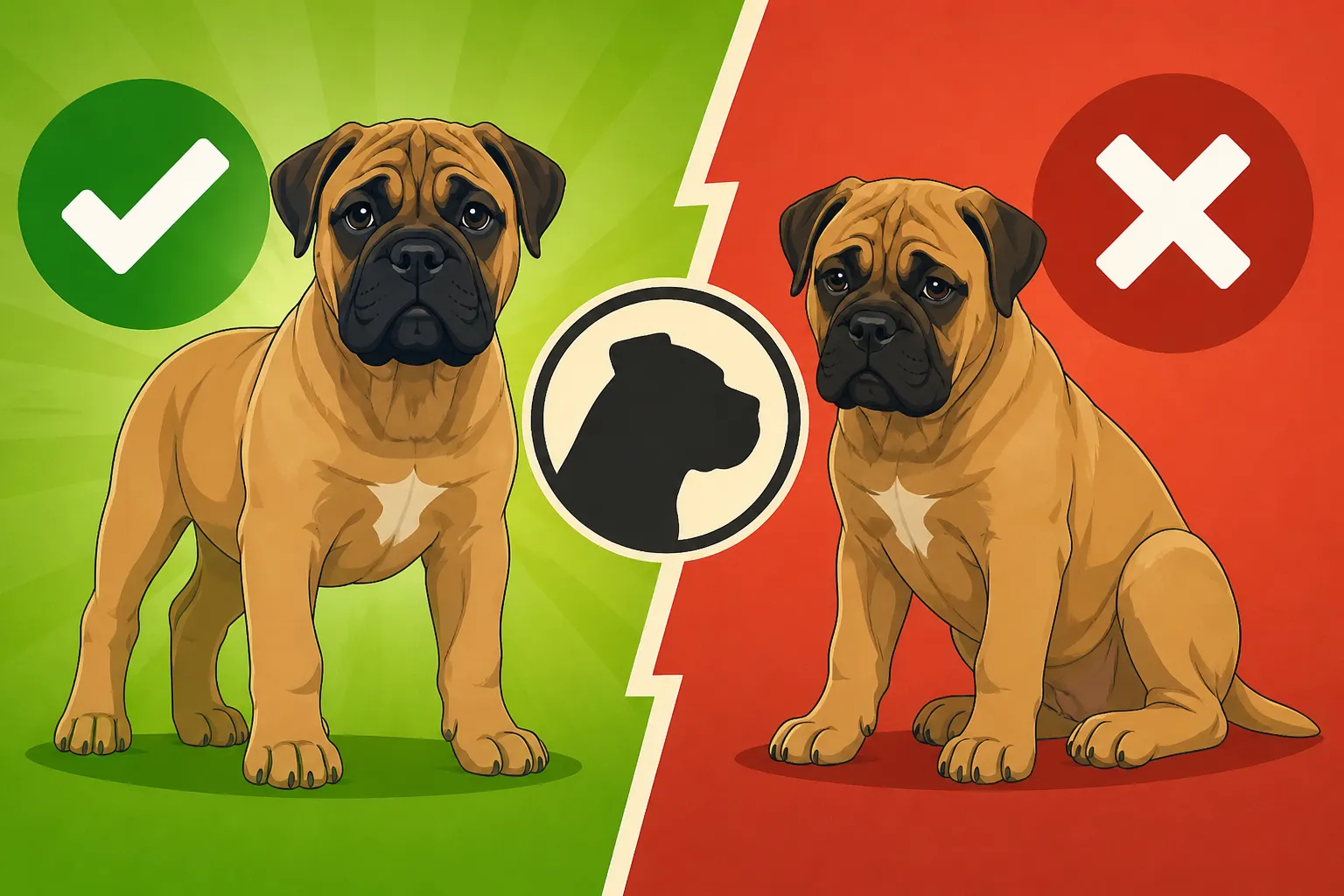
Whether a Small Bullmastiff Is Faulted
A compact Bullmastiff can look surprisingly small beside a tall male, especially during the long puppy-to-adult growth period. But “small” is not a formal judging category: what matters is the dog’s age, sex, measurements, proportions, and the standard used in the ring. This guide explains when size may count against a Bullmastiff and when it is simply normal variation.
What counts as small for a Bullmastiff
Compare an adult with the standard for its sex
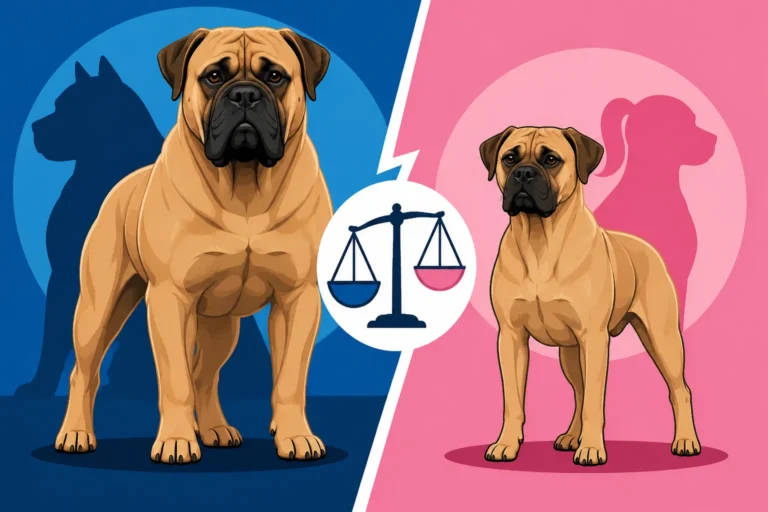
A Bullmastiff should be judged against the expected size for its sex, not against the biggest dog in the neighborhood or the largest one at a show. In the American Kennel Club standard, adult males are expected to stand 25 to 27 inches at the shoulder and weigh 110 to 130 pounds. Adult females are expected to stand 24 to 26 inches and weigh 100 to 120 pounds.
Those ranges help put “small” in context. A female at the lower end of the standard is not automatically undersized simply because she is shorter or lighter than a male. Similarly, a male toward the lower end is not necessarily too small. For a fuller breakdown of measurements, see How Tall a Bullmastiff Stands and How Much a Bullmastiff Weighs.
The key distinction is between being at the lower end of an accepted range and falling clearly outside the range. A dog may look small in a photo or beside an especially substantial companion while still measuring within the standard. A judge has a measured dog in front of them and evaluates it against the standard for the breed, rather than against an informal idea of what a “big Bullmastiff” should look like.
Puppies and adolescents are not judged like finished adults
A young Bullmastiff can go through awkward growth stages. Legs may look long before the chest and body have filled out; a teenager may be tall but lean; another may look sturdy early and then grow more gradually. Those changes are part of development, not a reliable reason to label a puppy permanently undersized.
Age matters because adult height and weight standards are not targets to force a growing dog toward. A puppy who has not reached adult size should be considered in light of its age and development, and growth is best discussed with a veterinarian who can assess the individual dog. Deliberately overfeeding a puppy in an effort to make it larger can create avoidable strain on developing joints.
For owners, regular measurements are more useful than guessing from appearance. Record height at the shoulder and weight at consistent intervals, and bring the record to routine veterinary visits. If you order food through Chewy or another retailer, keeping the food label and portion notes with your growth log can help you discuss the puppy’s diet without relying on memory.
Is a small Bullmastiff faulted in the show ring
Being below the preferred look is different from being outside the standard
In ordinary conversation, “faulted” often means any feature that is less than ideal. In conformation judging, a fault is a specific departure from the breed standard, and not every difference is treated equally. Size is one part of the picture, alongside structure, movement, balance, and overall type.
Under the AKC Bullmastiff standard, dogs clearly outside the specified height or weight limits are disqualified. That is a stronger consequence than a judge simply preferring a dog nearer the middle of the range. The word “clearly” matters: a casual impression that a dog looks small is not the same thing as establishing that it falls outside the stated limits. If you are preparing for a show, check the standard and rules for the registry and country where the dog will compete.
A smaller adult that remains within the standard’s measurements is not automatically disqualified or marked down merely for being at the lower end. Judges assess the dog as a whole. A dog with sound proportions and movement may present a different overall impression from one that is genuinely below the specified size. The standard’s picture of the breed includes balance and substance, not just a number on a scale. For context on the intended outline, see Whether a Bullmastiff Should Look Square.
The governing registry matters
Breed standards are not universal rulebooks. Different kennel clubs may describe measurements, judging criteria, or the consequences of a size departure differently. The AKC ranges above are useful for U.S. owners and exhibitors, but a dog entered under another registry should be evaluated under that registry’s own standard.
This difference can surprise owners who travel to shows, compare online advice from different countries, or see measurements quoted without a registry named. If a breeder says a dog is “within standard,” ask which standard they mean. If a show entry is at stake, confirm the current rules with the relevant kennel club or show organization rather than relying on a general breed description.
The broader breed type can also be misunderstood when people compare Bullmastiffs with other mastiff breeds. A Bullmastiff is not expected to match the height or mass of a larger Mastiff; its own standard sets its proportions and size expectations. Why the Bullmastiff Standard Stops Short of Mastiff Height and Whether a Bullmastiff Is Smaller Than a Mastiff offer useful context for that comparison.
| Situation | What it usually means | Practical next step |
|---|---|---|
| Adult is at the lower end of the sex-specific range | May still be within the standard | Measure accurately and check the correct registry standard |
| Puppy looks small for its age | Appearance alone does not establish adult size | Track growth and ask a veterinarian about healthy development |
| Adult measures clearly below the applicable minimum | May fall outside the standard and affect show eligibility | Confirm measurements and consult the governing registry |
| Dog looks smaller beside a large companion | The comparison may be misleading | Compare the dog with the written standard, not another individual |
| Dog is light but appears lean or unwell | Size may not be the only concern | Ask a veterinarian to assess body condition and health |
Why a Bullmastiff can look small without being undersized
Sex, frame, condition, and proportions change the impression
A female standing beside a large male can look petite while being entirely typical for her sex. Frame also affects visual impression: some dogs appear more compact, while others seem taller or longer. Coat, posture, camera angle, and the dog’s stance can make a meaningful difference in photographs, too. A picture is a poor substitute for a careful measurement.
Body weight is especially easy to misread. A lean dog may weigh less than a heavier dog of the same height, but a lower number alone does not establish whether the dog is appropriately conditioned or too thin. Likewise, extra weight can make a dog appear more substantial without making its underlying structure better. The goal is not to make a Bullmastiff as heavy as possible; it is to maintain healthy condition and sound movement.
If you are unsure whether your dog is lean, small-framed, or simply still maturing, use a veterinarian’s hands-on assessment rather than trying to correct the appearance with extra food. Chewy can be part of an owner’s normal food-order routine, but portion changes should be based on the dog’s needs and professional advice, not on a desire to hit a show-ring weight.
Growth should be steady, not forced
Bullmastiffs are a giant breed, and their development takes time. A puppy may look less imposing than expected for months, then gradually gain height, chest, and muscle as it matures. Growth does not proceed in a perfectly even line, so a short-term plateau or a temporarily rangy appearance should not automatically cause alarm.
Keep a simple record of weight, food portions, activity, and veterinary observations. If the puppy’s growth seems to stall, or there are signs such as poor appetite, low energy, digestive problems, or an unhealthy coat, discuss those concerns with a veterinarian. The question is then not only whether the puppy is small, but whether its overall development is healthy.
Avoid adding supplements or increasing calories just to make a dog larger unless a veterinarian recommends a change. Feeding for rapid size gain can work against healthy development, and excess weight can be hard on a large dog’s joints. For a broader look at how structure and size fit together in the breed, see What a Bullmastiff Judge Puts a Hand On First.
How to assess a small Bullmastiff sensibly
Measure consistently and use the right reference
For height, the dog should be standing squarely on a level surface, with the measurement taken at the highest point of the shoulder blades. It can be tricky to measure an excited or wiggly dog accurately, so ask a veterinarian, experienced breeder, or show handler to demonstrate the technique if needed. Weight should be recorded on a reliable scale; a clinic scale is often easier for a large dog than a household bathroom scale.
Then compare the result with the relevant standard for the dog’s sex, age, and registry. Do not compare a puppy with adult measurements, or a female with the male range. If a measurement is close to a boundary, repeat it carefully rather than treating one rough measurement as conclusive.
For show questions, ask an experienced breed mentor or the show organization how measurements are handled. A judge evaluates the dog in the ring according to the rules and standard; informal comments from spectators are not an official decision. Standards may also differ between countries, as discussed in How the British and American Bullmastiff Differ.
Separate a size concern from a health concern
A naturally smaller adult may be healthy, active, and well proportioned. A dog that is losing weight unexpectedly, failing to grow as expected, or showing other changes deserves a veterinary assessment, regardless of how it compares with the breed standard. The same is true of a dog that is overweight: looking bigger does not necessarily mean it is healthier or closer to the ideal.
When talking with a veterinarian, bring specific details: the dog’s age, recent weights, appetite, diet, activity, and any symptoms. If you use Chewy for food or routine supplies, keep your feeding records alongside those details. That makes it easier to describe what has changed and when, instead of trying to reconstruct a month of meals during an appointment.
If you are choosing a puppy, ask the breeder about the parents’ size, the puppy’s growth, and health screening, but treat adult-size predictions as estimates rather than promises. A responsible breeder should be willing to discuss the range seen in their dogs and explain which breed standard they use. The discussion should focus on soundness and health, not simply producing the largest possible puppy.
In short, a Bullmastiff is not automatically faulted for being smaller than another dog. The important questions are whether the dog is being compared with the correct sex-specific and registry standard, whether it is fully mature, and whether its measurements are actually outside the accepted range. A healthy dog at the smaller end of the standard is a very different case from an adult clearly below the applicable limit.
Disclaimer
This article is for general informational purposes only and does not constitute professional advice. Laws, prices and regulations vary by location and change over time. Consult a qualified professional for guidance on your specific situation.