Whether a Toddler Is Safe Around a Bullmastiff’s Bulk
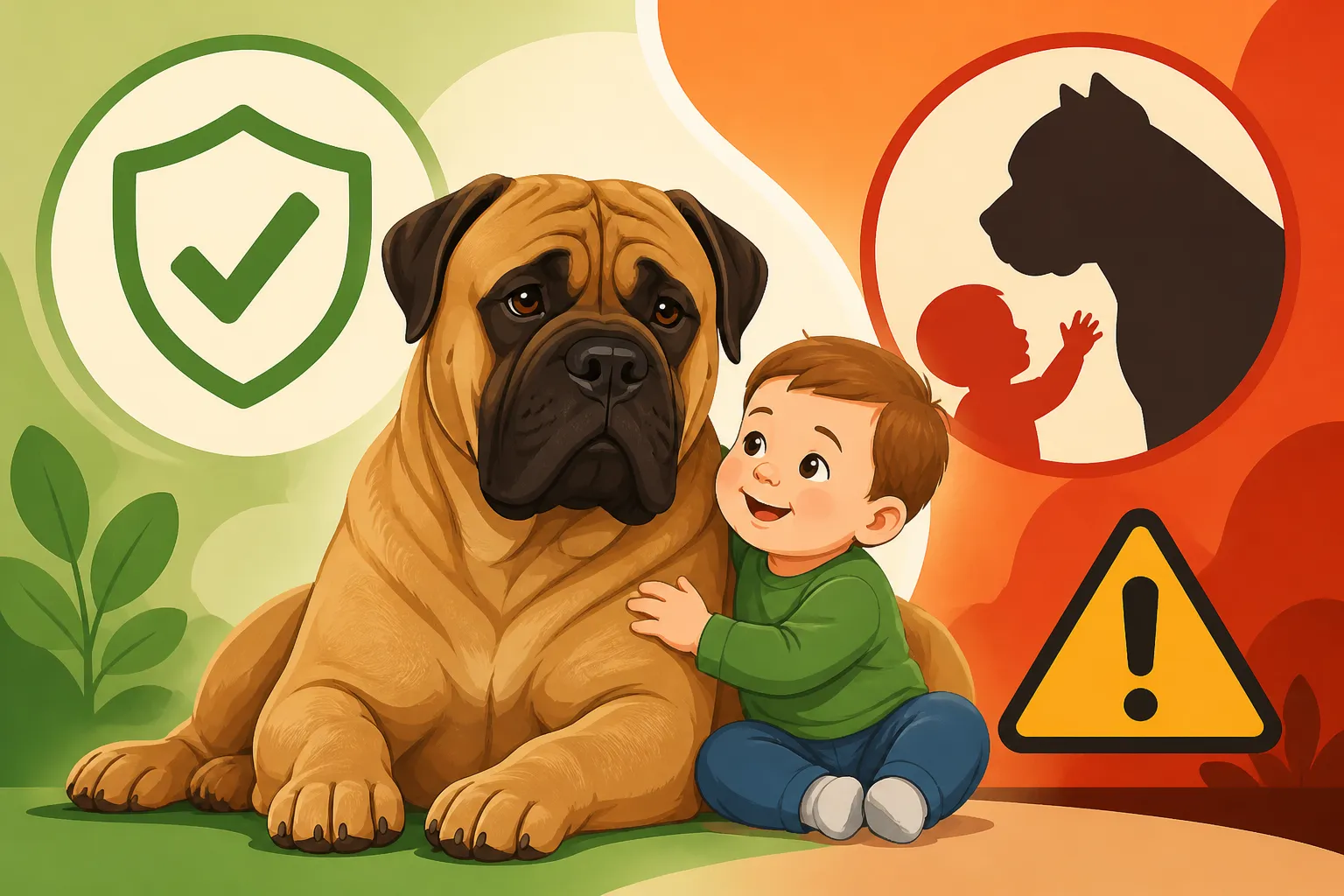
A Bullmastiff can be gentle with children and still accidentally knock a toddler over. The risk is not only aggression: a heavy body, swinging tail, excited greeting, or startled turn can overwhelm a small child. This guide explains how to manage the size difference, set up safer routines, spot discomfort, and decide when a toddler and Bullmastiff should be separated.
Why a Bullmastiff’s Size Changes the Safety Picture
A friendly dog can still cause an accidental injury
Bullmastiffs are powerful, heavy dogs. Even a calm dog can bump a toddler while turning around, lean against them for attention, or step on a small foot while moving through a crowded room. A wagging tail can catch a child at face height, and a playful nudge that barely registers for an adult may send a young child off balance.
That is why “good with kids” and “safe without close supervision” are not the same thing. Temperament matters, but so do the dog’s size, the toddler’s balance, and how much space the pair have. A Bullmastiff that has lived peacefully with older children may still need careful management around a newly mobile toddler who squeals, runs, grabs, or suddenly falls.
This distinction can be frustrating for families who know their dog as a patient, affectionate companion. It is not a judgment of the dog or a prediction that an accident will happen. It is a practical recognition that a small child can be hurt by ordinary dog movement, even when nobody intended harm. For more on breed temperament and family life, see A Bullmastiff With Children and How a Bullmastiff Behaves With Children.
Toddlers and dogs communicate differently
A toddler may not understand that hugging a dog’s neck, pulling an ear, climbing on the dog, or reaching toward a food bowl can feel uncomfortable or threatening. Young children also have limited impulse control. They can move from gentle petting to grabbing in a moment, especially when they are tired, excited, or upset.
Dogs, meanwhile, often communicate discomfort quietly before they growl or move away. A Bullmastiff may turn its head, lick its lips, yawn, stiffen, look away, or try to leave. If the child keeps following or touching the dog, that early signal can be missed. Adults need to step in before the dog has to make its message more obvious.
A toddler’s unpredictable movement can also startle a dog that is resting. A sudden shriek or stumble near the dog’s face may trigger a defensive reaction, even in a dog with no history of aggression. Families comparing breed behavior can read Whether a Bullmastiff Knocks Over Toddlers for a closer look at the accidental-bump risk.
Individual temperament matters more than a reassuring label
No breed description can guarantee how one particular dog will respond to a particular child. Age, health, pain, socialization, past experiences, sleep, and the immediate situation all affect behavior. A dog with sore joints may be less tolerant of a toddler bumping into it. A dog that is startled awake may react differently from one calmly greeting a child in an open room.
Look at what your dog actually does. Does it choose to move away when the toddler approaches? Can it relax behind a barrier? Does it remain loose and comfortable when the child is nearby, with an adult managing the interaction? Or does it freeze, avoid the child, guard resting spots, or become tense around food and toys? These observations are more useful than assuming every Bullmastiff is naturally patient.
If your dog has growled, snapped, bitten, or repeatedly shown fear around children, do not test whether the behavior has passed by allowing closer contact. Keep the child and dog physically separated and seek help from a qualified veterinary behavior professional or experienced, reward-based trainer.
How to Manage Toddler and Bullmastiff Interactions
Supervise closely and stay within reach
Supervision means an attentive adult is close enough to intervene immediately—not watching from another room, cooking with their back turned, or relying on a camera. During direct interaction, stay near the child and dog, keep the session brief, and end it while both are still comfortable. If you need to answer the door or help another child, create separation first.
An adult can guide a toddler to offer a gentle stroke on the dog’s shoulder or side, if the dog is relaxed and freely able to move away. Avoid encouraging face-to-face contact, hugging, climbing, pulling, or touching the dog while it eats, sleeps, chews, or rests in a protected space. Do not ask the dog to tolerate handling simply to demonstrate that it is “good.”
Even with constant supervision, a toddler should not be left alone with a Bullmastiff. A child can move quickly, and a large dog can react or shift position faster than an adult can cross a room. For more on the limits of child-dog contact, see Whether a Bullmastiff Should Be Left With Children.
Build physical boundaries into the home
Baby gates, closed doors, and a dog-only resting area make safety less dependent on everyone remembering the rules every minute. Give the Bullmastiff a quiet place where the toddler cannot follow. The dog should be able to rest without being approached, and the child should learn that the dog’s bed, crate, or gated area is off-limits.
A gate is especially useful during busy transitions: when groceries are being carried in, a child is having a tantrum, dinner is being served, or visitors arrive. It lets the dog observe household life without being in the middle of a crowded, unpredictable moment. If you are shopping for a gate or other dog-management supplies, a retailer such as Chewy may be one place to compare available options; check product dimensions and installation requirements for your home.
A crate can also provide a retreat if the dog has been gradually taught to feel comfortable there. It should never be used as punishment or treated as a place where a toddler can reach through the bars. A dog that is cornered in a crate or bed still needs space. Make the boundary simple for everyone: when the dog is in its resting area, the child does not approach.
Keep greetings calm and controlled
Excited greetings are a common time for accidental knocks. When the toddler enters the room, have the dog on a leash or behind a barrier until it is calm. Ask for a familiar, easy behavior such as sitting or settling on a mat, and reward calm attention. If the dog is too excited to respond comfortably, increase distance rather than trying to hold it in place beside the child.
Teach the toddler to pause and let the dog approach rather than chasing after it. The dog should always be able to turn away and leave. Do not restrain the dog so the child can pet it, and do not hold the child in place for a forced introduction. A positive meeting is one in which both can disengage.
If your Bullmastiff tends to lean, jump, or push into people, address that behavior before allowing close toddler interaction. Practice polite greetings with adults first, using a leash and rewards. The article How a Bullmastiff Handles a Toddler can help you think through the specific challenges of everyday contact.
| Situation | Safer approach | Avoid |
|---|---|---|
| The dog is eating or chewing | Give the dog a separate, child-free area | Letting the toddler approach the bowl or take an item |
| The dog is sleeping | Leave the dog undisturbed or guide the child away | Waking the dog by touching, climbing, or calling in its face |
| The toddler wants to pet | Stay close, invite a brief gentle stroke only if the dog is relaxed | Hugging, grabbing, climbing, or holding the dog in place |
| The dog gets excited at the door | Use a leash or barrier until everyone settles | Letting the dog rush up to the child |
| An adult must leave the room | Separate the dog and child before stepping away | Assuming a familiar dog and child will be fine for a moment |
Teach the Dog and Toddler Safer Habits
Train practical behaviors before they are urgently needed
Useful skills include settling on a mat, moving away from a doorway, walking calmly on leash, leaving an item when asked, and responding to a recall indoors. Practice in quiet conditions first, reward cooperation, and keep sessions manageable. Training is not a substitute for barriers or supervision, but it can make ordinary household moments easier to manage.
Teach these behaviors without yelling, intimidation, or physical correction. Harsh handling can increase stress and make the dog less comfortable around the child. If the dog struggles to respond around a toddler, lower the difficulty: increase distance, remove distractions, and practice with an adult before bringing the child into the exercise.
The toddler also needs simple, repeated rules. Use short phrases such as “let the dog sleep,” “hands gentle,” and “come get me.” Do not expect a young child to remember rules consistently or to judge a dog’s mood. An adult remains responsible for managing the interaction, even when the toddler has learned to be careful.
Notice early signs that the dog needs space
A dog may show discomfort without growling. Watch for a stiff body, closed mouth, ears held differently from the dog’s relaxed baseline, repeated lip licking, yawning when not tired, turning away, whale eye, panting unrelated to heat or exercise, or trying to leave. These signs do not prove the dog is about to bite, but they are a clear reason to pause and create distance.
If you see one of these signals, calmly call the toddler away or guide the dog to a safe retreat. Do not scold the dog for growling. A growl is important information that the dog is uncomfortable; punishing the warning may make the situation less predictable. Instead, end the interaction and consider what made the dog feel trapped, startled, or pressured.
Changes in behavior deserve attention, too. A Bullmastiff that suddenly avoids the toddler, guards a bed, reacts to touch, or becomes unusually irritable may be uncomfortable or in pain. Arrange a veterinary check when behavior changes abruptly, particularly if the dog is older or showing signs of stiffness. How Careful a Bullmastiff Is Around Children offers more context on reading individual behavior rather than relying on assumptions about the breed.
Protect the dog’s essential resources
Food, chews, toys, beds, and favorite resting places can become flashpoints when a toddler wanders close. Feed the dog behind a closed door or secure gate. Pick up high-value chews when the child is present, and do not let the toddler take toys from the dog’s mouth. Adults should manage these situations rather than asking the dog to “share.”
The same principle applies to personal space. A dog resting beneath a table or tucked into a corner may have limited ways to move away. Arrange furniture and barriers so the dog has a clear exit route. The safest plan is not to teach the toddler to test boundaries, but to prevent the child from entering situations where the dog may feel cornered.
A simple household routine helps. For example, the dog eats behind a gate, rests in a child-free room during naps, and greets the toddler only when an adult is available. If you need practical items such as a secure leash or a designated dog bed, Chewy may be a retailer to browse, but choose equipment suited to your dog’s size and your household layout.
When to Separate Them and Get Extra Help
Separation is the right choice in some situations
Keep the toddler and dog apart when either is overstimulated, sick, hurt, exhausted, or difficult to supervise. Separate them during meals, high-energy play, roughhousing, visitors’ arrivals, and moments when the toddler is crying or running unpredictably. Separation is also appropriate if the dog is guarding a resource, trying to escape, or showing signs of fear.
A safe plan can still allow the dog to be part of family life. The Bullmastiff can relax behind a gate while the child plays nearby, join the family when the toddler is seated and an adult is present, or enjoy quiet time with another adult in a separate room. The goal is not to force constant closeness; it is to make shared space predictable and comfortable.
Families expecting a baby or bringing a toddler into a home with a dog should introduce changes gradually. New furniture, altered routines, and sudden attention shifts can affect a dog’s comfort. For guidance on a younger child’s arrival, see How a Bullmastiff Behaves With a Baby and How to Introduce a Bullmastiff to a New Person.
Get professional advice when warning signs appear
Seek qualified help if the dog has snapped, bitten, lunged, guarded food or resting places, or repeatedly frozen when the child approaches. Also get support if you cannot reliably keep the two separated, if the dog is difficult to control on leash, or if adults disagree about how much contact is safe. A veterinary behavior professional can assess the dog’s health and behavior and help create a plan tailored to the household.
Do not rely on a child’s ability to “be gentle,” a dog’s past good behavior, or a promise that the dog would never hurt anyone. A safe arrangement depends on management every day. If you have doubts about whether you can supervise closely and maintain physical boundaries, keep the child and dog separated until you have a workable plan.
Disclaimer
This article is for general informational purposes only and does not constitute professional advice. Laws, prices and regulations vary by location and change over time. Consult a qualified professional for guidance on your specific situation.