How a Bullmastiff Behaves With Children
Bringing a magnificent Bullmastiff into a home, especially one with children, can be a joyful but also somewhat daunting prospect for many families. Parents often wonder if such a large and powerful dog can truly be a safe and gentle companion for their little ones, or if the sheer size alone poses too great a risk. This guide will walk you through the nuances of a Bullmastiff's behavior with children, helping you understand their natural instincts, how to navigate their physical presence, and the essential steps you need to take to foster a harmonious, safe, and loving environment for everyone.
Understanding the Bullmastiff's Natural Temperament Around Children
It's completely normal to feel a mix of excitement and apprehension when picturing a massive dog like a Bullmastiff sharing space with your precious children. After all, their size is undeniable, and their breed history involves guarding. But delve a little deeper, and you'll often find a truly remarkable nature that, with the right guidance, can make them an incredible family member.
The Gentle Giant Stereotype and Reality
The term "gentle giant" is often thrown around casually, but for many Bullmastiffs, it truly rings true. These dogs were historically bred not to attack or injure poachers, but to silently track and then hold them until the gamekeeper arrived. This foundational instinct means they possess an innate sense of responsibility and control, preferring to use their immense presence and body language over aggression. They are typically calm, observant, and surprisingly mellow indoors, often content to lounge near their family, keeping a watchful eye on their surroundings. This calm demeanor makes them generally tolerant of the hustle and bustle that children bring into a home, far more so than some breeds that are easily startled or overstimulated.
However, it's crucial to understand that "gentle giant" is not a guarantee that absolves owners of their responsibility. While their temperament is generally stable, every dog is an individual. A Bullmastiff's sheer size means that any lapse in judgment, whether by the dog or the humans, can have significant consequences. Their gentle nature is a wonderful starting point, but it must be nurtured through consistent training, proper socialization, and vigilant supervision to remain a reality. It's about setting them up for success, not just hoping for the best.
Patience and Tolerance with Little Ones
One of the most endearing qualities of many Bullmastiffs is their remarkable patience and tolerance, especially with younger children. They often seem to inherently understand that little humans are different—clumsy, noisy, and prone to unpredictable movements. I’ve seen Bullmastiffs who will simply sigh and shift their position when a toddler inadvertently uses them as a headrest, or who will let a small child "help" them drink water with a splash. This high threshold for minor annoyances is a huge asset in a busy family home. They rarely react impulsively or with aggression to typical childish antics, preferring instead to retreat or simply endure.
That said, it's vital to remember that tolerance has its limits for any dog. A Bullmastiff might tolerate a child pulling on an ear for a moment, but persistent or painful grabbing can eventually elicit a defensive response. It's not about whether the Bullmastiff will snap, but about ensuring they are never put in a position where they feel they need to. The adults in the household are the ultimate protectors of both the dog and the child, responsible for teaching boundaries to both parties and ensuring interactions are always positive and respectful. Even the most patient dog should never be treated like a toy or a punching bag, no matter how good-natured they seem.
Instinctive Protection and Supervision
The Bullmastiff's heritage as a protector means they often possess a strong, innate guarding instinct. This doesn't necessarily manifest as aggression, but rather as a profound sense of responsibility for their family, especially the most vulnerable members. You might notice your Bullmastiff positioning themselves between your child and a stranger, or quietly observing play from a vantage point in the room. They might lean into you or block a path when someone they perceive as an outsider approaches a child in your care. This is their way of saying, "I've got this."
However, this protective instinct, while comforting, should never be relied upon as a substitute for adult supervision. It’s a wonderful trait, but it needs to be managed and understood. An untrained or poorly socialized Bullmastiff might misinterpret innocent play between children as aggression, or react defensively to a stranger’s sudden movement towards your child. Therefore, while you can appreciate their loyal nature, every interaction between your Bullmastiff and children, especially those outside your immediate family, must be closely monitored by an adult. For a deeper dive into this bond, you might find our article A Bullmastiff With Children helpful. Understanding How a Bullmastiff Behaves With a Baby is particularly crucial for new parents.
Navigating the Physical Presence of a Large Dog and Small Children
Let's face it: Bullmastiffs are big. Really big. This isn't just a number on a scale; it's a living, moving, potentially clumsy force that needs careful management around small, unsteady humans. A Bullmastiff's heart is often as big as its body, but even the gentlest giants can cause accidental mishaps if precautions aren't in place.
The "Bullmastiff Avalanche": Preventing Accidental Knock-Overs
Anyone who has lived with a large dog knows that sometimes, in their excitement or simple obliviousness, they can become a living, breathing bulldozer. A happy tail wag from a Bullmastiff can clear a coffee table, and an enthusiastic run-through can send a toddler sprawling. This isn't malice; it's just the physics of a hundred and thirty pounds of dog moving at speed. A common frustration for parents is fearing that their Bullmastiff will accidentally knock over children. Our article Whether a Bullmastiff Knocks Over Toddlers covers this in more detail.
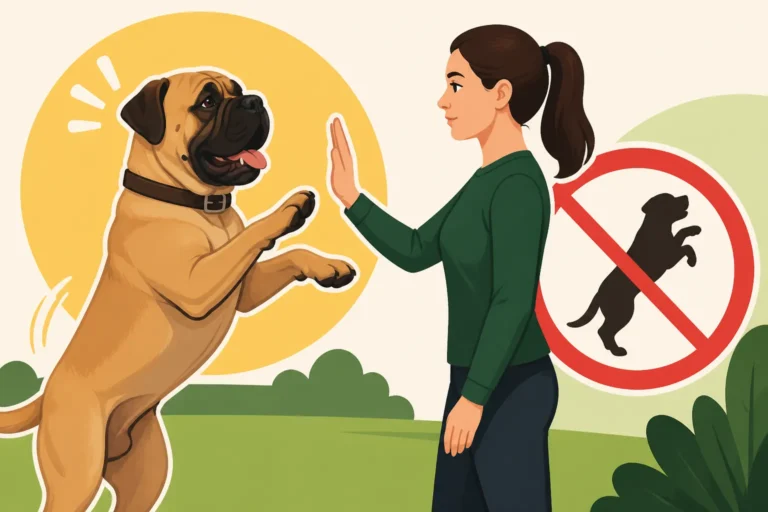
Preventing these accidental "Bullmastiff avalanches" is paramount. This starts with training your Bullmastiff from an early age to understand spatial awareness and to avoid jumping. Commands like "off" (meaning get off the furniture or the person), "four on the floor" (keep all paws on the ground), and a solid "stay" are non-negotiable. You’ll also want to teach your dog to walk calmly past children, rather than bounding through the room. During moments of high excitement, such as when guests arrive or during intense play, it can be helpful to manage your Bullmastiff's access to the children, perhaps by having them "go to their place" or using a baby gate. Even with the best training, vigilance is key, especially with very young children who are still finding their feet.
Managing Enthusiasm and Play
Bullmastiffs, despite their calm demeanor, can be quite playful. Their play might involve a heavy lean, a playful nudge with their powerful head, or even a clumsy pounce. While these are all signs of affection and fun for them, they can be overwhelming or even painful for a small child. Imagine a Bullmastiff deciding your child's hand looks like a fun chew toy during a game, or simply not understanding that their wagging tail is knocking a child's legs out from under them. It's a classic gentle giant paradox: they want to play, but their size makes it inherently risky for little ones without proper guidance.
Managing this requires teaching both the dog and the children appropriate ways to play. For the Bullmastiff, this means redirecting overly enthusiastic play onto appropriate toys and away from human bodies. Keep sturdy chew toys and heavy-duty tug ropes handy. For the children, it means teaching them how to play with the dog respectfully, understanding that dogs have teeth, even if they're not intending to bite hard. This is where a clear "no mouth" rule for the dog, and teaching children to offer toys rather than hands, becomes vital. Think of it as a constant dance of boundaries and redirection, ensuring playtime is safe and enjoyable for everyone.
Safe Spaces for Both Dog and Child
Creating designated safe spaces is absolutely essential in a multi-species household. Your Bullmastiff needs a retreat where they can go to rest, chew a toy, or simply escape the hubbub of family life without being bothered. This is particularly important when children are active or when the dog is eating. A crate in a quiet room or a comfy bed behind a sturdy baby gate can serve as this sanctuary. When your Bullmastiff is in their safe space, children must be taught, without exception, that they are not to disturb the dog. This rule helps prevent resource guarding issues and ensures the dog always has an option to de-stress. You can find durable baby gates and large crates that are perfect for a Bullmastiff on Amazon, providing immediate boundaries and peace of mind.
Conversely, children also need their own safe spaces away from the dog. This might be a bedroom door that can be closed, or a playpen for infants that the dog cannot access. The goal is to prevent unsupervised interactions, which are almost always where problems arise. By clearly defining boundaries and providing sanctuaries for both your Bullmastiff and your children, you create a structured environment where everyone can feel secure and respected. This proactive approach significantly reduces potential conflicts and fosters mutual respect.
Essential Training and Socialization for a Child-Friendly Bullmastiff
A Bullmastiff's natural disposition is a fantastic foundation, but it's just that—a foundation. To ensure a truly safe and harmonious relationship with children, dedicated training and thoughtful socialization are non-negotiable. It's about shaping that raw potential into a polished, reliable family member.
Early Socialization is Non-Negotiable
Socialization begins the moment you bring your Bullmastiff puppy home, if not sooner through a responsible breeder. Exposing your puppy to a wide variety of sights, sounds, people, and, yes, children, in a controlled and positive manner, is critical. This isn't about letting a parade of kids mob your puppy; it's about carefully orchestrated, positive interactions where the puppy learns that children are a normal, non-threatening, and often pleasant part of their world. A good puppy class is invaluable for this, as it provides structured exposure to various stimuli.
The key to successful socialization with children is always positive association and close supervision. During these early stages, ensure children are calm, gentle, and supervised by an adult at all times. Use treats and praise to reward your Bullmastiff for calm, appropriate behavior around kids. Even if you don't have children in your home, it's vital to expose your Bullmastiff to children of all ages, from toddlers to teenagers, in a variety of settings. The more positive experiences they have when young, the more resilient and accepting they will be as adults. Remember, a Bullmastiff at three months is very different from When a Bullmastiff Finally Settles Down at three years!
Obedience Commands for Safety
A large, powerful dog like a Bullmastiff needs to be responsive to commands, especially when children are present. Simple commands become safety tools. "Sit," "stay," and "down" can prevent jumping and control excitement. A solid "leave it" command is invaluable if your Bullmastiff shows interest in a child's toy or dropped food. "Come" is critical for recall, especially if your dog wanders too close to an unsupervised child. Perhaps one of the most important commands for a large dog in a child-filled home is "go to your bed" or "place," which teaches them to calmly retreat to their designated spot when asked. This provides an immediate way to create space and manage interactions.
Consistent, positive reinforcement training is the most effective approach for Bullmastiffs, who respond poorly to harsh methods. They are intelligent but can be deliberate thinkers, sometimes pausing to "decide" if a command is worth their effort. Training a Bullmastiff That Weighs More Than You Do is a unique challenge, and you'll need to be smarter, not stronger. For a structured approach to obedience training, many online programs offer fantastic resources. BAXTER & Bella, for example, provides comprehensive online puppy training programs that cover foundational obedience and socialization, which can be incredibly helpful for new owners navigating life with a Bullmastiff puppy.
Teaching Children How to Interact Respectfully
While training your Bullmastiff is vital, an equally important part of the equation is teaching your children how to interact respectfully and safely with dogs. Children, especially young ones, don't instinctively know how to behave around animals. They need to be taught that dogs are living beings with feelings, and that certain actions can be scary or painful for a dog. This includes teaching them:
- Gentle hands: No hitting, pulling, or poking. Pet gently on the shoulders or chest, not the head or tail.
- Respect personal space: Do not disturb a dog when it's eating, sleeping, or in its bed/crate.
- Approach correctly: Ask permission from an adult, then approach slowly. Let the dog sniff your hand (palm down, fingers curled) before petting.
- Read body language: Learn to recognize when a dog wants to be left alone (turning head away, yawning, lip licking, moving away). This is covered extensively in How Careful a Bullmastiff Is Around Children.
- No running or screaming near the dog: Sudden loud noises and erratic movements can startle or overstimulate a Bullmastiff, leading to accidental collisions or an unwanted chase instinct.
These lessons are ongoing, reinforced by adults at every interaction. A useful table to guide these interactions might look like this:
| Interaction Type | Child's Action | Bullmastiff's Likely Reaction (if trained/socialized) | Adult's Role & Advice |
|---|---|---|---|
| Approaching | Running up, grabbing, loud sounds | Startled, retreats, may react defensively | Teach slow approach, ask permission, offer hand for sniff. Supervise closely. |
| Petting | Pulling ears/tail, hitting, climbing on | Moves away, stiffens, growls (warning sign) | Teach gentle strokes on approved areas (shoulder, chest). Never allow climbing. |
| Playtime | Roughhousing, chasing, stealing toys | Overstimulated, accidental nips, knocks over children | Redirect to appropriate toys. Teach "four on the floor" and "leave it." Always supervise. |
| Dog Eating/Sleeping | Disturbing, trying to take food/toys | Resource guarding, defensive growls/snaps | Strict rule: NEVER disturb. Provide safe retreat for dog. |
| Leaving Alone | Unsupervised interaction | Accidents (accidental or intentional), fear, injury | NEVER leave unattended. Use gates/crates for separation. |
Common Challenges and Proactive Solutions
Even with the best intentions and training, living with a Bullmastiff and children can present specific challenges. Being aware of these potential pitfalls and having proactive solutions in place is key to a smooth and safe household.
Resource Guarding and Food Safety
Resource guarding is when a dog becomes defensive over possessions like food, toys, beds, or even a preferred resting spot. While not unique to Bullmastiffs, their size and strength mean that even a mild instance of resource guarding can be dangerous around children. A child innocently approaching a dog’s food bowl or trying to retrieve a toy can trigger a protective growl or snap. This is one of the most common scenarios leading to dog bites in homes with children.
The solution is multi-faceted and begins early. First, establish clear rules: children are never to approach the dog while it's eating, chewing a bone, or resting in its bed. The dog should eat in a quiet, undisturbed area, perhaps in a crate or behind a baby gate. Second, practice "trade-up" games with your Bullmastiff, where you offer a higher-value treat in exchange for a toy they are holding. This teaches them that humans approaching their stuff means good things happen, rather than a threat. If you notice any signs of resource guarding, seek professional help immediately. This behavior must be addressed and is not something to take lightly when children are involved.
Managing Excitability and Overstimulation
Bullmastiffs are generally calm, but like all dogs, they can become excited or overstimulated. This might happen during boisterous play, when new people arrive, or in a chaotic household environment. An overstimulated Bullmastiff might jump, mouth, bark, or run around erratically. While usually good-natured, these actions can still lead to accidental injuries for small children. Imagine a Bullmastiff doing "zoomies" through the living room with a toddler in the way!
Proactive solutions include providing plenty of appropriate outlets for energy (like short, brisk walks or puzzle toys), but also teaching impulse control. Practice waiting at doors, sitting before getting treats, and "place" commands to help them calm down. If things get too chaotic, a "time out" for your Bullmastiff in their safe space can help them decompress. It's also about managing the environment: limiting rough play between children when the dog is present, and ensuring children understand that calm voices and movements are preferred when interacting with their Bullmastiff. Even a Bullmastiff needs mental work to stay balanced; consider the importance of What Mental Work a Bullmastiff Needs.
Recognizing Stress Signals in Your Bullmastiff
A Bullmastiff, despite its imposing size, is often quite sensitive and will typically give subtle warning signs long before resorting to aggressive behavior. Learning to recognize these stress signals is paramount for preventing incidents, particularly with children. These signals are their way of saying, "I'm uncomfortable, please give me space." Common signs include:
- Lip licking or yawning (when not tired): A sign of mild stress or appeasement.
- Turning head or body away: Trying to disengage from the interaction.
- "Whale eye": Showing the whites of their eyes when looking at something, indicating fear or discomfort.
- Stiff body posture or tail tuck: Tension and anxiety.
- Low growl: A clear warning that they are deeply uncomfortable and may escalate if ignored.
- Retreating or hiding: Actively trying to get away from a situation.
If you observe any of these signs, intervene immediately by removing the child or the dog from the situation. Never punish your Bullmastiff for growling, as this teaches them to suppress the warning, potentially leading to a bite without preamble. Instead, thank them for communicating, remove the stressor, and reassess the situation to prevent it from happening again. Understanding these signals is a huge part of How a Bullmastiff Hides Pain, and it's essential for their well-being and everyone's safety.
The Evolving Relationship: Puppyhood to Senior Years
The relationship between your Bullmastiff and your children isn't static; it changes as both dog and child grow and mature. What works for a clumsy puppy might not work for a rebellious adolescent dog, and an aging Bullmastiff has different needs than a youthful one.
The Boisterous Puppy Phase and Toddlers
Bringing home a Bullmastiff puppy when you have toddlers can feel like managing two equally clumsy, energetic, and unpredictable creatures at once. Bullmastiff puppies are often all paws and enthusiasm, prone to nipping, jumping, and crashing into things. Their boundless energy and sharp puppy teeth, even in playful nips, can be overwhelming and even frightening for a small child. The first year with a Bullmastiff puppy, especially The First Year With a Bullmastiff Puppy, is a critical time for establishing boundaries.
During this phase, constant vigilance and management are your best friends. Keep puppy and toddler interactions short, supervised, and positive. Use baby gates extensively to separate them when you can't give 100% attention. Redirect all puppy nipping onto appropriate chew toys, never allowing them to mouth children. Enroll in puppy classes early to instill good habits and practice obedience commands. Remember that everything your Bullmastiff learns now forms the foundation for their adult behavior, so consistency is paramount.
Adolescence and Boundary Testing
Just like human teenagers, Bullmastiffs go through an adolescent phase, typically between 6 months and 2 years, where they might test boundaries and push limits. They become physically mature and strong, but their minds are still developing. During this period, a Bullmastiff might try to assert themselves, ignore commands they once knew, or become more independent. This can be particularly challenging when combined with the presence of children, as a lapse in consistency can quickly undo earlier training.
Maintaining firm, consistent rules and continuing with regular training sessions are essential during adolescence. Don't assume your Bullmastiff has "forgotten" commands; they're likely just seeing if they can get away with ignoring them. Double down on reinforcement and ensure all family members are on the same page with commands and expectations, especially regarding interactions with children. This is the time to reinforce commands like "stay" and "leave it" in distracting environments, ensuring your Bullmastiff remains a reliable companion even when their hormones are telling them to be a bit rebellious.
Aging Bullmastiffs and Children
As your Bullmastiff transitions into their senior years, typically around age 6-7, their needs and tolerance levels may change. The Age a Bullmastiff Is Considered Senior often brings with it physical discomforts like arthritis, decreased hearing or vision, and a general slowing down. An aging Bullmastiff who once tolerated a child's playful bump might now react with a grumble or even a snap if touched in a sore spot. Their patience might wear thinner, and their ability to move out of the way quickly will diminish.
It's critical to respect your senior Bullmastiff's changing needs. Create quiet, comfortable resting spots that are easily accessible and off-limits to children. Teach children to be extra gentle and to always approach senior dogs slowly, making their presence known to avoid startling them. Watch for signs of pain or discomfort and consult your vet for appropriate management. While an aging Bullmastiff may slow down, they still cherish their family time. It just needs to be on their terms, with careful consideration for their comfort and dignity. Ensuring that your children understand and respect their aging companion will strengthen the bond for everyone.
Disclaimer
This article is for general informational purposes only and does not constitute professional advice. Laws, prices and regulations vary by location and change over time. Consult a qualified professional for guidance on your specific situation.