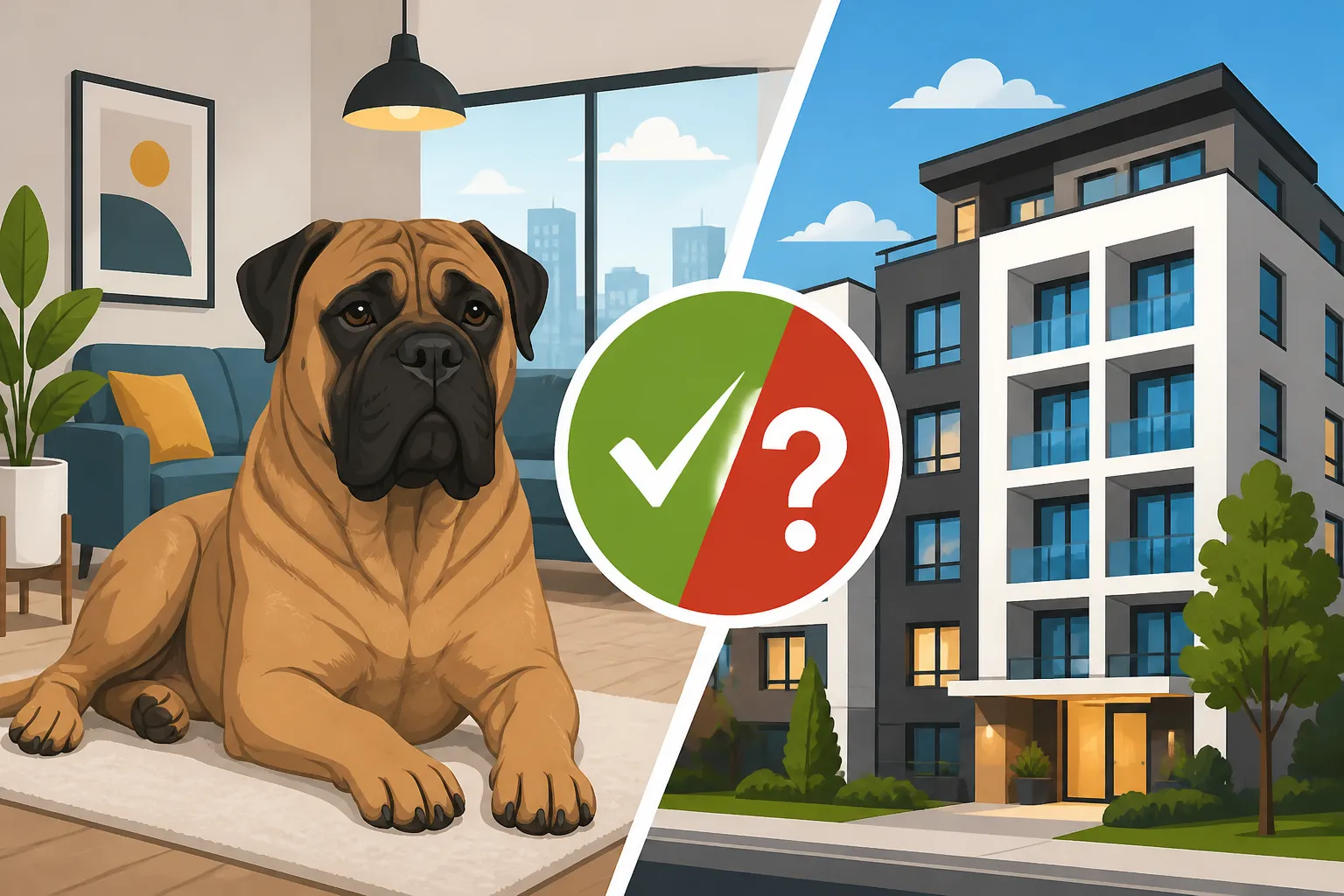
Whether an Apartment Can Hold a Bullmastiff
A Bullmastiff can live in an apartment, but square footage is only part of the question. The harder realities are getting a powerful dog through a lobby, managing bathroom breaks without a yard, keeping shared spaces comfortable, and finding a home that allows the breed. This guide helps you assess the building, your routine, and your dog’s needs before making the move.
What matters more than apartment size
A Bullmastiff’s indoor energy is often manageable
Bullmastiffs are large, but they are not usually dogs that need to race around a home all day. Many are content to relax indoors after a sensible walk and some company. That can make apartment living more realistic than their size suggests: a calm dog resting near the sofa may need less floor space than a smaller, highly active dog.
Still, “calm indoors” does not mean “no room required.” Your dog needs a comfortable place to stretch out, turn around, and get up without knocking into furniture. A giant bed wedged into a narrow walkway can become a daily nuisance for both of you, especially as the dog grows older or develops joint stiffness. Look at the usable floor area, not just the listing’s total square footage.
Think through ordinary movement as well. Can your Bullmastiff walk from the sleeping area to the water bowl without squeezing between chairs? Is there a spot where the dog can settle away from the front door and foot traffic? If the layout makes every passing roommate or visitor step over a resting dog, the apartment may feel cramped even if it looks spacious during a showing.
For a realistic picture of the breed’s day-to-day rhythm, read What a Bullmastiff Does All Day. Apartment suitability also depends on the dog as an individual. A well-socialized adult who settles easily may adapt more readily than a young dog still learning household manners.
Elevators, stairs, and hallways change the calculation
A third-floor walk-up can be a serious practical problem. A Bullmastiff puppy may seem easy to carry at first, but large-breed puppies grow quickly, and repeatedly carrying a heavy dog is not a sustainable plan. Stairs can also be difficult for a dog with joint pain, an injury, or mobility challenges. If you are considering a walk-up, ask yourself how you would manage both routine outings and an emergency when the dog cannot comfortably use the stairs.
An elevator helps, but it does not solve everything. You may need to wait while neighbors get on and off, keep the dog close in a tight cabin, and handle an excited greeting in a confined space. A dog that pulls hard toward people or other dogs can make those few seconds stressful. Practice calm elevator entries and exits before relying on them as part of your daily routine.
Hallways, vestibules, and shared doors are worth inspecting during a building visit. Narrow corners can be difficult to navigate with a broad dog, and a heavy fire door may be awkward to hold while managing a leash. Try walking the route from the apartment to the nearest outdoor area as if you already had the dog with you. If it feels frustrating without a dog in tow, it is unlikely to become easier on a rainy morning.
A yard is helpful, but not a requirement
A private yard makes quick bathroom breaks easier, but it is not a substitute for walks, training, or companionship. Many Bullmastiffs can live without one when their owner reliably takes them outside and provides appropriate activity. The practical question is whether you can meet those needs from your particular apartment—not whether the building has grass somewhere nearby.
Walks should suit the dog’s age, health, and the weather. A young puppy needs frequent opportunities to go outside, while an older dog may need shorter, more frequent outings. A route that involves several busy blocks, a long elevator wait, or an inaccessible entrance can turn a simple bathroom trip into a chore. Read Whether a Bullmastiff Needs a Yard and How Much Exercise a Bullmastiff Needs when planning what your daily routine would actually involve.
Nearby parks can make apartment life easier, but plan for more than the nearest patch of green. Consider whether the route has safe crossings, whether the park is crowded at the times you can go, and whether your dog is comfortable around other dogs. You may prefer quiet neighborhood streets, a less busy park, or a consistent walking route rather than an off-leash area.
How to assess the building and neighborhood
Check the lease and building rules first
Before you pay a deposit or make plans to bring a dog home, confirm the building’s pet policy in writing. Rules can differ between a landlord, a property manager, a condominium association, and a co-op board. Ask specifically about large dogs, breed restrictions, weight limits, common-area requirements, and any documents the building expects. Verbal reassurance is not as useful as clear written terms.
Also consider what happens if the building changes ownership or management. A pet approval should be understood alongside the lease and any applicable building documents. If a policy is unclear, ask for clarification before signing rather than assuming the dog will be accepted because another resident has a large dog.
Breed-related restrictions can affect housing and insurance arrangements, so research them early. The details vary by location and provider; do not rely on a neighbor’s experience as proof that your situation will be treated the same way. For more context, see Whether a Bullmastiff Is Restricted by Landlords.
Test the route from your door to the outdoors
A convenient bathroom route is one of the biggest factors in whether apartment life feels sustainable. Walk from the apartment to the nearest suitable outdoor spot. Notice how many doors you need to open, whether there is a safe place to wait, how long the trip takes, and whether the route is accessible at night or in bad weather.
If you live in a dense neighborhood such as Manhattan, downtown Chicago, or central Boston, the nearest patch of grass may be shared by many dogs and people. That can be perfectly workable, but it calls for reliable leash skills and a plan for busy periods. In quieter areas, the challenge may be distance rather than crowds: a long trip outdoors becomes tiring when your dog needs to go urgently.
Consider the building’s practical details, too. Is there a reliable elevator? Is the lobby calm enough to wait in? Are there nearby sidewalks with enough room to give other dogs space? Can you get outside promptly when the dog is sick or has an upset stomach? These are small questions until they become part of a daily routine.
| Apartment feature | Why it matters for a Bullmastiff | What to check |
|---|---|---|
| Elevator or ground-floor access | Makes regular outings and mobility changes easier | Test the route and consider elevator crowding |
| Nearby outdoor area | Supports bathroom breaks and daily walks | Check distance, lighting, access, and foot traffic |
| Clear floor space | Gives a large dog room to rest and move safely | Measure the bed area and walkways |
| Building pet rules | Determines whether the dog can live there | Get breed and size rules in writing |
| Cooling and ventilation | Helps manage warm indoor conditions | Check airflow, shade, and access to a cool room |
| Quiet resting area | Gives the dog a place to settle away from activity | Look for a spot apart from doors and busy walkways |
Shared walls require good manners, not just a quiet breed
Bullmastiffs are not generally known for constant barking, but any dog can vocalize when startled, uncomfortable, bored, or left alone for too long. Heavy footsteps, excited greetings, and a dog leaning against a shared wall can also be more noticeable in an apartment than in a detached home.
Help your dog learn to settle when hallway noises happen. Reward calm behavior rather than scolding every bark after it has already started. If you are adopting an adult dog, ask how the dog responds to delivery sounds, neighbors passing, and time alone. A short trial period or structured transition, when available, can reveal issues that a quick meet-and-greet will not.
Think about your neighbors as part of the plan. Keep the dog leashed in common areas, give people room to pass, and avoid letting the dog rush toward a lobby door. A dog’s size can make an ordinary greeting feel intimidating, even when the dog is friendly. Calm, predictable handling helps everyone share the building more comfortably.
Building a routine that works in a small home
Plan bathroom breaks around your actual schedule
Apartment life usually requires more planning than opening a back door. Before bringing home a puppy, work out who will handle daytime outings, what happens during long work shifts, and who can help if you are delayed. Puppies need frequent bathroom opportunities, and an adult dog still needs a dependable schedule.
If you work outside the home, think through the practical options before you need them. A trusted dog walker, a neighbor, or a family member may help, but the person must be comfortable handling a large dog safely. Walks should not be delegated to someone who cannot manage the leash if the dog pulls or reacts to a distraction. Guidance on leash handling is available in How to Walk a Bullmastiff That Outweighs You.
Make rainy days, winter weather, and late-night outings part of your plan. A route that is easy at noon may feel very different in a crowded lobby after dark. Keep essentials near the door so you are not searching for a leash, waste bags, or a towel while the dog waits. If you need bulky supplies or regular food deliveries, Chewy may be one option to consider, but check that deliveries can be received and stored conveniently in your building.
Make the apartment comfortable and safe
A Bullmastiff’s bed should be large enough for the dog to lie comfortably, with enough clearance around it that people are not forced to step over the dog. Place it somewhere quiet, but not so isolated that the dog feels shut away from household life. Non-slip rugs can help on slick floors, particularly near the bed, water bowl, and entryway.
Keep walkways clear. A dog this size can knock over a lamp or catch a hip on a narrow table while turning around. Secure food, medications, cleaning products, and small objects out of reach. Even a generally relaxed dog can investigate a tempting smell when left alone.
Drool and muddy paws are ordinary realities for many Bullmastiff households. Keep washable towels near the entrance and choose surfaces you can clean without a complicated routine. Chewy can be useful for comparing practical supplies such as washable bedding or cleaning items, though the right choice depends on the dog’s size, the apartment’s flooring, and how much storage you have.
Heat deserves special attention. A Bullmastiff can struggle in warm conditions, and an apartment that holds afternoon sun may become uncomfortable even when the weather outside seems manageable. Make sure the dog has access to shade, fresh water, and a cool indoor resting place. If the unit relies on open windows for airflow, consider whether the room remains safe and comfortable when you are away. See Whether a Bullmastiff Needs Air Conditioning and Why Eighty Degrees Is Dangerous for a Bullmastiff for more on warm-weather risks.
Teach apartment skills before problems become habits
Basic manners matter more when you share walls and hallways. Teach the dog to wait at doors, walk without dragging you through the lobby, and pause while people pass. Rewarding calm behavior in small steps is more dependable than waiting until the dog is already excited and trying to manage a large, powerful animal in a crowded space.
Practice short, low-pressure routines at first. For example, walk to the elevator, reward the dog for waiting, then return home. Later, take a quiet ride when the elevator is empty. If your dog is nervous, do not force close interactions with neighbors or unfamiliar dogs. Give the dog distance and build confidence gradually.
Leaving the dog alone also needs preparation. Start with brief absences and observe how the dog responds rather than assuming that a quiet departure means the dog is comfortable. Chewing, pacing, barking, or trouble settling can point to a need for a different training plan or more support. For a broader look at the time commitment, read How Much Time a Bullmastiff Takes Each Day.
Is an apartment the right home for your Bullmastiff
A practical fit depends on the dog and the household
An apartment can work well when the dog has regular outdoor access, the building permits the breed and size, and the household can provide calm handling and consistent care. A ground-floor apartment near a safe walking route may be easier than a much larger unit several flights up. A smaller home with a reliable routine can be more suitable than a spacious apartment where the dog is left alone for long stretches.
The dog’s temperament and history matter. A relaxed adult who is comfortable with elevators and hallway traffic may adjust quickly. A puppy may need more frequent outings and more supervision, while a dog with mobility limitations may need step-free access and a shorter route outdoors. Make the decision around the actual dog in front of you, not only a general description of the breed.
It is also worth considering your own strength, time, and backup support. A Bullmastiff who pulls toward another dog can be difficult to manage in a narrow hallway. If you cannot confidently control the dog in ordinary situations, work on training and handling before moving into a busy building. Apartment living makes everyday encounters more frequent, not less.
Use a candid checklist before committing
Ask yourself these questions before bringing a Bullmastiff into an apartment:
- Have I confirmed the building’s pet and breed rules in writing?
- Can I reach a suitable outdoor area quickly, including at night and in bad weather?
- Is there elevator or ground-floor access that will remain manageable as the dog ages?
- Can I create a comfortable resting area without blocking everyday walkways?
- Do I have a realistic plan for puppy bathroom breaks or adult-dog care during work hours?
- Can I safely handle the dog in a lobby, elevator, or busy sidewalk?
- Is the apartment cool and well ventilated during warm weather?
- Do I have help available if I am sick, delayed, or unable to walk the dog?
A “no” does not automatically rule out apartment living. It identifies a problem to solve before the dog arrives. For example, if the route outside is inconvenient, you may need to arrange help for daytime outings. If the building is noisy, you may need to choose a quieter unit or work more deliberately on settling skills. But if several essential pieces are missing—especially housing permission, safe handling, or reliable outdoor access—it may be kinder to choose a different home.
In short, an apartment can hold a Bullmastiff when the space, building, dog, and daily routine fit together. Do not judge the home by square footage alone. Walk the route, measure the resting area, check the rules, and picture an ordinary Tuesday in bad weather. That practical test will tell you more than the floor plan.
Disclaimer
This article is for general informational purposes only and does not constitute professional advice. Laws, prices and regulations vary by location and change over time. Consult a qualified professional for guidance on your specific situation.