Whether a Bullmastiff Chases Livestock
It's a question many Bullmastiff owners, or those considering bringing one into their lives, grapple with: "Can my big, gentle giant really be trusted around livestock?" You might picture your calm companion lounging on the couch, only to wonder if that inherent guarding instinct, combined with their sheer size and power, could spell trouble if they ever encountered a flock of sheep, a herd of cattle, or even just some chickens. This guide is here to shed light on whether a Bullmastiff's natural inclinations lead them to chase livestock and, crucially, how you can manage and train them to be reliable, no matter what animals they might encounter.
Understanding the Bullmastiff's Original Purpose and Instincts
When you look at a Bullmastiff, it's easy to see the strength and gravitas. These magnificent dogs were specifically developed in England in the mid-19th century by gamekeepers to protect vast estates from poachers. Their job wasn't to viciously attack or kill, but to track, silently approach, and then hold the intruder without causing grievous harm. This heritage is absolutely key to understanding their behavior today. They were called "The Gamekeeper's Night Dog" for a reason – they needed to be intelligent, brave, and possess a strong protective instinct, but also exercise restraint.
This unique blend of Mastiff (for size, power, and guarding) and Bulldog (for tenacity, courage, and a lower prey drive than many other breeds) resulted in a dog that was a formidable deterrent. The goal was to apprehend, not to maul. This means that while they have a protective drive, their traditional role wasn't centered on pursuing and killing prey animals like a sighthound or terrier might. Instead, it was about confrontation and containment of human threats. A Bullmastiff Was Bred to Hold a Man, Not Bite Him delves deeper into this fascinating history.
However, even with this specific historical role, no dog is entirely devoid of natural instincts. All dogs carry some level of prey drive, varying greatly by breed and individual temperament. A Bullmastiff, while not bred for the frantic chase of a rabbit, can still find themselves stimulated by the sudden movement of a flock of birds or the darting movements of a smaller animal. Their size and strength mean that any chase, even if not intended to harm, can have serious consequences for delicate livestock.
Decoding Prey Drive in Your Bullmastiff
Prey drive isn't just about chasing and killing; it's a spectrum of behaviors that includes orienting, stalking, chasing, grabbing, and even dissecting. For a Bullmastiff, who might be more deliberate and less prone to frantic, high-speed pursuits, their prey drive can manifest differently than in, say, a Greyhound. You might notice them fixating on a squirrel, or perhaps a cat that runs across their path.
The key difference for Bullmastiffs is often the intent. While a breed like a Border Collie might "herd" sheep with intense focus, a Bullmastiff's interest in livestock might stem from curiosity, a desire to investigate, or simply the instinct to interact with something moving. If they're not explicitly trained otherwise, that interaction can quickly escalate. Their immense size means that even playful "noses" or clumsy attempts at engaging could easily injure smaller, more fragile animals. Imagine a 120-pound Bullmastiff deciding to "play" with a lamb or a chicken – the outcome could be devastating.
It's also important to remember that Bullmastiffs are intelligent and often deliberate in their actions. The Bullmastiff That Pauses to Decide Whether You Are Worth It describes their thoughtful nature, which can be both a blessing and a curse. They might pause before acting, but that pause doesn't always lead to the conclusion you want if they haven't been taught otherwise. A Bullmastiff's natural protective instincts, while usually directed at humans and their property, can sometimes generalize to protecting "their" livestock from perceived threats, or simply feeling ownership over the animals they are accustomed to seeing. However, this is a trained behavior, not an inherent one when it comes to livestock specifically.
Training and Management Strategies to Prevent Chasing
Given their size and potential strength, managing a Bullmastiff around livestock isn't something to take lightly. Proactive training and consistent management are absolutely crucial.
Early Socialization and Exposure
Starting early is always best. If you live in an area where livestock is common, or if you plan on visiting farms or properties with animals, expose your Bullmastiff puppy to these sights, sounds, and smells from a young age, always in a controlled, safe manner. This doesn't mean letting them run loose with the chickens! It means observing from a distance, perhaps on a leash, rewarding calm behavior. The goal is for them to see these animals as part of the normal environment, not as exciting prey or novel objects to chase. Puppy classes, like those offered by BAXTER & Bella, can lay a strong foundation for obedience and focus, which are critical when introducing new, stimulating environments.
Reliable Recall and Impulse Control
A rock-solid recall is your most important tool. Your Bullmastiff must come when called, every single time, regardless of distractions. Practice this in increasingly distracting environments. Start in your quiet yard, then move to a park, and eventually, if appropriate, to the edge of a field where you can observe livestock from a safe distance. Reward heavily for success. High-value treats and enthusiastic praise are essential for a breed like the Bullmastiff, which can be quite food-motivated. What Motivates a Bullmastiff explains more about leveraging their drives.
Impulse control exercises are equally vital. Teach "leave it" and "stay" commands with extreme consistency. These commands directly address the instinct to chase or engage. Practice having your dog ignore distractions in their environment, gradually increasing the level of temptation. This might start with a dropped toy and progress to a moving object, then perhaps a person running, and eventually, controlled exposure to the sight of distant livestock.
Leash Training and Equipment
Due to their powerful build, walking a Bullmastiff requires proper equipment and training. Even if you have the best intentions, a sudden lunge after a squirrel or, heaven forbid, a chicken, can pull you off your feet. Invest in a sturdy, comfortable harness or a head halter that gives you maximum control without causing discomfort. Tools like a front-clip harness can help discourage pulling, making walks more manageable. Check out options on Amazon for durable, large-breed appropriate harnesses that can withstand the strength of a Bullmastiff.
Never underestimate their strength. Training a Bullmastiff That Weighs More Than You Do offers practical tips for handling such a powerful dog on leash. A long line can be an invaluable training tool for practicing recall and impulse control in a more open space, allowing your Bullmastiff some freedom while still maintaining a connection. Just ensure the area is secure and free of actual livestock during these practice sessions.
Managing Environmental Access
The simplest and often most effective strategy is to prevent access to livestock altogether unless under direct, controlled supervision. If you live on a farm, this might mean secure fencing around animal enclosures that your Bullmastiff cannot breach. If you visit friends with livestock, your Bullmastiff should always be on a leash, or safely crated or secured away from the animals.
It's important to remember that a Bullmastiff is not "grown up" until around three years of age, and their maturity comes with a sense of deliberate decision-making that needs to be guided. When a Bullmastiff Finishes Maturing highlights the extended adolescence of the breed, emphasizing that training is an ongoing process.
Real-World Scenarios and Safety Considerations
Let's talk about how this all plays out in different situations.
Living on a Farm or Ranch
If your Bullmastiff lives on a property with livestock, consistent, vigilant management is non-negotiable. They should never be unsupervised in areas where livestock are present. Training should focus on a clear understanding of boundaries and a strong "leave it" command. Many farm dogs are specifically bred for herding or guarding livestock (like Great Pyrenees or Anatolian Shepherds), and while a Bullmastiff can be trained to coexist, it's not their inherent genetic purpose. Their presence alone might deter some predators, but they are not a substitute for a dedicated livestock guardian dog if that is what you require.
| Scenario | Risk Level | Recommended Action |
|---|---|---|
| Unsupervised in field with sheep | High | Never allow. Bullmastiff's size can easily injure. |
| Leashed walk near pasture | Moderate | Keep distance. Practice "leave it." Watch for fixation. Use appropriate leash/harness. Maintain firm control. |
| Visiting friends with chickens | High | Secure Bullmastiff in car or separate area. If supervised, keep on a short leash, maintain distance, and reward calm behavior. Do not assume "play" will be gentle. |
| Encountering deer/wildlife | Moderate | Reinforce strong recall. Keep on leash in areas with known wildlife. Deer are livestock in a sense, and the instinct to chase can be strong. |
| Farm dogs/guard dogs | Low-Moderate | Be mindful of How a Bullmastiff Accepts a New Dog. Introductions should be calm and supervised. While not their primary function, a Bullmastiff can be socialized to coexist peacefully with other working dogs, but direct interaction with livestock should still be heavily managed. |
Rural or Suburban Living with Occasional Encounters
Even if you don't live on a farm, you might encounter horses on a trail, chickens in a neighbor's yard, or deer in your local park. The principles remain the same:
- Always Be Prepared: Assume your Bullmastiff could react, especially if they are not specifically trained around livestock.
- Leash Up: When in doubt, a leash is your best friend. A Bullmastiff's size means they can cover ground quickly if they decide to chase. How Much Exercise a Bullmastiff Needs also notes that while they don't need endless running, they do benefit from regular, controlled walks where they can practice good leash manners.
- Observation: Pay attention to your dog's body language. Are they stiffening? Staring intently? Ears forward? These are signs of heightened interest that could precede a chase. Intervene before they act.
- Positive Reinforcement: Reward calm, disengaged behavior around any animal. If they see livestock and look to you instead of lunging, that's a jackpot moment for treats and praise.
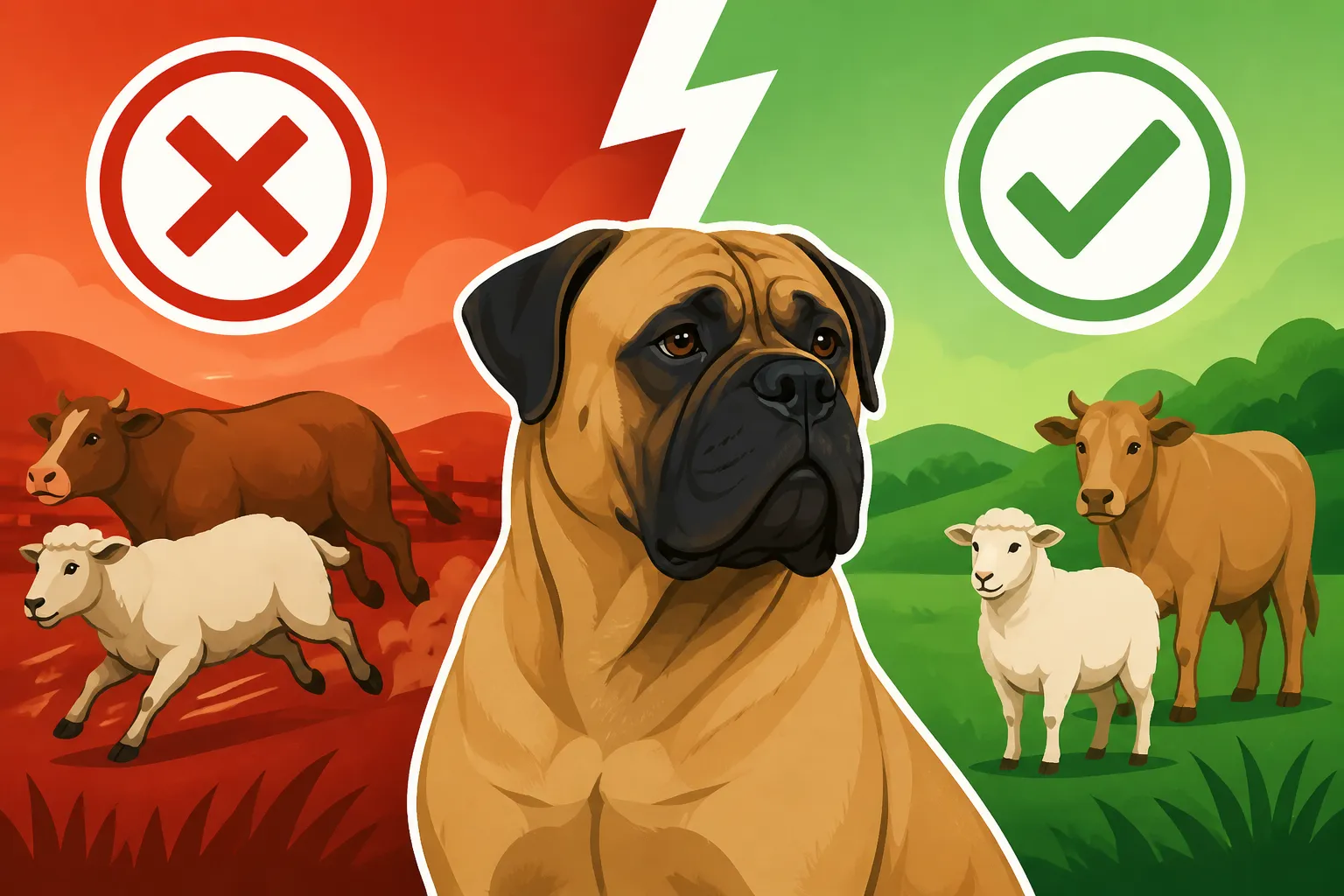
While a Bullmastiff is generally a calm and steady companion, their ancestral role, while not focused on prey, does imbue them with an inherent strength and a guarding instinct that needs careful guidance. It is entirely possible for a Bullmastiff to coexist peacefully with livestock, but it requires diligent training, consistent management, and a deep understanding of their powerful nature. Don't leave it to chance; train for success to ensure the safety of both your beloved Bullmastiff and any animals they might encounter.
Disclaimer
This article is for general informational purposes only and does not constitute professional advice. Laws, prices and regulations vary by location and change over time. Consult a qualified professional for guidance on your specific situation.