How Fast a Bullmastiff Had to Cover Ground
A Bullmastiff was not bred to race across open country or run beside a horse for miles. Gamekeepers needed a powerful dog that could move quickly enough to intercept a poacher in the dark, then hold him until help arrived. This guide explains what “cover ground” meant for the breed, why its build mattered, and how that working history differs from the exercise a Bullmastiff needs today.
What covering ground meant to a working Bullmastiff
A quick interception, not a long-distance chase
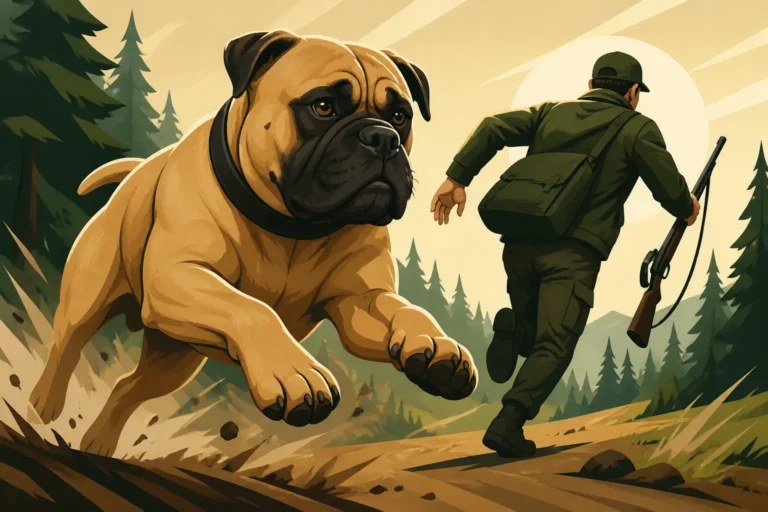
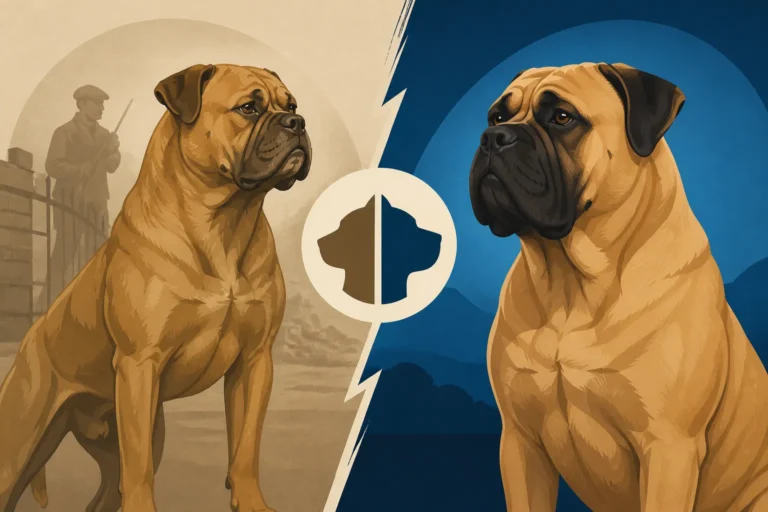
The Bullmastiff’s historical job was practical: help a gamekeeper catch a poacher on an estate. In that setting, covering ground meant moving fast enough over a short distance to reach and stop someone before he escaped. It did not mean keeping up a sustained gallop over miles of open land, as a purpose-bred coursing or herding dog might.
The distinction matters because the breed’s reputation can invite an exaggerated picture of a tireless pursuit dog. A Bullmastiff was a substantial, muscular animal, and its work depended on strength and control as much as speed. The aim was to close the gap, make contact, and restrain—not to win a race.
Gamekeepers worked in darkness and uneven surroundings, where a dog might need to move through grass, woodland edges, or estate grounds. A short burst of purposeful movement could be more useful than great endurance. For more on the setting that shaped the breed, see The Bullmastiff Was Built to Catch Poachers in the Dark and What a Gamekeeper Needed a Night Dog For.
Why the dog had to be quick enough
A dog that could not reach a fleeing poacher would be of limited use. But speed alone would not solve the gamekeeper’s problem. The dog also needed the weight and confidence to stop a person, along with enough steadiness to work under direction rather than simply chase anything that moved.
That combination helps explain why the Bullmastiff was developed as a powerful but mobile guardian. A very heavy dog might have strength but struggle to move efficiently across rough ground. A lighter, faster dog might reach a target but lack the force to hold him. The breed’s working ideal sat between those extremes: substantial, athletic for its size, and capable of a short, forceful response.
This is the sense behind the phrase “light enough to run.” It does not mean the historical Bullmastiff was light in an everyday sense, or built like a racing dog. It means its body had to remain functional for the task. Why a Bullmastiff Was Bred Light Enough to Run explores that balance in more detail.
There is no useful single speed figure
It is tempting to ask exactly how fast a Bullmastiff had to run, or to look for a historical top-speed figure. But a single number would give a misleading impression. The work was not described as a timed sprint over a standardized course, and an individual dog’s pace would have depended on its condition, terrain, age, and the situation.
More importantly, “covering ground” was about getting from the gamekeeper’s side to the target in time to intervene. A short, quick acceleration over estate ground is a different job from maintaining a high pace for a long distance. A dog could be effective at the former without being an endurance athlete.
The practical takeaway is that speed was one part of a working package—not the whole point of the Bullmastiff. The dog needed to arrive, respond, and hold. How a Bullmastiff Was Sent After a Poacher gives more context on the dog’s role once a gamekeeper decided to send it.
How the Bullmastiff’s build supported short bursts
Strength and movement had to work together
The Bullmastiff’s broad, muscular appearance can make people assume that it was built mainly for brute force. But a working dog that had to intercept someone could not be useful if it was too cumbersome to move. The desired outline needed strength without sacrificing the ability to get across the ground with purpose.
That does not mean the historical ideal was a lean, lightly framed animal. The Bullmastiff still needed the substance to restrain a person. Instead, the goal was functional balance: enough power to make the hold effective, with a body capable of a quick approach. The Outline a Gamekeeper Wanted in a Bullmastiff looks at the kind of shape that suited this work.
The breed’s development also reflected a combination of qualities rather than a single athletic trait. Its background is often described through the influence of Mastiff-type and Bulldog-type dogs, but the story is more useful when considered in terms of what the gamekeeper needed: size and steadiness paired with strength and determination. For the breed’s commonly repeated formula and its limits, see The Bullmastiff Is Sixty Percent Mastiff and Forty Percent Bulldog.
Terrain and judgment mattered as much as pace
Estate work was not a clean track with a finish line. Ground could be uneven, visibility poor, and the route unpredictable. A dog needed to move effectively in the conditions it encountered, but it also needed to respond to the handler. Raw speed without control could create a dangerous situation for the dog, the gamekeeper, or the person being caught.
That is one reason not to imagine the Bullmastiff as a dog simply released to chase at full tilt. Its usefulness depended on judgment and handling, not just physical capacity. The gamekeeper had to make decisions about when and where the dog should act. Whether Bullmastiffs Worked in Pairs offers another perspective on how the dog’s work could fit into a broader gamekeeping effort.
This history also helps explain why modern Bullmastiff owners should not treat speed as a goal in itself. A dog’s build may allow it to move with surprising purpose, but encouraging repeated hard sprints does not recreate its historical work. Safe, controlled movement and sound conditioning matter more than trying to make a large companion dog perform like a specialist athlete.
Historical working ability versus modern exercise
A working past does not mean endless exercise
Bullmastiffs today are generally household companions, not estate patrol dogs. Their ancestry can help explain why they are alert and physically capable, but it does not mean every individual needs hours of strenuous activity. Exercise needs vary with age, health, body condition, and the dog’s own temperament.
A practical routine is usually built around regular, manageable movement rather than exhaustive workouts. A comfortable walk, brief training, and opportunities to sniff and explore can provide useful activity without pushing a heavy dog into repetitive high-impact exercise. For guidance on everyday needs, see How Much Exercise a Bullmastiff Needs and Why a Bullmastiff Needs Less Exercise Than It Looks.
Owners sometimes feel pressure to “wear out” a large dog, especially when it has a burst of energy or pulls toward something interesting. But a Bullmastiff can be strong without needing to run hard every day. Training calm leash skills and building a predictable routine are often more useful than trying to exhaust the dog physically.
Heat, weight, and joints change the picture
A Bullmastiff’s ability to move well depends on more than its historical purpose. Excess weight can make movement harder and put additional strain on joints. Heat can also turn an ordinary outing into a risk, particularly for a large, short-muzzled dog. Exercise should be adjusted to the weather and the dog’s comfort, with walks kept short or moved to cooler parts of the day when conditions are warm.
Watch for signs that the dog needs a break: unusually heavy or persistent panting, slowing down, seeking shade, or seeming unsteady. Stop activity and help the dog cool down if you are concerned; signs of heat illness need prompt veterinary attention. When It Is Too Hot to Walk a Bullmastiff offers more on making safer decisions in warm weather.
For a modern walk, useful equipment is the kind that helps you stay in control and keep the dog comfortable—not gear meant to encourage speed. A well-fitted harness, secure leash, water, and a plan for shade are more relevant than sprint equipment. Chewy is one retailer where owners may look for routine walking or cooling supplies, but fit and suitability should be checked for the individual dog. A cooling mat or travel bowl from Chewy may be useful for some households, though neither replaces stopping activity and moving a hot dog to a cooler place. If your dog has a medical condition or struggles during exercise, ask your veterinarian what level of activity is appropriate before increasing it.
| Question | Historical working Bullmastiff | Modern companion Bullmastiff |
|---|---|---|
| Main purpose | Reach and restrain a poacher | Enjoy safe, regular activity and companionship |
| Useful pace | A purposeful short burst when needed | A comfortable pace suited to the individual dog |
| Endurance expectation | Not defined by long-distance running | Avoid assuming the dog needs exhaustive exercise |
| Important limits | Handler control, terrain, and the task | Heat, body condition, age, joints, and health |
| Best focus | Strength and movement working together | Consistent, controlled, comfortable activity |
What the breed’s history can and cannot tell you
It explains function, not a modern fitness target
The historical job helps explain why Bullmastiffs were expected to be capable of moving quickly for a short distance. It also explains why their bodies needed to combine substance with mobility. But that context cannot tell you how fast an individual dog should run today, how far it should walk, or whether it is fit for strenuous activity.
Dogs differ. A young, healthy Bullmastiff may move with enthusiasm, while an older dog or one with joint or breathing concerns may need a gentler routine. Even two dogs of similar size can have different stamina and comfort levels. Build exercise gradually, pay attention to recovery, and avoid comparing your dog with a dramatic story about its working ancestors.
This is especially important when the dog is still growing. Large-breed puppies need age-appropriate activity rather than forced running or repetitive impact. If you are unsure whether a particular game, walk, or sport is suitable, your veterinarian can help assess your dog’s health and development.
Preserve the useful traits through control
A Bullmastiff’s historical ability to act decisively makes reliable everyday manners especially valuable. A dog that can walk calmly, pause at a door, and respond to its handler is easier to manage than one encouraged to charge after movement. Training should reward calm behavior and build cooperation before the dog’s strength becomes difficult to handle.
That is not a call to suppress normal play or curiosity. It is a reminder that the safest modern version of the breed’s working confidence is a dog that can move with its owner’s guidance. For more on the breed’s instinctive physical communication, see How a Bullmastiff Body Blocks a Stranger.
The old phrase “cover ground” is best understood as a description of a job requirement: reach the target quickly enough to help the gamekeeper, then use strength and control. It is not a claim that Bullmastiffs were built for sustained racing, nor a reason to push a modern dog into hard exercise. A healthy Bullmastiff’s movement should be judged by comfort, condition, and veterinary guidance—not by how closely it seems to match a legend about the breed’s past.
Disclaimer
This article is for general informational purposes only and does not constitute professional advice. Laws, prices and regulations vary by location and change over time. Consult a qualified professional for guidance on your specific situation.