Which Harness Lifts an Aging Bullmastiff
Watching your beloved Bullmastiff struggle to stand, navigate stairs, or even just get up after a nap can be incredibly heartbreaking and, frankly, physically challenging for you too. Their immense size, which we adore, becomes a significant hurdle when their mobility starts to decline. This guide is here to walk you through the world of lifting harnesses, helping you understand what to look for and how to choose the right one to provide comfort and crucial support for your aging Bullmastiff, while also protecting your own back.
Understanding Your Aging Bullmastiff's Mobility Challenges
It's a tough truth that our big, beautiful Bullmastiffs often face significant mobility challenges as they age. Their impressive size and weight, while a hallmark of the breed, can put immense strain on their joints over a lifetime, leading to issues that make everyday movements a struggle. It's not just about getting older; it's about getting older as a hundred-plus-pound dog.
The Reality of Canine Seniority, Especially for a Giant Breed
As a Bullmastiff enters their senior years, which for many can start around six years old, you might notice subtle changes at first. They might be a bit slower to rise, or they might hesitate before jumping into the car, something they once did with gusto. These aren't just quirks; they're often early indicators of underlying discomfort. Conditions like arthritis, a common ailment where The Age a Bullmastiff Gets Arthritis often begins to show, can make every step painful. Their powerful muscles, which once supported their substantial frame with ease, can start to atrophy, making them weaker and less stable. This muscle loss is a natural part of aging, and it's particularly noticeable in large breeds where the sheer volume of muscle is so significant. Why an Aging Bullmastiff Loses Muscle becomes evident in the hindquarters, making simple acts like standing up from a lying position a Herculean effort.
Bullmastiffs are notoriously stoic, and they often try to hide their pain, a trait that can make it even harder for us to gauge their true discomfort. How a Bullmastiff Hides Pain means you might only see a limp or hesitation when their pain level is already quite high. This is why paying close attention to any changes in their movement, even subtle ones, is so important. When a dog like a Bullmastiff struggles with its mobility, it affects their quality of life, their desire to engage in walks, and even their ability to relieve themselves comfortably. It's not just about assisting them; it's about maintaining their dignity and comfort during their golden years.
Why a Standard Harness Just Won't Cut It Anymore
You might have a perfectly good standard walking harness that has served your Bullmastiff well for years. It's great for leash manners and preventing neck strain. However, when your dog needs help lifting, those harnesses fall short. A typical harness is designed to control movement and distribute pulling pressure across the chest and shoulders, not to bear the full weight of a dog being lifted. Trying to hoist a heavy Bullmastiff by a flimsy D-ring or a narrow strap can cause several problems. First, it concentrates all the pressure on a small area, potentially causing pain or injury to your dog's sensitive underbelly, chest, or armpits. Imagine trying to lift a heavy box with just a thin string – it digs in and hurts.
Second, a standard harness simply doesn't offer the necessary leverage or stability. You'd find yourself struggling to get a good grip, and your dog could easily slip out or feel unbalanced, making the situation more stressful for both of you. Many standard harnesses also lack the robust construction and wide, padded surfaces needed to safely and comfortably support a senior Bullmastiff's substantial weight. They're built for leading, not for lifting. This is why investing in a specialized lifting harness is not a luxury, but a necessity when your aging Bullmastiff starts to need a helping hand, quite literally, to get around. It's about safety, comfort, and providing effective support that a traditional harness just isn't equipped to deliver.
Key Features of an Effective Lifting Harness for a Bullmastiff
When your gentle giant needs help getting around, you can't just grab any old piece of gear. A lifting harness for a Bullmastiff isn't just a bigger version of a standard walking harness; it's a carefully designed piece of equipment intended to safely bear and distribute their substantial weight. Think of it as a specialized support system.
Support and Distribution of Weight
The absolute paramount feature of any good lifting harness for a Bullmastiff is its ability to provide comprehensive and even weight distribution. We're talking about a dog that can easily weigh over a hundred pounds, so you absolutely cannot have pressure points. Look for harnesses with wide, padded straps that cradle the body, rather than narrow bands that dig in. The padding is crucial, often made from soft fleece or neoprene, to prevent chafing and maximize comfort, especially in sensitive areas like the groin and armpits. A well-designed harness will often cover a significant portion of your Bullmastiff's torso, sometimes extending from the shoulders all the way to the hips, ensuring that their weight is supported across their entire core. This full-body embrace minimizes strain on any single joint or muscle group, which is vital when addressing conditions like Hip Dysplasia in a Bullmastiff or general weakness from old age.
The materials themselves need to be robust. Durable, heavy-duty nylon webbing is common, designed to withstand the stress of lifting a large dog. Reinforced stitching is also a non-negotiable. You want something that feels sturdy in your hands and instills confidence that it won't give way when you need it most. Some harnesses even incorporate a semi-rigid structure or multiple layers of fabric to maintain their shape and prevent bunching, further enhancing weight distribution. This thoughtful design ensures that when you lift, the force is spread out, making it more comfortable and secure for your dog, and more effective for you.
Ease of Use and Adjustability
Let's be real, when your Bullmastiff is struggling, the last thing you need is a complicated harness that's a puzzle to put on. Ease of use is critical for both your sanity and your dog's comfort. Look for designs that are intuitive and don't require your dog to contort into uncomfortable positions to get into. Many effective harnesses feature large, sturdy buckles (often quick-release) that are easy to fasten and unfasten, even with shaky hands or an impatient senior dog. Velcro closures, when used, should be strong and cover a good surface area to provide secure fastening without tearing out fur.
Adjustability goes hand-in-hand with ease of use. A Bullmastiff's body shape can be surprisingly variable, and you need a harness that can be customized for a snug, yet comfortable, fit. Multiple adjustment points, usually with durable slides or clasps, allow you to tailor the fit around the chest, waist, and often the leg openings. This customization prevents the harness from shifting or rubbing, which could cause sores, especially for a dog with thin or sensitive skin. It also ensures maximum support. Imagine trying to help Why an Aging Bullmastiff Struggles to Rise if their harness is too loose and just slides around – it's ineffective and potentially dangerous. The ability to quickly and easily adjust the harness means you can get a perfect fit every time, whether your dog is standing, lying down, or in various stages of needing assistance.
Handles and Lifting Points
Perhaps the most defining characteristic of a lifting harness is its handles. These are your connection points, and their design makes all the difference in how effectively and safely you can assist your Bullmastiff. You want handles that are ergonomically placed, easy to grip, and incredibly strong. Many harnesses offer multiple handles:
- Top Handle: A single, central handle on the back is great for general assistance, steadying your dog, or offering a quick boost.
- Front and Rear Handles: Some designs feature separate handles for the front and rear portions of the harness. This is particularly useful if your dog needs more targeted help, for instance, just with their hindquarters due to Degenerative Myelopathy in a Bullmastiff or if you have two people assisting – one at the front, one at the back.
- Side Handles: Less common, but some full-body harnesses might have reinforced loops on the sides for more versatile lifting angles.
Regardless of the configuration, the handles themselves should be comfortable for human hands. Thick, padded handles prevent the straps from cutting into your hands, especially when lifting a heavy dog. They should be securely stitched or riveted to the main body of the harness, capable of bearing your Bullmastiff's full weight without showing signs of strain. The placement is key; handles should be positioned so you can maintain good posture and use your legs, not your back, when lifting. This protects both you and your dog, making the process safer and less strenuous.
Types of Lifting Harnesses and When to Use Them
When it comes to helping your aging Bullmastiff, there isn't a one-size-fits-all solution for mobility support. Different harnesses are designed to address specific needs, so understanding the types available can help you choose the best fit for your dog's particular challenges.
Full-Body Support Harnesses
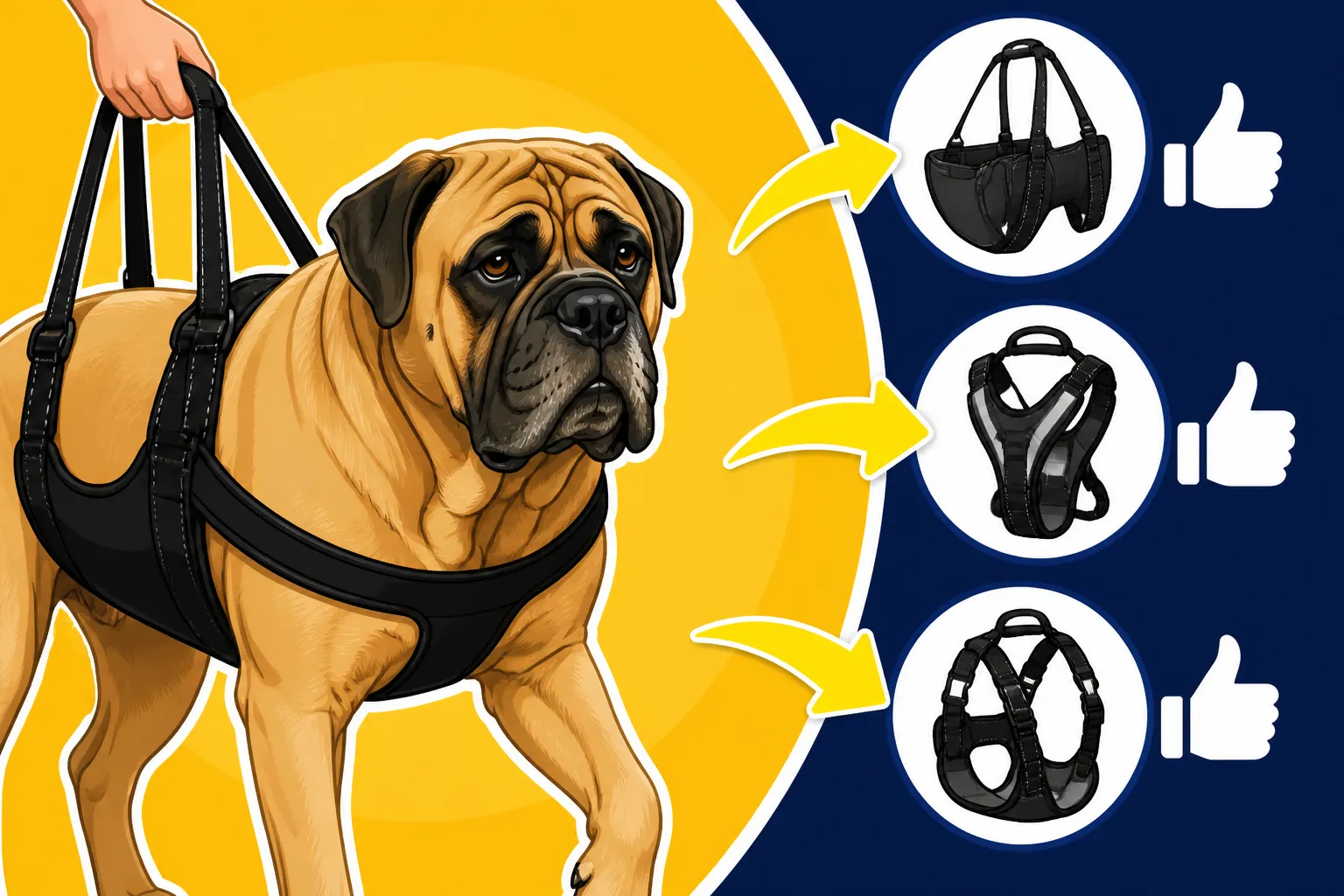
Full-body support harnesses are exactly what they sound like: they envelop a significant portion of your Bullmastiff's body, providing comprehensive support. These are often designed to be worn for extended periods, even for most of the day, acting as a constant aid. They typically feature wide, padded straps that run along the chest, belly, and back, often with adjustable leg openings to prevent chafing. The key advantage here is the even distribution of weight across a large surface area, which is crucial for a breed as heavy as a Bullmastiff.
You'd consider a full-body harness if your Bullmastiff has general weakness, struggles with overall instability, or needs help with both front and rear mobility. For instance, if they have difficulty getting up from a lying position, navigating slippery floors, or managing a few steps up or down, this type of harness provides the steadying hand they need. They often have multiple handles – sometimes one over the hips and one over the shoulders – allowing you or a partner to lift more effectively and with better balance. Brands available through retailers like Chewy or Amazon offer various models, some with integrated leashes or quick-release features. These harnesses are excellent for Caring for an Aging Bullmastiff who might be dealing with multiple age-related issues, as they offer consistent, reliable support without requiring you to constantly don and doff the equipment.
Rear-End Support Slings/Harnesses
Sometimes, an aging Bullmastiff's mobility issues are primarily concentrated in their hindquarters. This is incredibly common with conditions like severe arthritis in the hips or knees, or neurological issues that affect the back legs. For these situations, a rear-end support sling or harness is often the most appropriate and sometimes the simplest solution. These designs typically consist of a padded sling that wraps under the dog's belly, just in front of the hind legs, with handles extending upwards for you to lift.
The beauty of a rear-end sling is its targeted support. It allows you to provide direct assistance to their back legs without interfering with their front half, which might still be strong. It's particularly useful for helping them up stairs, into a car, or simply boosting them for a short walk when their back legs are giving out. They're generally easier and quicker to put on and take off than full-body harnesses, making them ideal for intermittent assistance. However, they aren't meant for long-term wear, as the concentrated pressure on the belly area can become uncomfortable. Always ensure the padding is sufficient and the sling is wide enough to prevent digging in. If your Bullmastiff is mostly doing well but just needs a little "lift" for specific obstacles, this type of support is a lifesaver, providing targeted help without the bulk of a full-body harness.
Integrated Walking and Lifting Harnesses
For Bullmastiffs whose mobility issues are still mild to moderate, and who still enjoy regular walks but occasionally need a boost, an integrated walking and lifting harness might be a practical choice. These harnesses combine the functionality of a standard walking harness with the added benefit of sturdy lifting handles. They typically feature a robust design with a chest plate and back strap, along with one or more reinforced handles on the top.
The main advantage here is convenience. You don't need to switch between a walking harness and a lifting aid. You can head out for a gentle stroll, and if your Bullmastiff stumbles, needs help over a curb, or struggles to get up after a potty break, the handles are right there for immediate assistance. However, it's important to evaluate the degree of lifting support these offer for a Bullmastiff's size. While they're excellent for minor assistance and steadying, they may not provide the same comprehensive, even weight distribution as a dedicated full-body lifting harness if your dog's mobility challenges become severe. Always check the handle placement and construction to ensure they are robust enough for your dog's weight. Many popular brands offer these versatile options, giving you a good balance between daily walk functionality and emergency lift support for Whether an Aging Bullmastiff Should Still Be Walked with increasing care.
| Harness Type | Pros | Cons | Ideal Use Case for Bullmastiff |
|---|---|---|---|
| Full-Body Support Harness | Maximum weight distribution, constant support, good for overall weakness | Can be bulkier, might be warm in summer, can be harder to put on initially | General instability, severe weakness (front & rear), long-term wear |
| Rear-End Support Sling/Harness | Targeted support for hindquarters, quick to put on/off, less bulky | Not for full-body weakness, can cause localized pressure if worn too long | Hip dysplasia, weakness in back legs, temporary assistance with stairs |
| Integrated Walking & Lifting Harness | Convenient for walks and occasional boosts, versatile, less conspicuous | May not offer sufficient support for severe mobility issues, handles can be less robust | Mild to moderate mobility issues, still active but needs occasional help |
Choosing the Right Harness for Your Bullmastiff and Tips for Use
Finding the perfect lifting harness for your Bullmastiff isn't just about picking one off the shelf; it requires careful consideration to ensure it truly helps your dog and makes your life easier. Remember, this is a tool to enhance their quality of life, not add to their discomfort.
Sizing and Fit are Paramount
Just like a perfectly tailored suit makes a world of difference, a properly sized and fitted harness is absolutely crucial for your Bullmastiff. An ill-fitting harness is not only ineffective, but it can also cause more harm than good. If it's too tight, it can chafe, restrict blood flow, or cause pain in sensitive areas like the armpits or groin. If it's too loose, it can shift, become unbalanced, or your dog could even slip out, leading to dangerous falls. For a large, heavy breed like a Bullmastiff, precision is key.
Before you even think about buying, grab a soft tape measure and carefully measure your Bullmastiff. You'll typically need measurements for:
- Chest Girth: The widest part of their rib cage, usually just behind the front legs.
- Neck Circumference: Around the base of the neck.
- Back Length: From the base of the neck to the base of the tail (for full-body harnesses).
- Weight: Their current weight is essential for confirming sizing charts.
Compare these measurements meticulously with the manufacturer's sizing chart. Don't assume that because they're a Bullmastiff, they automatically fit into an 'XL' or 'Giant' size without checking. Different brands have different sizing conventions. When the harness arrives, try it on your dog and adjust all the straps. You should be able to comfortably slide two fingers under any strap, but no more. Check that there's no rubbing, especially around the leg openings, and that the harness sits securely without twisting or bunching. A good fit ensures the weight is distributed correctly and that Whether an Aging Bullmastiff Needs Help Standing is truly supported without undue pressure.
Introducing the Harness and Safe Lifting Techniques
Once you have your perfectly fitted harness, the next step is to introduce it to your Bullmastiff in a positive way. Remember, they might already be feeling sensitive or anxious about their mobility, so patience is key. Let them sniff the harness, offer treats, and praise them as you gently put it on. Keep the first few sessions short, just long enough for them to get used to the feel. Associate the harness with good things – a favorite treat, a gentle walk, or calm cuddles.
When it comes to lifting, technique is vital for both your Bullmastiff's safety and your own. Never lift by just one handle unless it's a very light assist. Always use both hands on the handles, trying to keep your back straight and bending at your knees and hips, using your powerful leg muscles. This is especially true given What Changes in an Aging Bullmastiff's Care often includes more physical assistance from you. If your Bullmastiff is particularly heavy or struggling significantly, enlist a second person. One person can take the front handles, the other the rear, allowing for a more balanced and safer lift. Coordinate your movements, count to three, and lift together smoothly.
It's not about hoisting them high off the ground; it's about providing enough support for them to maintain balance, get leverage, or take some weight off their painful joints. Practice in a safe, carpeted area first, and always observe your Bullmastiff for any signs of discomfort or stress. If they seem hesitant or resistant, stop, reassure them, and try again later.
Where to Look for Quality Lifting Harnesses
Finding a reliable lifting harness means seeking out reputable retailers and brands that specialize in pet mobility or high-quality dog gear. You're looking for durability, thoughtful design, and materials that can stand up to the task of supporting a large breed.
Online giants like Amazon offer an enormous selection, often with detailed product descriptions and invaluable customer reviews, many from owners of other large breeds, which can give you a good idea of fit and effectiveness. Just be sure to filter reviews for dogs with similar size and mobility needs to your Bullmastiff. Major pet supply retailers like Chewy also carry a wide range of mobility aids, often with helpful customer service representatives who can answer specific questions about products. They might even have buying guides for senior pet care.
Beyond these general retailers, there are specialized companies that focus solely on canine rehabilitation and mobility aids. These businesses often provide higher-end, more medically-oriented products designed with input from veterinary professionals. While they might have a higher price point, the quality, durability, and ergonomic design can be well worth the investment for long-term use. What Mobility Aids Cost for a Bullmastiff can vary, but remember that this is an investment in your dog's comfort and your peace of mind. Always prioritize safety and comfort over cost when it comes to supporting your aging companion. Check their return policies too, just in case the first choice isn't quite right.
Disclaimer
This article is for general informational purposes only and does not constitute professional advice. Laws, prices and regulations vary by location and change over time. Consult a qualified professional for guidance on your specific situation.