Whether a Bullmastiff Can Be Trusted Off Leash
It’s a question every Bullmastiff owner eventually grapples with: can this magnificent, powerful dog, weighing upwards of a hundred pounds, truly be trusted off-leash? The dream of a Bullmastiff gracefully trotting beside you on a winding trail, or playing freely in an open field, is a lovely one, but the reality often brings a knot of anxiety. This guide will delve deep into the unique challenges and possibilities of off-leash training for Bullmastiffs, helping you understand their instincts, manage expectations, and implement practical strategies for safety and success.
The Bullmastiff's Instincts and Off-Leash Freedom
When we talk about a Bullmastiff and off-leash freedom, we're not just talking about teaching a simple "come" command. We're talking about working against centuries of selective breeding that instilled a very specific set of traits. Understanding these foundational instincts is key to setting realistic expectations for your dog's off-leash reliability.
Bred for Independence and Focus on a Task
Let's rewind to the Bullmastiff's origins. They were bred by gamekeepers on vast English estates to catch poachers. Their job wasn't to "fetch" or "sit"; it was to silently track, corner, and hold an intruder. This required a dog with immense independence, courage, and a singular focus on the task at hand, often operating far from its handler in low light conditions. When a Bullmastiff locks onto something – be it a squirrel, a distant jogger, or even just an interesting scent – that innate drive to pursue and investigate can easily override a handler's voice. This is a far cry from a breed designed to be highly biddable and always checking in with its human. If you're wondering What a Gamekeeper Needed a Night Dog For, you'll quickly see why "perfect recall" wasn't at the top of their priority list.
They were not bred to be distracted by every rustle in the bushes or every other animal they encountered. Their focus was intense and self-directed. This trait means that while your Bullmastiff is likely very devoted to you, their attention span can be surprisingly short when a high-value distraction appears. It's not defiance; it's deeply ingrained instinct. That hundred-pound dog might suddenly decide that sniffing that tantalizing patch of grass is more important than your insistent calls, and you might find yourself feeling utterly powerless.
The Strong Prey Drive and Guarding Instinct
Bullmastiffs possess a notable prey drive, a remnant of their working past. A rabbit darting across a field, a bird taking flight, or even a leaf blowing just right can trigger that chase instinct. This isn't something you can train out of a dog; it's a hardwired behavioral pattern. When that instinct kicks in, your voice can become background noise. Imagine trying to stop a freight train with a whisper – that's often what it feels like when your Bullmastiff decides to give chase.
Furthermore, while not an aggressive breed, they are inherently protective. How Protective a Bullmastiff Is often surprises new owners. They were bred to deter, not necessarily attack, but their sheer presence and guardian tendencies mean they might react to perceived threats or strangers in ways that are not conducive to a relaxed off-leash environment. A new person entering their perceived space, even a friendly one, could shift their focus entirely from you to their assessment of the newcomer. This dual nature – strong prey drive for small animals and a protective instinct toward people – makes predicting their off-leash behavior in varied environments incredibly complex and often risky.
Understanding the Realities of Bullmastiff Recall Training
Let's be brutally honest: achieving reliable off-leash recall with a Bullmastiff is an uphill battle, and for many, it's an unachievable ideal in all but the most controlled environments. It's not about your love for your dog or your dedication; it's about physics, instinct, and a deep understanding of the breed.
The Challenge of Size and Stubbornness
A full-grown Bullmastiff can weigh up to 130 pounds, sometimes more. This isn't just a number; it's a force of nature. If your Bullmastiff decides to bolt, whether out of excitement, fear, or pure instinct, you simply cannot physically overpower them to bring them back. This is why early, consistent training on a leash is paramount. Teaching a Bullmastiff to Walk on Leash isn't just about good manners; it's about safety for both of you.
Beyond their physical strength, Bullmastiffs are known for their deliberate nature, which often translates into what many owners call "stubbornness." They aren't eager-to-please Golden Retrievers. They process commands, they consider them, and then they decide if it's worth their effort. How Stubborn a Bullmastiff Is is a topic that resonates with every Bullmastiff owner. This isn't to say they can't be trained; quite the opposite. But their motivation needs to be incredibly high, and your cues need to be crystal clear and consistent. Expecting instant obedience in a distracting environment is often setting yourself up for disappointment.
Defining "Reliable" Off-Leash Recall for a Bullmastiff
What does "reliable" even mean in the context of a Bullmastiff? For many breeds, it means they'll come back 99% of the time, no matter what. For a Bullmastiff, "reliable" might mean they come back 80% of the time in a low-distraction environment, or maybe 50% in a moderately distracting one. That remaining percentage is a huge risk when you consider the potential consequences: a collision with a car, a lost dog, or an unwanted encounter with another person or dog.
It's crucial to acknowledge that their recall often hinges heavily on their current motivation and the level of distraction. If they're bored, they might be more inclined to respond. If they've just spotted something of intense interest, your voice might not even register. This inconsistency is the primary reason why true off-leash freedom is often limited to securely fenced areas, even for well-trained Bullmastiffs. Don't be fooled by the idea that a few successful recalls in your backyard translate to safety at a busy park. The stakes are simply too high to gamble on that remaining percentage.
Practical Steps and Tools for Building Off-Leash Reliability
While the challenges are significant, it's not impossible to work towards a stronger off-leash foundation with your Bullmastiff. It requires immense dedication, the right tools, and a realistic understanding of what success looks like.
Foundation Training: The Long Line is Your Best Friend
Before you even think about letting your Bullmastiff off a traditional leash, you need to master recall on a long line. A 30-foot or even 50-foot long line, available readily on platforms like Amazon, allows your dog to experience a sense of freedom while you maintain a safety connection. This tool is invaluable for practicing recall in increasingly distracting environments without the risk of your dog bolting.
Start in a quiet, securely fenced area with minimal distractions. Use high-value rewards – think cooked chicken or cheese, not just dry kibble. Make "come" the most positive word in your dog's vocabulary. Practice frequently, but keep sessions short and fun. The goal is for your Bullmastiff to associate coming to you with amazing things happening. Gradually increase distractions, moving to a larger, still fenced area, then perhaps a quiet park during off-peak hours. Always remember, the long line is your insurance policy. Never drop it until you are absolutely certain of your dog's consistent response, and even then, proceed with extreme caution. This foundational work also lays the groundwork for understanding What Motivates a Bullmastiff – you need to find their ultimate reward.
Advanced Training and Professional Guidance
For a dog as powerful and independent as a Bullmastiff, advanced training is often necessary. Consider enrolling in advanced obedience classes or working with a professional trainer who has experience with large guardian breeds. They can help you fine-tune your techniques, introduce new strategies, and identify any gaps in your training. An online program, such as those offered by BAXTER & Bella, can provide a structured curriculum and expert guidance, even from the comfort of your home. These programs often break down complex commands into manageable steps, which is ideal for a deliberate learner like a Bullmastiff.
A professional can also help you understand Why a Bullmastiff Cannot Be Physically Made to Do Anything and teach you how to motivate rather than force. They might introduce tools like e-collars (used responsibly and with professional guidance, never for punishment) to reinforce recall at a distance. The key is consistency and making coming to you more rewarding than any potential distraction. Even with advanced training, always consider the environment. A well-trained Bullmastiff might have impeccable recall in a quiet field, but that doesn't mean they'll ignore a group of children playing soccer in a crowded park.
Essential Equipment for Safety
When considering any form of off-leash activity, even on a long line, certain equipment is non-negotiable for a Bullmastiff:
- A sturdy, well-fitting harness: This provides better control than a collar alone, reducing strain on their neck and throat if they pull suddenly. Look for harnesses designed for large, powerful breeds on Amazon. Which Harness Suits a Bullmastiff is a critical question for their comfort and your control.
- A long line: As mentioned, this is crucial for safe practice. Choose one made of durable material that won't tangle easily.
- High-value treats: Keep a pouch full of irresistible treats. These are your primary motivators.
- An identification tag and microchip: Accidents happen, and even the most vigilant owner can have a lapse. Ensure your Bullmastiff has up-to-date identification at all times.
- A whistle: Some dogs respond better to a distinct sound cue than a vocal command, especially at a distance. Train your Bullmastiff to associate the whistle with immediate recall and a high-value reward.
When Off-Leash Isn't an Option: Safety and Alternatives
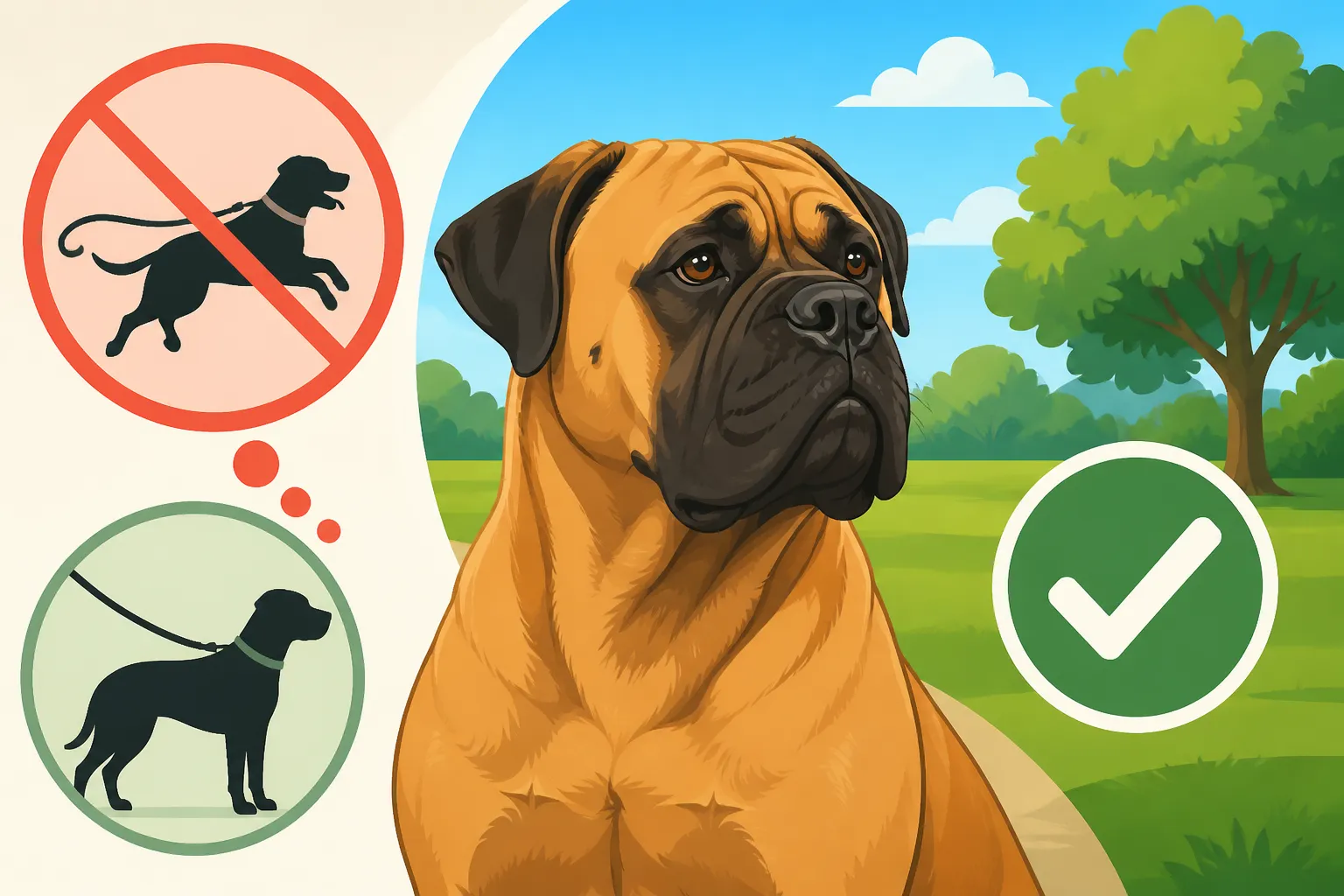
For many Bullmastiff owners, the reality is that true off-leash freedom, particularly in unfenced or public areas, is simply too risky. And that's perfectly okay. Responsible dog ownership means prioritizing safety above all else.
Recognizing High-Risk Environments
There are certain environments where, regardless of how well-trained your Bullmastiff is, the risks of off-leash activity are just too high. These include:
- Areas near roads or heavy traffic: A momentary lapse in judgment or a sudden distraction could have catastrophic consequences.
- Dog parks with unknown dogs: Bullmastiffs can have complex dynamics with other dogs, especially those of the same sex. How Two Male Bullmastiffs Get Along can be a serious concern. While some are fine, the risk of an altercation with an unknown dog is always present and can escalate quickly with such a powerful breed.
- Crowded public spaces: The sheer volume of people, children, and other stimuli can be overwhelming and unpredictable, leading to potential issues with their guarding instincts or accidental knocking over of people.
- Areas with abundant wildlife: That strong prey drive means a deer, rabbit, or even a flock of birds could send your Bullmastiff on an uncontrolled chase. How Fast a Bullmastiff Had to Cover Ground for gamekeepers is a strong indicator of their speed once they decide to pursue.
As Bullmastiffs take their time to mature, often not truly settling until they are A Bullmastiff Is Not Grown Up Until Three, exercising caution in these high-risk areas is even more important with younger dogs who might still be testing boundaries and exploring their independence.
Secure Fencing and Designated Off-Leash Parks
For most Bullmastiffs, the safest and most enjoyable off-leash experience will be in a securely fenced yard or a private, designated off-leash park specifically designed for large breeds. These environments allow them to run, explore, and expend energy without the constant worry of them wandering off or encountering unexpected dangers.
Even in a fenced yard, it’s good practice to periodically reinforce recall. Call your Bullmastiff, reward them heavily, and then release them to play again. This keeps the recall sharp and positive. Remember, even a secure fence isn't foolproof; a motivated Bullmastiff can sometimes find a way through or over. Regular checks of your fencing are crucial.
Embracing the Long Leash and Leash Manners
If true off-leash is not a safe option, don't despair! Your Bullmastiff can still lead a rich and fulfilling life with a strong emphasis on leash-based activities. A long line can provide a wonderful compromise, allowing them to sniff and explore a wider area while still under your control.
Focus on perfecting their leash manners. A Bullmastiff that walks politely on a leash, even through distractions, is a joy to behold and can accompany you on many adventures. How to Walk a Bullmastiff That Outweighs You is a skill every owner needs to master for everyday safety and enjoyment. Explore different types of adventures you can have on a leash, such as hiking on trails where leashes are required, visiting pet-friendly stores, or enjoying quiet walks in parks. The bond you share with your Bullmastiff isn't dependent on them being off-leash; it's built on trust, consistency, and mutual respect, regardless of whether a leash is connecting you.
| Off-Leash Environment | Typical Risk Level for a Bullmastiff | Why It's Risky |
|---|---|---|
| Securely Fenced Backyard | Low | Minimal external distractions, contained space, known environment. |
| Designated Large-Breed Park | Moderate | Contains dog-dog interactions, potential for gate lapses. |
| Quiet, Open Field (no fence) | High | Prey drive, potential for sudden bolting, long-distance distractions. |
| Public Park near Roads | Very High | Traffic danger, high distractions (people, dogs, smells), legal leash laws. |
| Hiking Trail with Wildlife | High | Strong prey drive, unpredictable wildlife encounters, difficult terrain. |
| Urban Sidewalks | Extremely High | Constant traffic, crowds, high distractions, legal leash laws. |
While the dream of an effortlessly off-leash Bullmastiff might not always align with reality, a deep understanding of their unique traits, combined with diligent training and responsible management, can lead to a wonderful and safe life together. Prioritize safety, celebrate their individuality, and enjoy the incredible bond you share, whether on a long line or within the secure boundaries of your home.
Disclaimer
This article is for general informational purposes only and does not constitute professional advice. Laws, prices and regulations vary by location and change over time. Consult a qualified professional for guidance on your specific situation.