The Age a Bullmastiff Reaches Working Weight
A Bullmastiff can look impressively large long before its bones, muscles, and joints are ready for adult work. That gap can confuse owners who are wondering whether their dog is growing too slowly—or whether it is safe to ask more of a powerful young dog. This guide explains what “working weight” means, when Bullmastiffs typically mature, and how to support steady, healthy development.
What working weight means for a Bullmastiff
It is not a formal growth milestone
“Working weight” is not a veterinary growth stage with one official number or age. People may use it to mean the weight at which a dog looks mature, feels strong, or is ready for demanding activity. Those meanings are not interchangeable. A Bullmastiff can weigh as much as a smaller adult while still being physically immature, and a heavier dog is not automatically a fitter or more capable one.
The phrase also has a historical flavor. Bullmastiffs were developed in Britain as estate dogs that could move quickly enough to catch and hold a poacher. That history helps explain the breed’s muscular build, but it does not establish a universal weight an individual dog should reach before it is “working.” For more background on that role, see The Bullmastiff Was Built to Catch Poachers in the Dark.
For a pet Bullmastiff, a useful everyday definition is a healthy adult body condition with mature strength and movement. Your dog’s frame, sex, family lines, and overall condition all matter. A target number on a scale is only one clue; your veterinarian’s assessment of body condition and development is more useful than chasing a particular figure.
Adult breed ranges are guides, not goals
Adult Bullmastiff males commonly fall around 110 to 130 pounds, while females often fall around 100 to 120 pounds. Individual dogs may be outside those broad ranges and still be healthy. The breed’s adult size is not a recommended weight target for every puppy, nor is the upper end a prize to aim for.
Two dogs that weigh the same can have very different builds. One may be tall and lean, while another may carry excess fat over a shorter frame. Ask your veterinarian to assess your dog’s ribs, waist, muscle, and movement rather than deciding from the scale alone. The article How Much a Bullmastiff Weighs offers more context on size variation.
It is also worth separating size from condition. A Bullmastiff should not be pushed toward a heavier number with extra food, supplements, or unrestricted feeding. That pressure can add stress to developing joints without making the dog stronger in a useful way. A lean, steadily growing youngster is often a better prospect for sound adult movement than a fast-growing puppy carrying unnecessary weight.
When a Bullmastiff usually reaches adult size
Height comes before the finished adult build
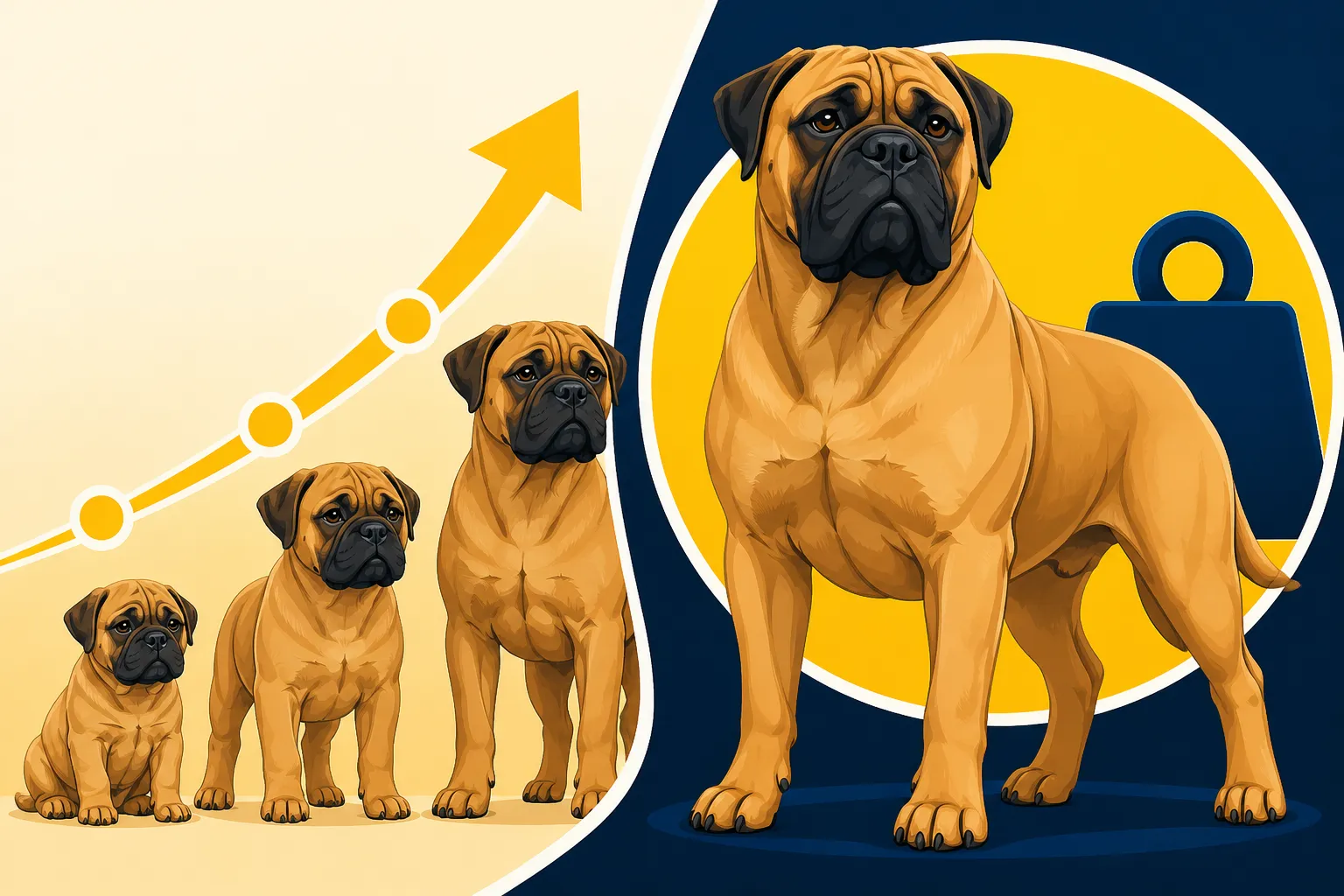
Many Bullmastiffs get close to their adult height before they have the broad, filled-out appearance people associate with a mature dog. Growth is not a perfectly smooth climb: a puppy may look leggy for a while, then gain muscle and body depth later. That can make a healthy adolescent seem awkward or too slim compared with an adult dog.
A Bullmastiff may approach full height around the end of the first year or into the second, but the timing varies. Reaching adult height does not mean that the dog’s body has finished developing or that it is ready for strenuous work. If you are comparing your puppy with breed-standard height, remember that height alone does not tell you whether its body is mature. See When a Bullmastiff Reaches Full Height for more on that distinction.
There is no need to panic over a temporary lanky stage if your dog is eating, active, and growing along a pattern your veterinarian considers appropriate. Bring up concerns if growth seems to stall, weight changes suddenly, or your puppy appears weak or unwell. A vet can interpret the dog’s growth in light of its age, frame, health history, and family build.
Filling out can continue well beyond the first birthday
After height gain slows, many Bullmastiffs continue to develop chest depth, muscle, and adult proportions. Some take until roughly two or three years of age to look fully mature. This later filling out is one reason owners may say their dog has not reached “working weight” even when it is already tall and surprisingly heavy.
The change should be gradual. A puppy that suddenly looks broader because it has gained fat has not necessarily matured; check its body condition and activity, and ask your veterinarian if you are unsure. If your dog is simply still growing into its frame, patience is safer than trying to speed the process with extra meals or intense strength-building activity. When a Bullmastiff Fills Out explores that later stage.
Owners can also mistake adolescent enthusiasm for adult readiness. A young Bullmastiff may be strong enough to pull hard on a leash while its joints are still developing. The fact that a dog can physically perform an activity does not mean repeated high-impact exercise is appropriate. Build skills and controlled fitness gradually rather than treating body size as proof of maturity.
Individual growth patterns matter more than a single age
A puppy’s growth depends on more than its birthday. Genetics, sex, nutrition, general health, and the size of its parents can all influence its pace and eventual build. Two littermates may grow differently and still mature into healthy adults, so comparisons with another Bullmastiff can create unnecessary worry.
Keep a simple record of weight and observations from routine veterinary visits. A growth log can show whether your dog is following a steady pattern, even when a single weigh-in seems surprising. It is more informative to look at the trend over time than to treat one number as a verdict. For age-based context, see What a Bullmastiff Puppy Should Weigh by Month.
If your puppy is not gaining as expected, is losing weight, has a persistent poor appetite, or seems unusually tired, contact your veterinarian rather than trying to correct the issue with a larger ration. The right response depends on the cause. Similarly, rapid gain deserves attention: a puppy can look robust while gaining too quickly for its developing frame.
How to support steady, healthy growth
Feed for controlled development, not maximum size
Choose a complete food formulated for large-breed puppies and follow feeding guidance as a starting point, not a rigid prescription. Individual needs depend on the puppy’s age, activity, current condition, and the food’s calorie content. Your veterinarian can help adjust portions if your puppy is gaining too quickly, appears too lean, or is not following a healthy growth pattern.
Avoid adding calcium or other growth supplements unless a veterinarian specifically recommends them. Extra supplementation is not a shortcut to a better adult frame and can be inappropriate for a growing large-breed dog. Also avoid free-choice feeding if it makes it difficult to monitor intake; measured meals make changes easier to notice. For related guidance, read Why a Bullmastiff Puppy Should Not Grow Fast and Whether a Bullmastiff Puppy Should Eat Free Choice.
If you shop for food through Chewy, compare the package’s life-stage and nutritional information rather than choosing a product because its label promises rapid growth or a larger adult dog. Chewy can be one place to find food options, but the important step is confirming that the formula suits a growing large-breed puppy and discussing any diet change with your veterinary team. Switch foods gradually unless your veterinarian advises otherwise.
Keep your puppy lean while it grows
A lean puppy may look less imposing than the broad, heavy adult Bullmastiff pictured in your mind. That is not a reason to add food without checking its condition. You should be able to feel the ribs with light pressure, though they should not be sharply prominent; from above, a waist should be visible behind the ribs. Your vet can show you what an appropriate body condition looks and feels like for your puppy.
Use meals and treats as part of the daily calorie picture. Training rewards, chews, and scraps can add up, especially when several family members are feeding the dog. If you need convenient training treats or food, Chewy may be one retail option, but keep portions modest and count treats as part of the day’s intake. A food diary for a week can help reveal whether “just a few” extras are becoming a substantial addition.
Keeping a growing Bullmastiff lean is not about restricting food until the dog looks thin. It is about avoiding excess weight while meeting nutritional needs. If you are struggling to judge the balance, take a current weight and a few notes about meals, treats, and activity to your veterinarian. Why a Bullmastiff Puppy Should Be Kept Lean goes deeper into why body condition matters during growth.
Build strength with age-appropriate movement
Young Bullmastiffs need regular, sensible activity, but they do not need to be conditioned like adult athletic dogs. Short walks, calm exploration, play on suitable ground, and basic training give a puppy useful movement without making every outing a test of endurance. Let the dog rest when tired, and avoid repeatedly pushing it to keep pace with a much older or fitter companion.
Be cautious with repetitive high-impact activity such as sustained running beside a bicycle, repeated jumping, or long hikes on difficult terrain while your dog is still growing. Stairs and ordinary household movement are not automatically forbidden, but repeated pounding and forced exercise are different from normal daily life. Ask your vet for guidance if you are planning an activity program or have concerns about your puppy’s joints.
A sensible routine is more valuable than trying to make a young dog look “worked.” Training should emphasize calm leash manners, reliable handling, and gradual exposure to everyday environments. For general exercise planning, see How Much Exercise a Bullmastiff Needs. If you buy a harness or other walking equipment through Chewy or another retailer, fit it to your dog’s body as it grows and check it regularly; a puppy can outgrow equipment surprisingly quickly.
How to tell whether your dog is ready for more demanding activity
Look at condition and movement, not weight alone
A scale can tell you what your dog weighs, but it cannot tell you whether the dog moves comfortably or has the muscle and coordination needed for a particular activity. Watch how your Bullmastiff gets up, walks, turns, and recovers after ordinary exercise. Persistent stiffness, limping, reluctance to move, or a change in gait deserves veterinary attention rather than a decision to “work through it.”
Maturity is also about behavior and training. A dog that is physically imposing but still distractible or difficult to control may not be ready for busy environments or demanding tasks. Work on predictable cues and calm handling before increasing the difficulty of outings. A dog’s size can make small training gaps consequential, so steady practice matters more than waiting for a certain number on the scale.
If the activity involves sustained effort, jumping, pulling, or challenging terrain, ask your veterinarian whether your individual dog is ready. The answer may depend on age, fitness, previous injuries, and any orthopedic concerns. There is no universal “working weight” that overrides those factors.
Use a gradual progression instead of a milestone
When your veterinarian agrees that your dog can take on more, increase one element at a time. For example, extend a walk modestly before adding hills, or introduce a new surface before making the session longer. Give your dog time to recover, and watch for soreness or unusual fatigue afterward. If symptoms appear, scale back and discuss them with your vet.
A practical way to assess the response is to note the activity, duration, weather, and how your dog behaves later that day and the next morning. That record can help distinguish normal tiredness from a repeated pattern of discomfort. It is especially helpful when different family members exercise the dog on different days.
Avoid comparing your Bullmastiff with a breed that matures faster or is built for sustained athletic work. A large dog may look ready for more before its body and coordination are prepared. Let the dog’s health, movement, and veterinary guidance set the pace—not a target weight or pressure to prove that the dog is fully grown.
When to ask your veterinarian
Bring growth questions to routine checkups, and ask for a body-condition assessment rather than only a weight reading. Mention any sudden change in appetite or weight, ongoing digestive problems, unusual tiredness, lameness, or reluctance to exercise. A veterinarian can decide whether the issue calls for monitoring, an adjustment to feeding, or further evaluation.
It can help to arrive with your puppy’s food label, measured daily portions, treat list, and recent weights. If you have been changing food or adding supplements, include that information too. Chewy orders and receipts may help you keep track of what food you have used, but your vet will need the product name and feeding amount, not the retailer itself.
For most Bullmastiffs, “working weight” is best treated as an informal description of a mature, healthy adult—not a deadline to reach or a number to force. Focus on steady growth, a lean body condition, comfortable movement, and gradual conditioning. Those are more meaningful signs of readiness than a heavy-looking puppy or an impressive figure on the scale.
Disclaimer
This article is for general informational purposes only and does not constitute professional advice. Laws, prices and regulations vary by location and change over time. Consult a qualified professional for guidance on your specific situation.