Whether the Bullmastiff Is a Molosser
A Bullmastiff’s broad head, heavy bones, short muzzle, and powerful build make the answer seem obvious: yes, it is a Molosser-type dog. But “Molosser” can mean different things depending on whether someone is talking about ancestry, appearance, or modern kennel-club groupings. This guide explains how the Bullmastiff fits the term—and what that label does and does not tell you.
Is the Bullmastiff a Molosser
What people mean by Molosser
“Molosser” is a broad label commonly used for large, substantial dogs associated with mastiff-type ancestry. It is not always used as a precise scientific category, and it does not refer to one single modern breed. People may use it to describe a historical family of dogs, a general body type, or a group of breeds that share certain physical traits.
Those traits often include a strong, muscular frame, a broad head, a relatively short muzzle, and a history connected with guarding or working. But there is no single checklist that every person or organization uses to decide whether a breed counts. As a result, one source might call a dog a Molosser, while another might use a more specific label such as mastiff-type or working breed.
The Bullmastiff fits the common meaning of Molosser because of its build, history, and relationship to mastiff-type dogs. Calling it a Molosser is useful shorthand, but it does not replace the more precise name of the breed: Bullmastiff.
Why the Bullmastiff fits the type
The Bullmastiff was developed in Britain from Mastiff and Bulldog ancestry. It was bred as a powerful working dog, with a body suited to moving quickly enough to catch and hold a person rather than being built for a prolonged chase. That history helps explain its muscular shape and substantial frame. For a closer look at the breed’s background, see The Bullmastiff Was Built to Catch Poachers in the Dark.
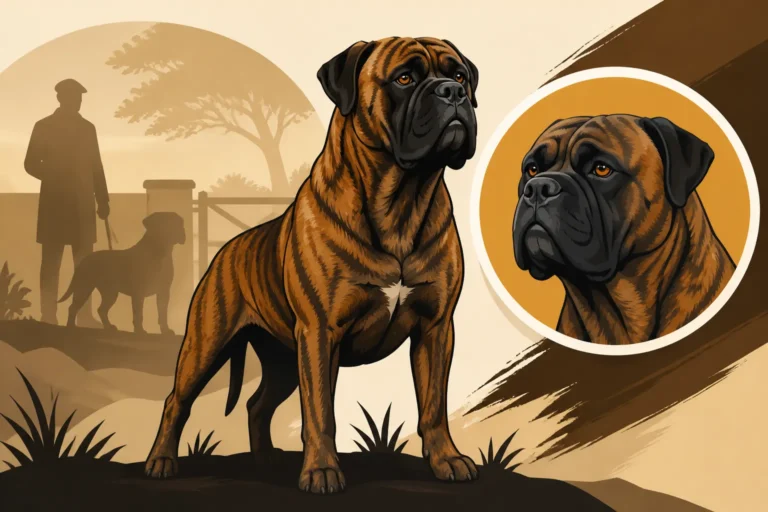
Its physical features also match what many people picture when they hear “Molosser.” A Bullmastiff is large and strong, with a broad skull, a short muzzle, and a compact, sturdy outline. These are general resemblances, not proof that every dog called a Molosser has the same ancestry or was bred for the same work.
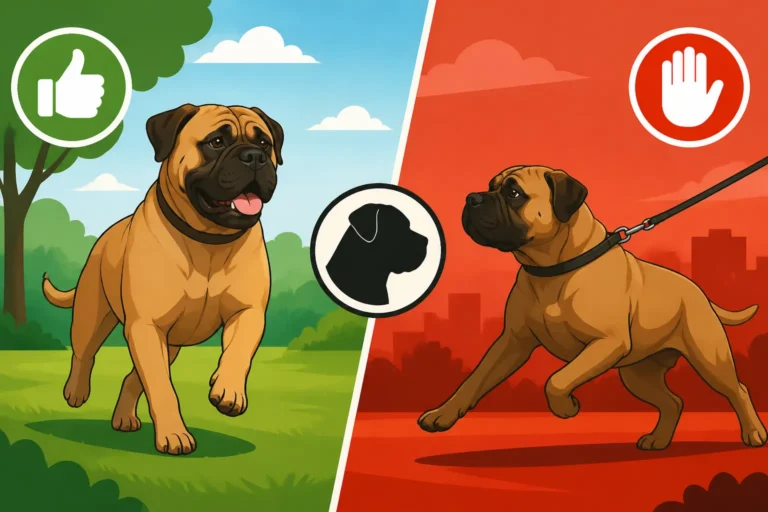
The label can also help explain why a Bullmastiff’s strength deserves practical attention in everyday life. A calm dog can still be difficult to manage if it pulls, leans, or rushes toward something with its full weight behind it. That is one reason early leash manners matter; Training a Bullmastiff That Weighs More Than You Do covers the training challenge in more detail.
Molosser is not the same as a formal breed group
“Molosser” is not necessarily the official category you will see on a kennel-club registration or show listing. Breed organizations sort dogs into their own groups, and those group names can differ. The American Kennel Club places the Bullmastiff in its Working Group, for example. That formal group placement does not contradict calling the breed Molosser-type; the terms describe different classification systems.
A useful way to separate the terms is to think of “Molosser” as a broad type or historical descriptor and “Working Group” as an organization’s official grouping. Neither label tells you everything about an individual dog’s temperament, health, training, or suitability for a particular home.
| Term | What it generally describes | How it applies to the Bullmastiff |
|---|---|---|
| Molosser | A broad mastiff-type category or shared physical and historical traits | Commonly used for the Bullmastiff because of its ancestry, build, and working history |
| Mastiff-type | A general description emphasizing substantial size and structure | A useful description of the Bullmastiff’s appearance |
| Working Group | A formal breed grouping used by a kennel organization | The Bullmastiff is listed in the AKC Working Group |
| Bullmastiff | The specific recognized breed | The clearest term when discussing the breed itself |
When you are reading about the breed, the specific label matters less than the question you are trying to answer. A historical discussion may use “Molosser,” while a show standard or registration record may use “Bullmastiff” and an official breed group.
What the Molosser label tells you about the Bullmastiff
It describes resemblance and history, not a complete personality
The Molosser label may point to a dog’s general build and working background, but it is not a temperament guarantee. It does not mean every Bullmastiff will behave in exactly the same way, nor does it tell you whether a particular dog is relaxed with visitors, comfortable around other animals, or easy to handle on a walk.
Individual temperament is shaped by many factors, including inherited traits, early experiences, health, socialization, and training. A Bullmastiff may be watchful or reserved in some situations, but that does not mean it should be encouraged to act aggressively. A stable household companion needs clear expectations and careful introductions, especially because its size can make an ordinary mistake more consequential.
If you are trying to understand the breed’s protective reputation, it helps to look beyond a single category word. The Bullmastiff Was Bred Not to Kill explains an important part of its working history, while How Protective a Bullmastiff Is focuses on how protective behavior may show up in a modern home.
It does not mean every large, broad-headed dog is the same
Molosser-type breeds can differ greatly in body proportions, activity levels, coat, and typical working history. Even when two breeds share a broad head and heavy build, that resemblance does not make them interchangeable. The Bullmastiff has its own breed history and standard, and comparisons should take those specifics into account.
The same caution applies to mixed-breed dogs. A dog with a Bullmastiff-like appearance may not have known Bullmastiff ancestry, and a label such as “Molosser mix” is not a reliable substitute for information about the dog’s individual behavior and needs. For a household choosing a dog, observed temperament, health history, and safe handling are more useful than appearance alone.
Physical size also has day-to-day consequences that broad breed labels cannot capture. A large dog may need sturdy equipment, room to turn comfortably, and a plan for transport and veterinary visits. If you are preparing for a Bullmastiff, check product measurements rather than relying only on a “large breed” label. Chewy is one place owners may browse for supplies such as beds or harnesses, but fit should be checked against the dog’s actual measurements.
How to use the label when learning about the breed
Start with the specific question you have
If you want to know where the Bullmastiff came from, search for breed history and the role it was developed to perform. If you want to know how large one may become, look for breed-specific size information rather than general Molosser descriptions. If you are evaluating behavior, prioritize information about Bullmastiffs and the individual dog rather than assuming a broad category predicts personality.
That distinction is especially helpful when comparing the Bullmastiff with other large breeds. A shared Molosser-type label may explain why the dogs look somewhat alike, but it does not tell you which breed is calmer, more active, or better suited to a specific household. For a direct comparison with another well-known mastiff breed, see How a Bullmastiff Differs From a Mastiff.
A practical reading habit is to ask, “Is this source talking about ancestry, appearance, official registration, or behavior?” Those are related subjects, but they are not the same one. Keeping them separate makes breed information easier to interpret and helps prevent a general label from becoming an assumption about an individual dog.
Think about the dog’s needs, not just its category
The Bullmastiff’s Molosser-type build can be a reminder to plan for strength and size. Teach polite leash walking early, supervise interactions with children, and make sure the dog has comfortable places to rest. A well-fitted harness or bed should be selected according to the dog’s body and measurements, not just a category printed on a product page. Chewy may be useful for comparing available sizes, but the dog’s fit and comfort should guide the choice.
The same realistic planning applies to warm weather. A heavy-bodied dog with a short muzzle can have difficulty coping with heat, so avoid assuming that a powerful-looking dog can handle strenuous activity in hot conditions. Learn the breed-specific precautions in Why a Bullmastiff Overheats So Easily and What Temperature Is Dangerous for a Bullmastiff.
Health planning matters, too. “Molosser” is not a diagnosis and does not tell you whether a Bullmastiff has a particular condition. Regular veterinary care, a healthy body condition, and attention to changes in movement or behavior are more useful than relying on a category label. For a broader introduction to breed-related health screening, see What a Bullmastiff Breeder Should Have Screened.
The clearest way to describe a Bullmastiff
Use both terms when the context calls for it
It is accurate in everyday conversation to describe the Bullmastiff as a Molosser-type breed. If you are talking about its official identity, however, call it a Bullmastiff. That wording is more precise and avoids suggesting that “Molosser” is a single universal registry category.
For instance, you might say, “The Bullmastiff is a British breed with mastiff-type ancestry and is often described as a Molosser.” That conveys the broad relationship while keeping the specific breed clear. In a discussion about show classifications, use the relevant kennel organization’s group name instead.
This kind of careful wording is useful because “Molosser” can be an umbrella term rather than a strict boundary. The Bullmastiff clearly shares many traits people associate with the category, but the word alone does not provide a full account of its origins, official classification, or individual character.
Keep appearance separate from suitability
A Bullmastiff’s imposing appearance is only one part of what living with the breed involves. A family considering one should look at the dog’s temperament, training needs, health, and ability to fit into the household—not simply decide that a Molosser-type dog is right or wrong for them. The breed’s size also makes careful management important, whether the dog is meeting visitors, walking through a busy neighborhood, or settling into a home with children.
When asking a breeder or rescue about a Bullmastiff, focus on concrete information: the dog’s history, behavior around people and animals, health records, and any support available after adoption. A broad breed label can be a starting point for learning, but those details help you understand the dog in front of you.
In short, the Bullmastiff is commonly considered a Molosser-type dog because of its mastiff ancestry, powerful build, and working history. “Molosser” is a broad descriptor; “Bullmastiff” is the specific breed name. Using the two terms with that distinction in mind gives you the clearest and most useful description.
Disclaimer
This article is for general informational purposes only and does not constitute professional advice. Laws, prices and regulations vary by location and change over time. Consult a qualified professional for guidance on your specific situation.